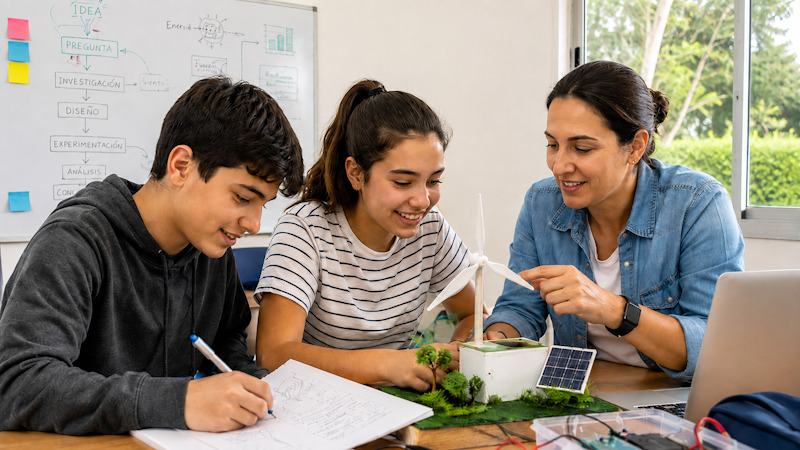
To create a scientific or technological project, a good idea alone is not enough. You have to give it shape, turn curiosity into a question that can be investigated, plan how to find answers, analyze what happens during the process, and present the results clearly.
Major innovations don't necessarily come from a state-of-the-art laboratory. In many cases, they stem from a simple question or an everyday observation that helps us understand how the world works.
That same process can begin in a classroom, but for an idea to truly become a scientific or technological project, it is necessary to follow a research process that shapes it and makes it possible to demonstrate whether the proposal works.
What Turns an Idea into a Project
Having an idea is the first step in carrying out any kind of project, but an idea alone isn't enough. Proposals can stem from general concerns, such as researching pollution or creating an app for students.
However, a solid project does not depend solely on having an innovative idea or using advanced technology. Planning and the way the process is carried out are just as important as the initial proposal.
Every idea needs a framework that allows it to be put into practice
According to the Science Buddies article“The Engineering Design Process: Choose the Best Solution,” when selecting an idea, factors such as the availability of materials and equipment, cost, and the realistic feasibility of carrying it out should be considered. In a school project, this analysis allows the team to tailor the proposal to its time, resources, and knowledge, without losing sight of its original purpose.
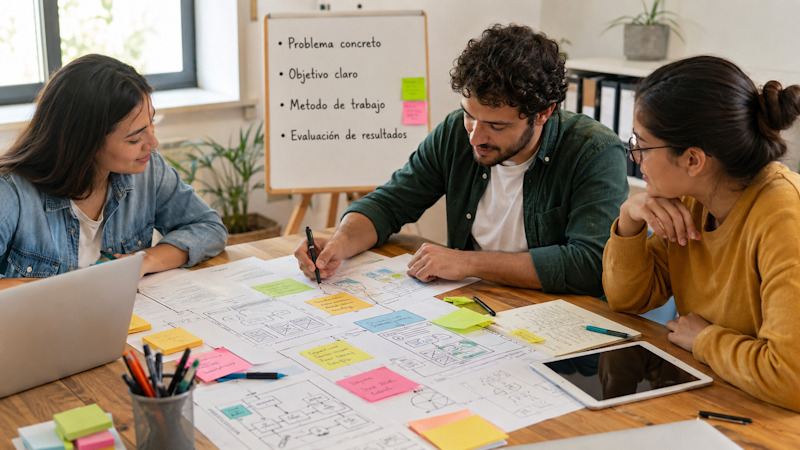
For an idea to become a viable project, it must include:
- specific problem: a specific question that can be investigated and that provides a focus for the entire project
- clear objective: what the research aims to discover, verify, improve, or create
- Work method: the steps, tools, or experiments that will be used to gather information and make progress
- method of evaluating results: data, tests, or criteria that make it possible to determine whether the proposal achieved its purpose
School projects allow students to apply what they’ve learned in class to real-life situations. A research project on water consumption at school or the design of a technological prototype to address a local need can provide opportunities for more hands-on learning.
A good school project is not defined by its complexity, but rather by the clarity of its research question, the coherence of its steps, and the quality of its conclusions.
Scientific Project vs. Technological Project
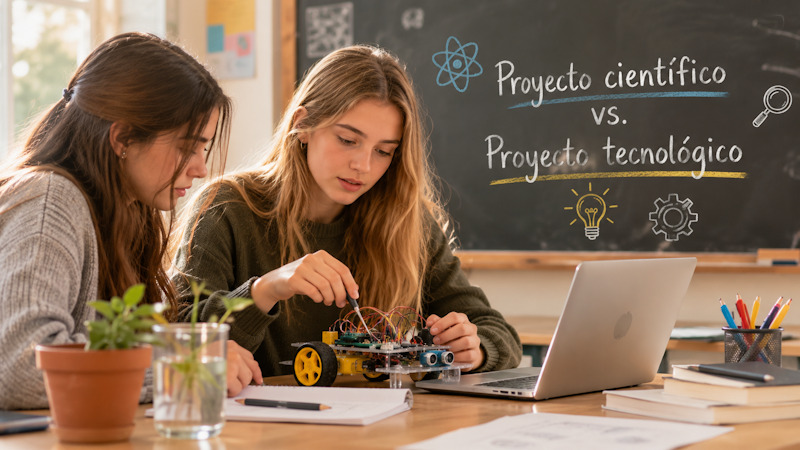
Although both stem from a question or a need, scientific and technological projects pursue different goals.
However, the two approaches can be combined. Scientific research can provide the information needed to develop a technology, while a technological tool can facilitate the observation or measurement of a phenomenon.
Scientific Project
A scientific project seeks to answer a question about how nature and society work through a research process.
According to the educational resource "Steps in a Science Fair Project", published by the U.S. National Oceanic and Atmospheric Administration (NOAA), some projects test ahypothesis, while others seek to answer a question, record measurements, explain how a natural phenomenon works, or develop a technology to measure it.
- Start with a research question or a hypothesis.
- It draws on prior information that serves as the basis for the research.
- Gather evidence from other experiments, observations, surveys, measurements, or sample analyses.
- Draw conclusions based on the data.
Some examples might include studying the effect of light on the growth of certain plants, comparing the insulating properties of different materials, or analyzing the quality of water collected from different locations.
Technology Project
A technology project aims to design or improve a product, service, system, or process that addresses a specific need.
The value of a technological solution does not depend solely on whether it works.
The potential impact of a technological solution on the people who use it must be considered. According to the report "Responsible Innovation in Technology for Children", produced by UNICEF, children’s well-being can be incorporated as a criterion within the design process for digital technologies.
This approach makes it possible to evaluate aspects such as safety, inclusion, and the user experience from the earliest stages of the project.
- It addresses a specific situation that needs to be resolved.
- Define operational requirements, such as the conditions under which it must operate and any restrictions it has.
- Develop and test prototypes before building the final version.
- Consider its impact on users by assessing whether the solution is safe and appropriate.
Some examples include creating an automatic irrigation system for a school garden, designing an app to organize tasks, or building a device that reduces energy consumption.
Are you thinking about what you'd like to study?
Learn about all the university degree programs at ORT
How to Develop an Idea for a Scientific or Technological Project
Curiosity is the starting point, but it's also important to choose a topic that can be researched or resolved given the available time, resources, and knowledge.
It’s best to focus on specific situations rather than tackling topics that are too broad. For example, analyzing how much waste a group of people generates in a week or comparing which materials retain heat best.
The more specific the approach, the easier it will be to obtain clear results.
Before proceeding, it is advisable to check that the question meets certain basic criteria:
- Is it easy to understand?
- Can this be investigated or resolved using the available resources?
- Is it possible to develop it within the planned timeframe?
- Will it allow us to collect data or verify results?

A good question guides the entire project and facilitates the decisions that will be made during
the following stages.
Set Objectives and Hypotheses
Now that the problem has been defined, it is time to establish what the project aims to achieve. The general objective states the main purpose of the research, while the specific objectives break that purpose down into concrete actions.
In scientific projects , a scientific hypothesis is also often formulated — that is, a possible answer to the question posed, which must then be tested using data.
Research this topic
Before starting an experiment or building a prototype, it is important to research what information is available in order to establish a theoretical framework. This is a set of concepts and background information that help to understand and justify a project.
Developing a theoretical framework does not mean copying information, but rather selecting the knowledge that will serve as the basis for the research.
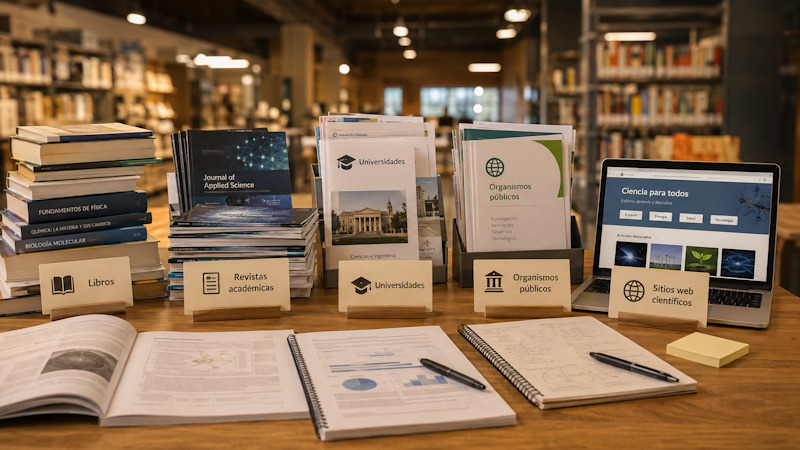
For reliable information, we recommend consulting:
- books and scientific publications
- universities and educational institutions
- specialized public agencies
- academic journals
- well-known science outreach websites
To make compiling the bibliography easier, it is also a good idea to record each source as you go, noting the author, title, institution, publication date, and corresponding link.
Develop a work plan
Good planning helps organize the project before beginning the practical phase. Having a work plan allows you to assign tasks and minimize unforeseen issues during the research.
A plan may include the activities to be carried out, who is responsible for each task, what materials and resources will be used, and how the results will be recorded.
It may also include other relevant information, such as dates and budgets.
Conduct experiments or build a prototype
Once the planning is complete, it’s time to put the project into action. Whether it’s a scientific experiment or the development of a technological solution, it’s important to follow a structured process in which all progress and changes are documented throughout the process.
The goal is to obtain reliable data that will allow us to answer the research question and verify whether the hypothesis holds true.
When conducting experiments, it is important to keep a few things in mind:
- independent variable: the factor that is intentionally altered, such as the amount of light or the temperature
- dependent variable: the outcome that is measured to observe the effect of the change; for example, a plant's growth
- controlled variables: all conditions that must remain the same in order for the results to be comparable
In a technology project, a solution is designed to address a specific need. That is why the development process does not end when the first prototype is built. The work is done through iterations.
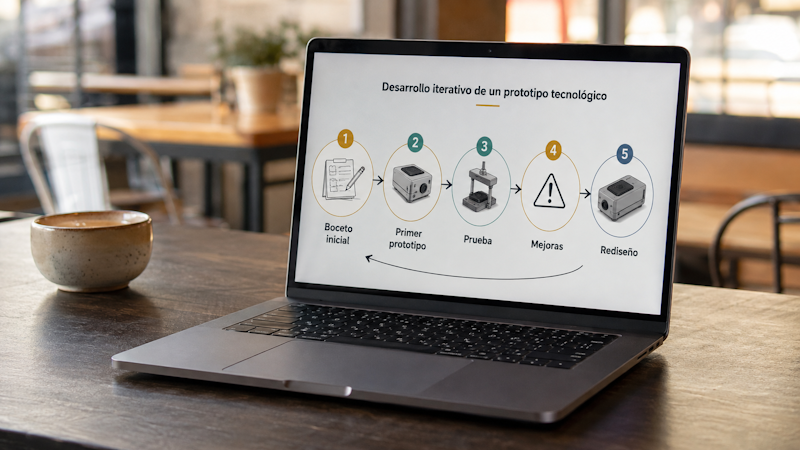
This process generally includes the following steps:
- create a sketch or initial design
- build a first version of the prototype
- test its performance under real or simulated conditions
- identify errors or potential improvements
- modify the design based on the results obtained
It is essential that the data accurately reflect what actually happened during the project.
Modifying, omitting, or selecting only favorable results can lead to erroneous conclusions and undermine the validity of the entire study.
Draw conclusions
The conclusion is the part where you answer the question that sparked the project, using the evidence gathered during the process. Here, you clearly explain what was discovered, what results were achieved, and what they mean.
A good conclusion should address, among other issues:
- Was the project's overall objective achieved?
- Was the hypothesis supported by the data, or did it need to be rejected?
- What were the limitations of the study?
- What aspects could be improved in future studies?
- What new questions arose from the results?
Provided that the procedure was rigorous and the data are properly documented, the project will remain valid and can serve as a starting point for further research or for the development of even more effective solutions.
- You may also be interested in:“What Are STEM Skills and Why Are More and More Students
Getting Involved?”
Working on a science or technology project allows you to participate in a science fair or complete a school assignment. However, it also offers the perfect opportunity to understand that knowledge is built through a process of exploration, analysis, and continuous improvement.
The abilities to observe, ask questions, seek evidence, and communicate results are essential skills in both scientific research and the development of new technologies.
Are you thinking about what you'd like to study?
Learn about all the university degree programs at ORT