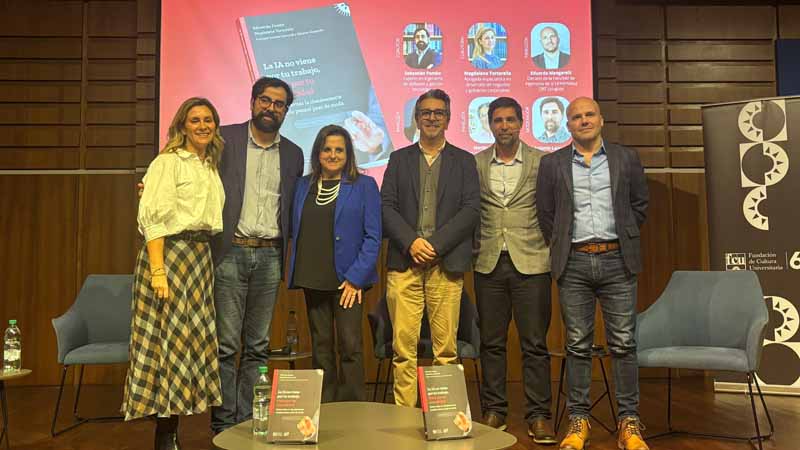
During the exhibition, they reflected on the impact of artificial intelligence on work, learning, and decision-making.
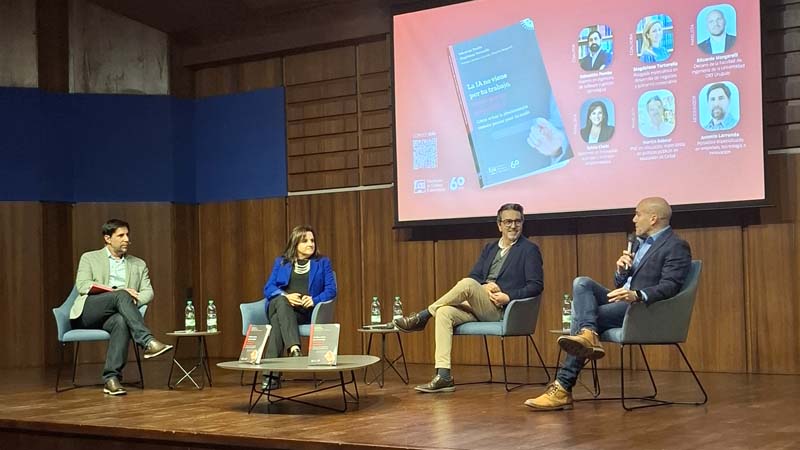
The event, moderated by journalist Antonio Larronda, featured a discussion with the authors and a panel consisting of Eduardo Mangarelli, dean of the School of Engineering; Sylvia Chebi, co-founder and executive director of ThalesLab; and Martín Rebour, Ph.D., an education specialist at Ceibal.
The Origin of the Book
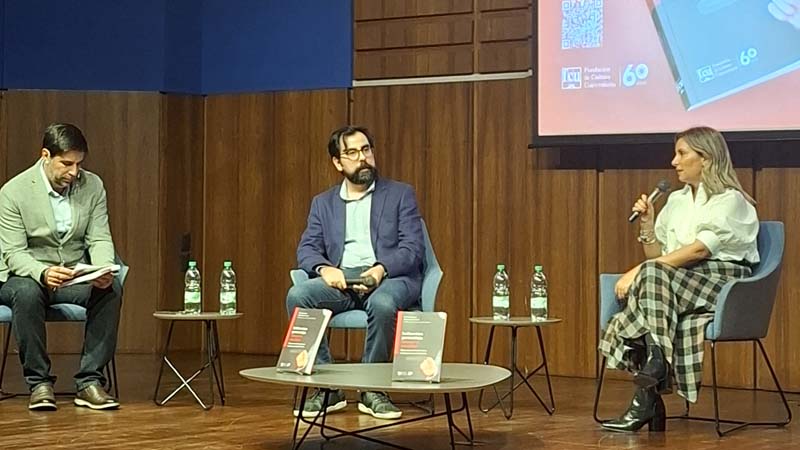
During the presentation, Tortorella explained that the idea stemmed from a personal experience he had while pursuing his MBA. As he used artificial intelligence tools to assist him with various academic tasks, he began to wonder what role professional judgment played when answers seemed to be just a click away.
That concern coincided with conversations he was having with Pombo about thegrowing use of these technologies in academic and business settings. Both had been writing and reflecting on these topics for several years, until they decided to turn those ideas into a book.
As they pointed out, the goal was not to question the use of artificial intelligence, but to provide guidance on how to use it thoughtfully and responsibly.
Criteria as a practice
One of the central concepts of the work is that discernment is not a static quality, but rather a skill that must be continually honed.
The authors warned of the risk of progressively delegating analysis and decision-making to systems that can generate convincing responses but lack intent, purpose, or a genuine understanding of the context.
In that regard, they emphasized the importance of keeping humans involved in the decision-making process—not merely as supervisors who validate results, but as active participants who are intellectually engaged in developing solutions.
“Critical thinking is a skill that must be practiced,” Pombo said during the presentation, explaining that the main risk is not the use of technology itself, but rather failing to exercise the skills needed to critically evaluate its results.
The authors also warned against what they call “complacency” or “cognitive laziness”: the tendency to accept answers generated by artificial intelligence systems without questioning, analyzing, or supplementing them with one’s own experience and knowledge.
Productivity with a Purpose
During the panel discussion, Mangarelli argued that generative artificial intelligence should be understood as a tool capable of enhancing human capabilities.
As he explained, automation will continue to advance in all tasks that can be automated. However, he noted that the real challenge lies not in competing with technology, but in strengthening those skills that remain uniquely human.
In that regard, he emphasized that productivity gains should make it possible to devote more time to higher-value-added activities, such as interacting with teams, students, and clients, or engaging in deeper reflection.
He also cautioned that it is important to understand how these tools work in order to use them effectively and responsibly, avoiding oversimplifications or unrealistic expectations about their capabilities.
Curiosity as a driver of learning
Mangarelli argued that artificial intelligence is forcing us to rethink the way we teach and assess. In that context, he emphasized that educational institutions must increasingly focus on developing skills that go beyond specific subject matter.
For the dean, curiosity is one of the fundamental drivers of learning and knowledge creation. As he explained, disciplinary knowledge and foundations remain essential, but they acquire true value when they enable students to understand problems, formulate questions, and develop their own criteria for making decisions.
He also emphasized the importance of problem-solving skills, a capability that, regardless of the field, will continue to be a key differentiator in a world where technological tools are becoming increasingly accessible.
The risk of losing cognitive friction
Another concept that emerged during the activity was the need to preserve the learning environments that are created through intellectual effort.
Mangarelli warned that, in a scenario where many tasks can be completed in seconds using artificial intelligence tools, there is a risk of losing“cognitive friction”—the process of analysis, trial and error, and reflection that enables the development of knowledge and professional judgment.
As he pointed out, a person’s education does not depend solely on getting the right answers, but on the process they go through to arrive at them. For that reason, he argued that educational institutions should move toward assessment models that allow us to understand how students construct knowledge, incorporating opportunities for ongoing assessment, project-based work, and oral presentations.
A challenge for education
The discussion also addressed the changes that artificial intelligence is bringing about in teaching and assessment processes.
Rebour noted that education systems face the challenge of training people to use these tools critically, ethically, and creatively.
Drawing on his experience at Ceibal, he emphasized the importance of developing skills related to digital citizenship, critical thinking, and an understanding of how the technologies that are part of everyday life work, starting at an early age.
He also explained that the rise of artificial intelligence requires us to rethink traditional forms of assessment. Rather than focusing exclusively on final products, educational institutions must develop mechanisms that allow for the observation and evaluation of learning processes, reflection, and the construction of knowledge.
Rebour also cautioned that access to technology does not in itself guarantee better learning outcomes. In his view, it is necessary to support students and teachers so they can develop the skills needed to use these tools effectively and prevent disparities in usage from exacerbating existing inequalities.
Innovating without losing sight of the human touch
From the perspective of the entrepreneurial ecosystem, Chebi emphasized that artificial intelligence is significantly lowering the barriers to creating prototypes, validating ideas, and developing new products.
However, he emphasized that identifying relevant problems, understanding user needs, and validating solutions remains a profoundly human task.
According to the CEO of ThalesLab, technology can streamline processes and expand capabilities, but it cannot replace creativity, sound judgment, or an understanding of the contexts in which the challenges that startups seek to solve arise.
He also cautioned about the need to pay attention to new challenges associated with the use of these tools, ranging from ethical issues to technological dependencies that are beginning to emerge in organizations and startups.
Separating fact from fiction
Toward the end of the panel discussion, Mangarelli noted that one of the biggest challenges today is distinguishing real technological advances from the flood of information and the high expectations that often accompany them.
As he explained, much of the discussion surrounding artificial intelligence is shaped by headlines, oversimplified messages, and extreme viewpoints that make it difficult to understand what these tools are actually capable of and what their limitations still are.
In that regard, he argued that critical thinking is key to analyzing the impact of these technologies on education, the workplace, and society.
One of the biggest challenges is distinguishing fact from fiction.
Beyond technology
Throughout the event, a common theme emerged among the speakers and panelists: the current challenge is not merely to learn how to use artificial intelligence, but to do so without sacrificing the abilities that set humans apart.
In a world where answers are becoming increasingly rapid and abundant, critical thinking, curiosity, responsibility, and decision-making skills are emerging as increasingly valuable competencies.
Artificial intelligence can greatly enhance human work, but the real value still lies with those who are able to interpret, question, and decide what to do with that information.