The workshop, organized by the Department of Human Resources, was led by Eduardo Mangarelli, Ph.D., dean of the university’s School of Engineering, and took place on July 30, 2026.
Rather than simply providing training on how various applications work, the initiative encouraged participants to reevaluate their daily practices: how information is shared, where decisions are documented, which channel is best to use in each situation, and how individual actions affect others’ time and work.
“The goal is to figure out how we can work better as a team,” said Mr. Mangarelli during the event.
From that perspective, he argued that productivity is not just about completing tasks more quickly, but also about creating conditions that allow information to be found, commitments to be clear, and teams to work with fewer interruptions and less duplication.
Work Habits
The training revisited the core content of three previous workshops and linked it to common situations in institutional life.
Among other topics, the session covered choosing the appropriate medium for each communication; organizing meetings and schedules; tracking tasks; collaborative document editing; managing permissions; and maintaining a single, current version of files.
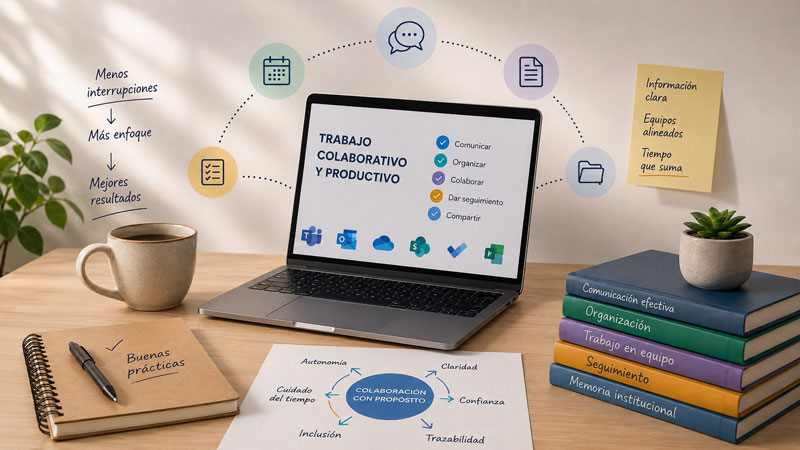
In this context, the use of Microsoft 365—the platform that integrates applications such as Teams, Outlook, OneDrive, SharePoint, To Do, and Planner—was presented as a means of organizing work, rather than an end in itself.
For example, choosing between email, chat, or a Microsoft Teams channel involves considering the audience, the urgency of the matter, and the need for the conversation to remain visible and retrievable in the future. Making the right choice helps preserve context and strengthen institutional memory.
The workshop also addressed situations that often cause friction: documents circulating in different versions, information that depends on a single person, meetings without follow-up actions, or messages sent through multiple channels at the same time.
In light of these scenarios, practices were proposed such as working from a single source, assigning responsibilities and deadlines to tasks, using tags only when they require a specific action, and storing materials in shared institutional spaces.
Learning by doing
The session combined a conceptual introduction, demonstrations, and an open question-and-answer period. The discussion provided an opportunity to address questions that arose from day-to-day work and to explore different ways of addressing the same need.
“We have to try things out and experiment,” said Mr. Mangarelli, who encouraged participants to continue exploring the tools and to keep the conversation going in the Teams group created to share questions, recommendations, and updates.
This approach aimed to ensure that training could be translated into concrete decisions: reducing the time spent searching for information, avoiding unnecessary email chains, facilitating participation in meetings, and maintaining records that ensure continuity in the work.
He also emphasized the importance of attentive communication. Some of the practices analyzed promote the selective use of notifications and mentions, preparing for meetings in advance, and choosing communication channels that do not cause unnecessary interruptions.
A Daily Guide
To complement the meeting, Mr. Mangarelli presented "Best Practices 365," a guide based on scenarios related to day-to-day work at the Universidad ORT Uruguay.
The resource brings together 79 best practices, organized into eight thematic areas and related to ten applications. Each one explains what to do, why to do it, what to avoid, and what factors to consider before implementing the recommendation.
The guidelines are not limited to technical management. They link day-to-day decisions to principles such as autonomy, clarity, trust, traceability, inclusion, respect for time, and institutional memory.
One of the recommendations, for example, suggests organizing shared files so that they can be found and understood without relying on the person who created them. Another recommends converting meeting commitments into tasks with expected outcomes, assigned responsibilities, and defined deadlines.
This activity is part of the initiatives through which the National Institute of Public Administration ( Universidad ORT Uruguay ) supports the continuing education of its staff.
Through this initiative, the Human Resources Department promoted not only the development of digital skills but also reflection on habits that foster a more organized, collaborative, and sustainable work environment over time.