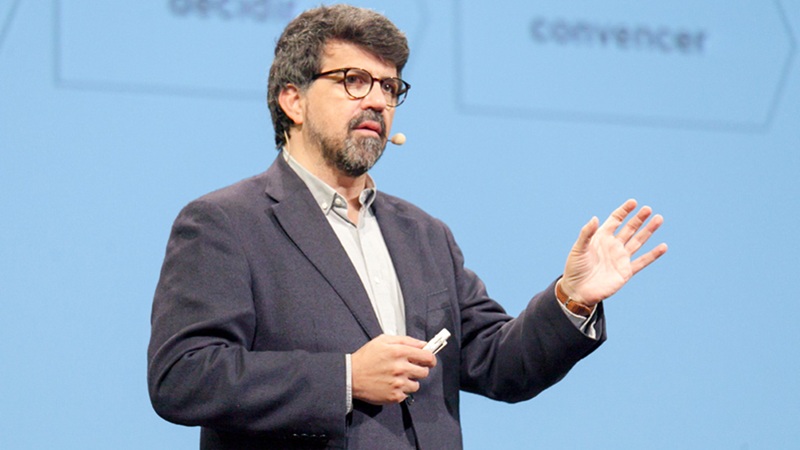
Students in the Master's Program in Creativity, Innovation, and Communication and theMaster's Program in Communication and Marketing Management attended a virtual lecture by Genís Roca, a renowned expert in digital transformation, innovation, and organizational change management.
The activity took place as part of the course "Communication Management and Corporate Social Responsibility," taught by Mag. Sabrina Bianchi, and encouraged reflection on the challenges organizations face in the face of rapid technological advancement, the growth of data, and the expansion of artificial intelligence.
From the outset of the exhibition, Roca encouraged attendees to examine these phenomena from a historical perspective, moving away from views that portray artificial intelligence as a sudden transformation.
"I think we're misreading the pace of what's happening."
He pointed out the importance of understanding technological changes from a long-term perspective, rather than focusing solely on the immediate future.
From personal computing to the Internet
During the presentation, Roca explained that the technological evolution of recent decades can be understood in terms of three major trends: the widespread adoption of personal computing, the expansion of the internet, and the advent of artificial intelligence.
According to the expert, each of these stages transformed different aspects of organizations. The first digitized internal processes such as accounting and administrative management; the second changed the way companies interact with customers and audiences; and the third is driving data-driven models capable of anticipating needs and generating personalized services.
The coexistence of three simultaneous transformations
One of the central themes of the talk was that companies are not undergoing a single digital transformation, but rather several at the same time.
While administrative processes have already reached a high level of technological maturity, many organizations are still in the process of consolidating the digitization of customer relationships, community management, and digital touchpoints. At the same time, they are beginning to explore the potential of artificial intelligence to optimize processes and develop new services.
The Challenge of Communication in the Age of Data
Roca emphasized that communications professionals play a key role in this changing landscape. As he explained, many organizations are still in a transitional phase as they move toward more integrated models for managing information and their relationships with their audiences.
In this context, he noted that future communications professionals will be responsible for promoting standardization and professionalization in the management of relationships.
The informal and relational aspects still need to be sorted out, and it will be up to you to do so.
Organizational culture and technology adoption
In addition to the introduction of new tools, the specialist emphasized that any technological transformation requires cultural changes, training, and leadership.
During his discussion with the students, he explained that the adoption of technologies such as management systems or artificial intelligence depends as much on people as it does on the available technology. For this reason, he considered it essential for organizations to support these processes with training and organizational change strategies.
Data as a Strategic Asset
One of the main themes of the conference focused on the value of data for the development of artificial intelligence-based solutions.
Roca argued that the quality, reliability, and availability of information will be key factors in determining the success of organizations in the coming years.
The real competitive advantage will lie in the ability to manage data efficiently and strategically.
He also explained that technological advances will make it possible to develop increasingly personalized and proactive services capable of responding to people’s needs in real time.
A transformation that will take years
In contrast to the rhetoric promising immediate change, the expert suggested a more gradual approach to the adoption of artificial intelligence in businesses and institutions.
As he noted, the transformation will require time, investment, learning, and organizational adaptation, much like what happened previously with the internet and business management systems.
“Everything is moving very quickly, but it won’t happen overnight,” he said, referring to the process of integrating artificial intelligence into various sectors.
About Genís Roca
Genís Roca is an archaeologist by training, specializing in the Early Paleolithic, and one of the most recognized leaders in digital transformation in the Ibero-American region.
Their participation took place through the Barcelona School of Management, the business school of Pompeu Fabra University, as part of the existing academic exchange agreement between the two institutions.
- Learn about the current exchange agreement with the Barcelona School of Management.
Throughout his career, he has worked as a consultant, speaker, and strategic advisor for companies, public institutions, and organizations across various sectors, addressing issues related to innovation, digital transformation, organizational culture, and change management.
His participation gave students a critical and strategic perspective on the impact of artificial intelligence, the evolution of communication, and the challenges organizations will face in the coming years, in a context marked by digital transformation and the growing importance of data.