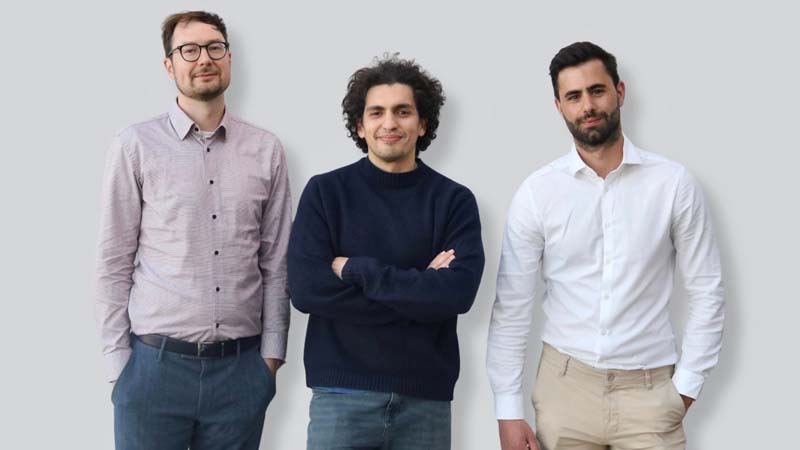
A graduate of the Systems Engineering program and the Master’s in Research Engineering program at Universidad ORT Uruguay, Martín Copes is the co-founder and CTO of Perceptic, a startup that recently secured a US$12 million investment and works with some of the world’s leading pharmaceutical companies to transform biomedical research.
When Martín arrived in California to start his career at Palantir, one of the world’s most innovative tech companies, he experienced something that many professionals share when facing high-stakes challenges: imposter syndrome.
He was from Uruguay, having attended high school and Universidad ORT Uruguay in Universidad ORT Uruguay. He was surrounded by people who had graduated from some of the most prestigious universities in the world.
“I thought they were going to fire me and that I’d have to go back to Uruguay,” he recalls with a laugh. However, that feeling quickly faded. As the months went by, he discovered that he was ready to compete at the highest level, and he began a career that would lead him to lead engineering teams, develop artificial intelligence solutions, and participate in some of the company’s most innovative technology projects. “I quickly realized I was up to the task.”
The Years at ORT
Before moving to London, Martín worked as a professor and researcher at the university. He looks back on that period as crucial to developing the way of thinking that he still applies today.
Academic research taught him how to tackle complex problems, challenge assumptions, and seek solutions with rigor—skills that would later prove crucial to his professional career.
Although he has been living abroad for nearly a decade, he maintains a very close connection with the university and with Uruguay. Every year he returns to the country and upholds a tradition he considers unmissable: attending the barbecue organized by professors Álvaro Tasistro and Nora Szasz. “I’ve been living in London for eight years and haven’t missed a single barbecue.”
The encounter that changed the course of events
When he joined Palantir in 2018, Martín recalls feeling a mix of excitement and uncertainty. During the onboarding process, the company assigned each new employee a mentor to help them through their first few days of training. The first person he met was Tilman Flock, who years later would become one of his partners at Perceptic.
Flock held a Ph.D. in Molecular Biology, had built an outstanding academic career, and was working with world-renowned researchers. “I already had imposter syndrome, but after talking with him, I felt it even more acutely,” he recalls.
Over time, that initial conversation evolved into a friendship and a professional relationship that would ultimately prove pivotal to the founding of Perceptic.
Years later, when he decided to start a business in the biotechnology sector, he knew immediately who to call. “I didn’t know anything about biology. We needed someone who really understood the problem.”
Spot the wave before everyone else
In 2018, he joined Palantir, a company specializing in data analysis and integration. During his early years there, he led teams focused on information processing, but in 2022 he began exploring a technology that was still virtually unknown to most people: the foundational artificial intelligence models developed by OpenAI.
Together with his colleague Zaki Trache, he recognized the potential of this technology early on and began experimenting with it months before ChatGPT became a global phenomenon.
What began as a project developed during an internal hackathon ended up becoming a strategic initiative for the company.
Over time, he went on to lead teams focused on developing artificial intelligence solutions and played a direct role in building Palantir's AI platform.
The experience gave him a firsthand look at how these tools can transform entire industries.
I am convinced that every industry will reach a point where people’s productivity will skyrocket thanks to these tools.
The decision to start from scratch
Despite the professional growth he was experiencing, Martín felt he wanted to use artificial intelligence to solve a different problem. While working on the development of these technologies, he became increasingly convinced that one of the areas where they could have the greatest impact was biotechnology.
“If there is one industry worth transforming, it is the one that can help discover treatments for diseases that currently have no cure.”
The decision meant leaving a well-established position at a global company to start over. Together with Tilman Flock, who holds a Ph.D. in molecular biology, and Zaki Trache, an artificial intelligence specialist, he left Palantir to found Perceptic.
The three shared the same vision: to use artificial intelligence to accelerate biomedical research and help bring new treatments to patients more quickly.
Flock also brought with him an extensive scientific background and a network of contacts built up over many years in the international academic community. Among the people he worked with were researchers who later went on to win the Nobel Prize in Chemistry, and some of them remain connected to the scientific ecosystem surrounding the startup.
A new way to discover drugs
Perceptic develops tools that enable scientists and researchers to collaborate with artificial intelligence systems during the drug discovery and development process.
Currently, bringing a drug to market can take more than ten years and require investments running into the billions. Furthermore, most projects fail before they become treatments available to patients. Perceptic’s proposal does not seek to replace researchers; on the contrary, it aims to enhance their work.
The great revolution won't come about simply because artificial intelligence discovers a single drug. It will come when a scientist and a computer work together efficiently.
The company currently works with some of the world's leading pharmaceutical companies in areas related to preclinical research, clinical trials, and the evaluation of innovation opportunities.
An investment of US$12 million
The proposal quickly caught the attention of the international technology and venture capital community. Perceptic secured a $12 million investment led by Accel and Air Street Capital.
According to Martín, raising capital was not one of the startup’s biggest challenges. Investor interest was driven both by the potential of the business model and by the founders’ extensive experience in artificial intelligence, scientific research, and technological development.
Validation came quickly and allowed the company to accelerate its growth plans. “Everyone wanted to work with us once they found out what we were building,” he recalls.
Growing to Make an Impact
Perceptic currently has 15 employees across engineering, operations, and business development. The company has offices in London and works with some of the world’s leading pharmaceutical companies. Its plan is to continue expanding the team and reach about 30 employees by the end of the year.
However, for Martín, the company's growth is a means to an end, not an end in itself.
A mission that looks to the future
Despite having built a career that took him from academic research at ORT to one of the world’s most influential technology companies, he feels that the best is yet to come.
When he talks about Perceptic, he rarely mentions growth metrics or funding rounds. What comes up time and again is the potential to make an impact.
His view of artificial intelligence goes far beyond a focus solely on automation or productivity. For him, the true potential of this technology lies in helping to solve some of society’s most complex challenges.
What I’d like is for us to be able to say, ten years from now, that we helped discover a cure for a disease. That’s when I’d feel like we really made a difference.
Having worked in research, teaching, the tech industry, and entrepreneurship, the common thread running through his entire career seems to remain the same: using technology to make a positive impact on people’s lives.
Learn more about Systems Engineering