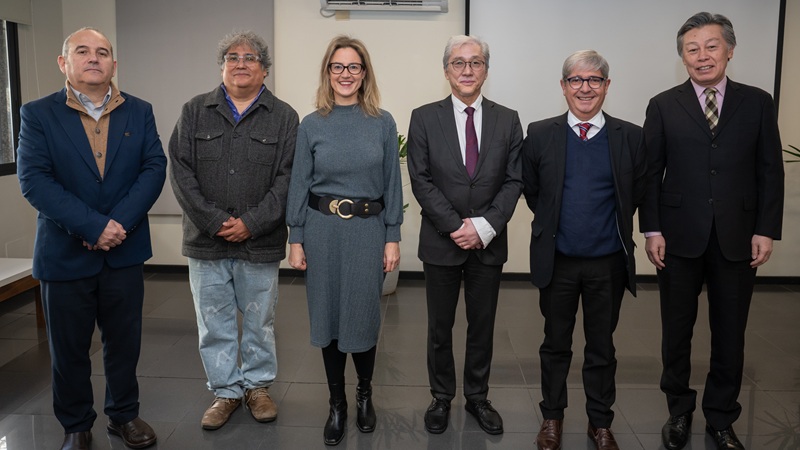
The event featured lectures on the manga industry, individual portfolio reviews, and a live drawing session led by artist Shinn Uchida.
The event was attended by students and members of the general public who are fans of manga, as well as staff, faculty, and officials from the School of Design, including Oscar Aguirre, B.A., dean of Design, andDiego Miranda, M.A., associate academic coordinator of the Bachelor’s Program in Animation and Video Games.
Also in attendance from the University of the Andes ( Universidad ORT Uruguay ) were Dr. Pablo Landoni, Vice President for Academic Affairs, andDr. María Azpiroz, the institution’s Director of International Relations.
Cultural Exchange Between Japan and Uruguay
The event began with remarks by Dr. Pablo Landoni, who reminded attendees that ORT offers courses in Japanese and that every year in December, it administers the Japanese-Language Proficiency Test (JLPT), an exam designed to assess the Japanese language proficiency of non-native speakers.
Landoni went on to emphasize that the Universidad ORT Uruguay was chosen as the host city because of its leading role in the field of design and illustration.
He also expressed his hope that this relationship will grow stronger and lead to new activities in the coming years.
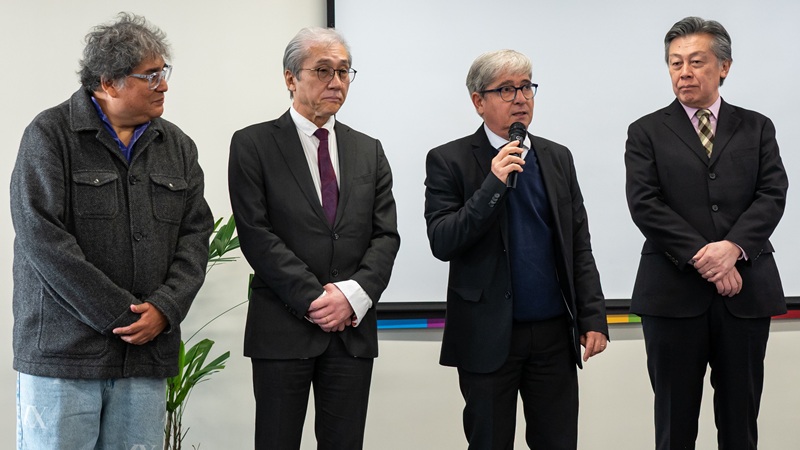
The next speaker was Kenichi Okada, Japan’s ambassador to Uruguay, who spoke about his personal connection to manga dating back to his childhood and highlighted the growing acceptance of this genre as a form of reading.
He stated that this reception was not limited to Japan but extended to the rest of the world.
Manga is a very important part of Japanese culture, but these days it is no longer unique to Japan: we live in a globalized world.
In this regard, he highlighted the Japanese industry's growing openness toward foreign creators and cited the recent debut in Japan of Uruguayan mangaka Guillermo Vitale—also known by his pen name, Gin—as an example for those seeking to advance their careers in this field.
Finally, he expressed his hope that the event would help strengthen cultural exchange between Japan and Uruguay.
For his part, Hiroyuki Ueno, a representative of the Japan-Lima Foundation, emphasized that manga, although it originated in Japan, has become a cultural phenomenon with global reach.
Finally, José Antonio Vilca, director of ElNoreN, a cultural agency dedicated to exchange between Japan and Latin America, highlighted his ties to Uruguay and explained that the tour aims to bring Japanese culture closer to the public and create opportunities for exchange among professionals, enthusiasts, and industry representatives.
Kodansha on the Manga Industry
During the conference, Kodansha editors Yusuke Imamura and Ayane Chiba presented the main characteristics of the manga industry in Japan and explained how a work is developed from the initial idea to its publication.
Kodansha, founded in 1909, is one of Japan's leading publishing companies and publishes not only manga but also novels, magazines, illustrated books, anime, and video games.
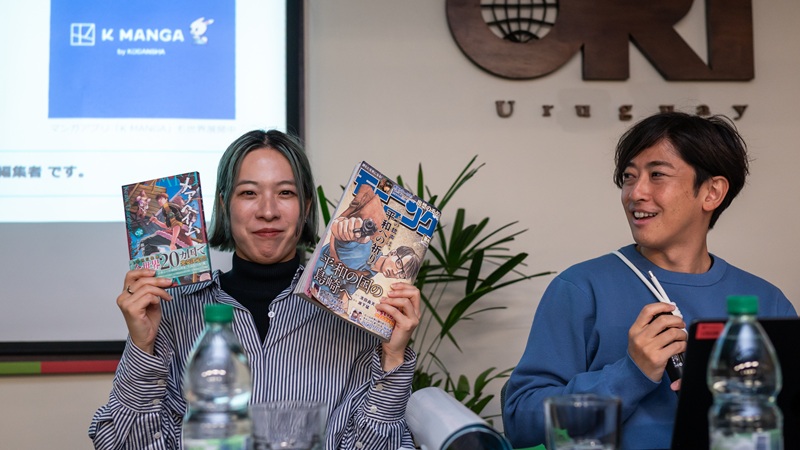
One of the central themes of the talk was the relationship between the mangaka —the manga author—and the editor. As they explained, the editor serves as the first reader and a creative partner: they guide the development of the story, provide an outside perspective, and help identify which elements might appeal to readers.
The main characteristic of the manga industry in Japan is that mangaka work on an equal footing, collaborating with the publisher.
The editors also described the production process, which includes regular meetings between the author and the editor, the creation of the nemu —a preliminary storyboard that outlines the page layout, dialogue, and panels—as well as sketching and successive revisions until the final version is reached.
In the series, this cycle repeats on a weekly or monthly basis, depending on the publication.
The talk also addressed opportunities for new authors. Imamura noted that there is no single formula for creating a hit, but he emphasized the importance of perseverance, the ability to accept feedback, and seeking an objective perspective on one's own work.
The secret to becoming a professional mangaka is to be very persistent and never get tired of putting in the effort.
Finally, representatives from Kodansha highlighted the impact of technology on the international expansion of manga.
Digitization makes it easier to produce and distribute works from anywhere in the world, while also enabling collaboration between artists and screenwriters from different countries.
Live Drawing
Throughout the day, manga artist Shinn Uchida held a live drawing session.
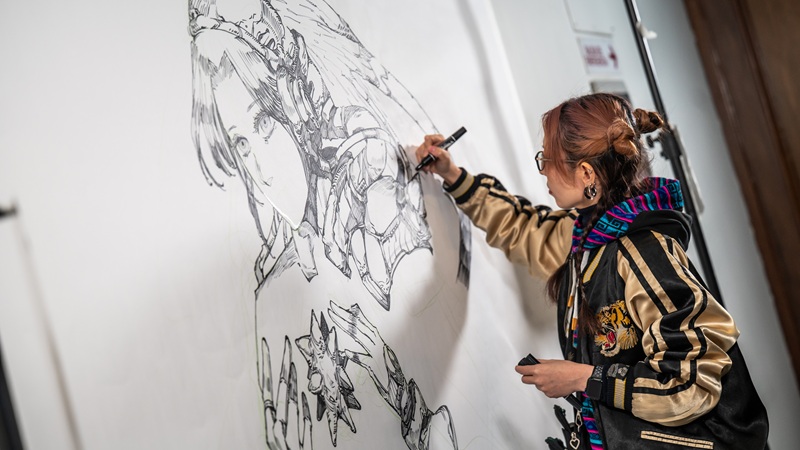
The drawing depicts a fantastical female figure accompanied by a dragon, with a mountain as the backdrop.
The composition combines various panels and techniques characteristic of the manga style, with detailed work on lines, textures, and hatching to bring the characters and setting to life.
While Uchida was creating the artwork, students and staff closely followed the creative process. The artwork was completed in approximately six hours of work.
Portfolio Review
In addition, during the event, individual portfolio reviews were conducted with 15 Uruguayan artists who had been previously selected by the editors at Kodansha.
The call for entries was open to mangaka aged 18 and older—both writers and illustrators—who had the opportunity to submit original works, whether published or unpublished.
Each session lasted 45 minutes and served as a forum for guidance and learning, during which participants received direct, technical feedback from professionals in the manga industry.
- You might be interested in:The Resurgence of Comics in Uruguay: Sequential Art and Local Narratives