Japan has given the world companies such as Sony, Canon, Honda, Toyota, and Toshiba. It is also a leader in sectors such as the automotive, scientific, and technology industries.
We’ve come to know Japanese culture through manga (such as the childhood classics *Supercampeones* and *Pokémon*), video games (such as the globally successful *Final Fantasy*), and anime series (such as *Dragon Ball Z*).
Japanese is the second most widely spoken language in Asia. More than 127 million people speak it as their native language, and over a million people speak it worldwide (the United States, Brazil, and Peru have the largest Japanese-speaking populations).
Since it is a rare language, those who are fluent in it have many opportunities in today's world.
Japanese characters (kanji) are of Chinese origin and represent concepts and ideas.
Learning Japanese will give you a deeper understanding of an ancient culture and one of the most technologically advanced countries in the world.

In addition, knowledge of Japanese is an important requirement if you are considering pursuing graduate studies in Japan.
And while it’s true that you can always hire a translator, if you speak Japanese, you’ll be able to communicate directly with Japanese businesspeople and navigate the process more effectively to build successful business relationships.
Japan, a unique country
Japan is a country with one of the highest life expectancies in the world, at 86 years for women and 79 for men. However, it also has the lowest birth rate, which has led to 21% of its population being over the age of 65.
Its infrastructure is impressive, with Shinjuku Station in Tokyo standing out as the busiest in the world, with 200 departures a day.
In addition, Japan is a pioneer in the development of high-speed rail, as evidenced by the maglev train operated by Central Japan Railway, which set a world speed record in 2015 by reaching 603 km/h.
Japanese culture and traditions have been widely popularized thanks to numerous Hollywood films, including *Memoirs of a Geisha* (2005), *47 Ronin* (2013), *Godzilla* (2014), and *The Last Samurai* (2003).
As for the language itself, Japanese allows sentences to be written both horizontally and vertically.
Phonetically, it resembles Spanish, as it uses the same five vowels. However, imitations of Japanese are often inaccurate, since people frequently mimic its sounds as if they were Chinese, substituting the R for the L. Interestingly, the R does not exist in Chinese, whereas it does in Japanese, and it is the L that is not part of its phonetic system.
In terms of architecture and safety, most doors in Japan open outward, a design intended to facilitate evacuation in the event of an earthquake or emergency.
There are also numerous urban areas and entire neighborhoods where smoking is prohibited, as part of its strict public health regulations.
In terms of beliefs, the Japanese consider the number four to be unlucky, since its pronunciation (shi) is the same as the word for "death."
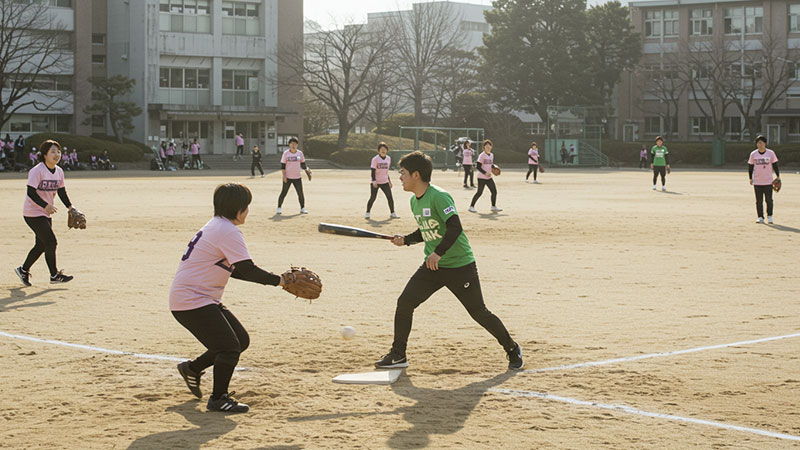
Finally, when it comes to sports, while sumo is the national sport, baseball is also very popular among the population.
Institution offering the courses
Uruguayan-Japanese Cultural Association.
Course Information
Taught by native-speaking instructors who have completed specialized training courses offered by JICA and the Japan Foundation. Extensive experience in preparing students for the JLPT international exam, which is administered at Universidad ORT Uruguay first Sunday of December each year.
Classes will be held exclusively online (via Zoom), with some in-person sessions to be scheduled throughout the year. The course uses both our own online teaching materials and those provided by the Japan Foundation.
Classes begin: Monday, March 9, or Tuesday, March 10, 2026.
Deadline: November 30.
Enrolment
Available exclusively online starting February 18.
Request a registration form from thori00@yahoo.com (for first-, second-, and third-year groups) and from nmori@vera.com.uy for fourth-year students (intermediate and advanced levels).
Class hours for all groups: 2.5 hours per week
Schedule
First year: Mondays and Wednesdays from 5:30 p.m. to 6:45 p.m. (subject to change; instructor: Tatsue Hori)
Second year: Tuesdays and Thursdays from 5:30 p.m. to 6:45 p.m. (Tatsue Hori)
Third year: Tuesdays and Thursdays – Tuesdays and Thursdays from 7:00 p.m. to 8:15 p.m. (Tatsue Hori)
Fourth year: Mondays and Wednesdays - time to be confirmed (Naoko Mori)
Advanced-level course: Tuesdays and Thursdays from 6:30 p.m. to 7:45 p.m.
Course fee
General public:
Tuition: $2,000.
Monthly fee from March to November: $2,800.
Students, graduates, faculty, and staff of Universidad ORT Uruguay members of the Uruguayan-Japanese Chamber of Commerce and Industry:
Tuition: waived for first-year students. Starting in the second year, tuition is $2,000.
Monthly fee from March through November: $2,600.