
In this context, thanks to an initiative by the Embassy of the Republic of Korea in Uruguay, a national center for the teaching of the Korean language was established: the King Sejong Institute Montevideo, which has been located on the Downtown Campus of Universidad ORT Uruguay August 31, 2015.
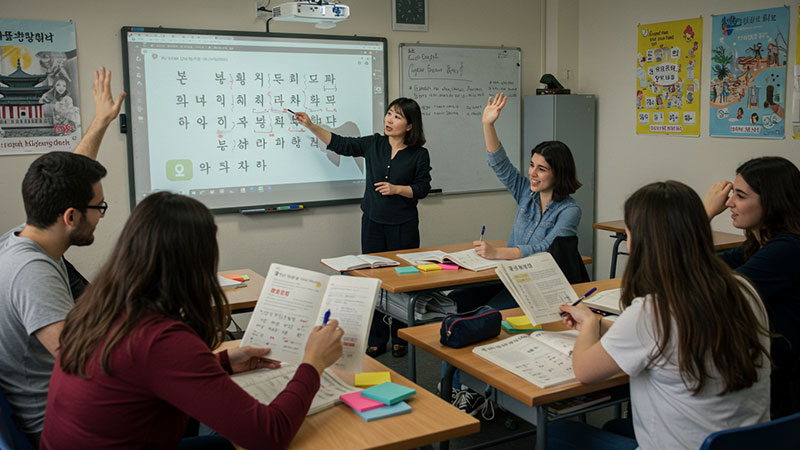
The King Sejong Institute in Montevideo offers Korean language courses using a teaching methodology based on the international standard model for Korean education established by the National Institute of the Korean Language.
This center has by the King Sejong Foundation, an institution established by the South Korean government with the aim of providing language students and teachers with a comprehensive range of study and information services.
has than 200 institutes worldwide, and their teachers hold a Korean language teaching certificate authorized by the King Sejong Foundation.
The institute is named after the fourth king of the Joseon Dynasty, who created the Korean alphabet in 1446.
K-pop and Korean culture
With pop music as its driving force, South Korean culture is all the rage among teenagers around the world and is currently at its peak in the region.
K-pop (short for Korean pop) is a musical genre that encompasses various styles (dance, hip hop, rap, rock, and R&B) and refers specifically to popular music from South Korea.

In 2012, K-pop made a splash in the mainstream Western media with Psy’s song “Gangnam Style,” which went viral online and, within a couple of months, became the most-viewed video in YouTube history—a record it held until 2017.
In May 2018, BTS, the new generation of K-pop, took the pop music world by storm by becoming the first group to top the Billboard 200 chart.
BTS has become the world's most popular group, inspiring young people to believe in themselves through their song "Love Yourself."
Just as K-pop continues to spread around the world, Korean culture, music, and dance are also gaining popularity.
In addition, interest in Korean dramas and movies is growing thanks to Netflix.
As a result of these events, interest in the Korean language and culture increased significantly.
Courses
Through the King Sejong Institute in Montevideo, Universidad ORT Uruguay offer—initially—two courses:
- Korean language courses at various levels.
- Courses on Korean culture.
| Level | Course | Text |
|---|---|---|
| Level 1 | 1A Division | Sejong 1 |
| 1B | Sejong 2 | |
| Level 2 | 2A Division | Sejong 3 |
| 2B | Sejong 4 | |
| Level 3 | Intermediate 1A | Sejong 5 |
| Intermediate 1B | Sejong 6 | |
| Level 4 | Intermediate 2A | Sejong 7 |
| Intermediate 2B | Sejong 8 |
Institution offering the courses
The Korean language courses are offered as part of an agreement between the King Sejong Institute in Montevideo and Universidad ORT Uruguay.
They are open to anyone interested in learning the language and experiencing Korean culture.
The school offers two Korean language courses and one cultural studies course.
Goals of the school
- Promote the Korean language and culture in Uruguay.
- Collaborate on student, faculty, and researcher exchange programs with various Korean universities.
- Provide materials and textbooks in Korean.
Course
Duration
Second semester: August 3 through November 18, 2026.
Course load
Four hours a week of Korean language classes.
Schedule
Beginner 1A-1 (Sejong 1): Mondays and Wednesdays from 6:00 p.m. to 8:00 p.m.
Beginner 1B (Sejong 2): Tuesdays and Thursdays from 6:00 p.m. to 8:00 p.m.
Beginner 2A (Sejong 3): Mondays and Wednesdays from 6:00 p.m. to 8:00 p.m.
Beginner 2B (Sejong 4): Mondays and Wednesdays from 8:00 p.m. to 10:00 p.m.
Intermediate 2A (Sejong 7): Tuesdays and Thursdays from 8:00 p.m. to 10:00 p.m.
Cost
Korean language course:
General public: 13,300 (registration fee: 1,300; course fee: 12,000)
Students, graduates, faculty, or staff members of Universidad ORT Uruguay: 11,500 $ (registration fee: 1,300 $; course fee: 10,200 $)
The fee covers the entire semester. Students who have been enrolled since previous years do not have to pay tuition.
Enrolment
Registration deadline: July 17 via the following form.