Can a classroom facilitate —or limit— the way we teach, learn, and assess? The question seems simple, but it opens up a central debate in today’s education: it is not enough to consider which technologies are incorporated into educational practices; we must also consider under what conditions, with what pedagogical purpose, and in what specific settings they are implemented.
That was one of the topics addressed at the conference “AI and Assessment: Opportunities and Requirements for Training, ” organized as part of the project “Strengthening Teachers’ Digital Competencies in Secondary Education for AI-Mediated Assessment ”—funded by ANII and the Ceibal Foundation.
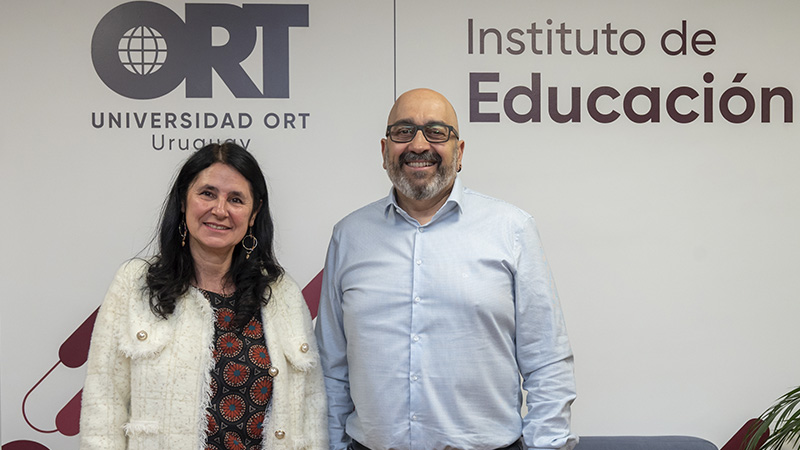
The event featured Dr. Guillermo Bautista, a professor at the Open University of Catalonia (Spain) and a researcher with the Smart Classroom Project, who shared his experiences in designing innovative educational spaces.
The event also provided an opportunity to present some preliminary results from the project led by the Institute of Education at Universidad ORT Uruguay, which focuses on developing teachers’ digital skills and using artificial intelligence to enhance assessment.
https://www.youtube.com/watch?v=Xv5d4QRkp50
When the classroom teaches as well
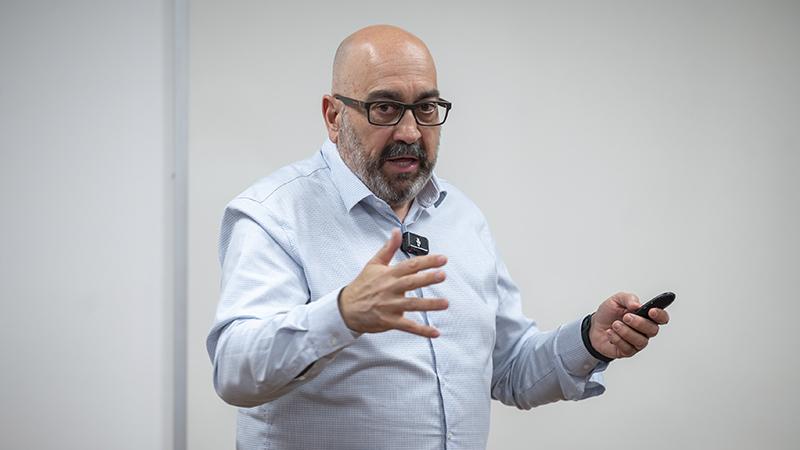
“Have you ever considered that space in an educational institution is a fundamental element?” Dr. Guillermo Bautista asked the virtual and in-person conference attendees.
The professor from the Open University of Catalonia (Spain) suggested focusing on the physical space where teaching takes place and where learning occurs: “I’m simply suggesting we think about it, because many teachers haven’t even considered that classrooms don’t have to all look the same, with everyone facing the blackboard.”
“What we have is a design and layout of the space that is not at all student-centered, as it reflects a specific pedagogical approach that is teacher-centered, ”he added, noting that this traditional layout often serves as “a means of exercising complete control” over students.
In response, he proposed moving toward co-design processes that involve students, teachers, school administrators, families, and other key stakeholders. The key point, he explained, is that the spaces that meet people's needs and ways to learn from each school community.
“We shouldn’t assume there’s a single spatial model that works for all schools,” he cautioned. In fact, Bautista emphasized the importance of the “cultural context of the design”: “A group of students from Catalonia or Madrid is not the same as a group of students from Rocha, who likely experience and understand space in very different ways.”
Educational Environments for Teaching with Artificial Intelligence
The integration of artificial intelligence into educational processes and the physical conditions that enable its pedagogical use are often considered separately. However, the conference sought to challenge this separation: teaching with artificial intelligence also involves rethinking the environmentsin which these practices take place.
During his presentation, Bautista shared examples of educational spaces designed to enable teachers to work with their students or prepare their lessons with the support of artificial intelligence, in order to develop digital skills and promote inclusive education.
The professor and researcher noted that innovative methodologies can be designed for working with artificial intelligence, but if the necessary spaces, training conditions, and institutional dynamics are not in place, it will be difficult for that innovation to be sustained.
In line with this perspective, the project “Strengthening Teachers’ Digital Competencies” also emphasizes the need for teachers to have suitable physical spaces where they can learn, exchange ideas, and experiment. In this context, community centers—as temporary spaces for exchange—emerge as a key strategy. These are spaces for collective work where it is possible to experiment, make mistakes, review, and try again with artificial intelligence tools within a careful and reflective pedagogical framework.
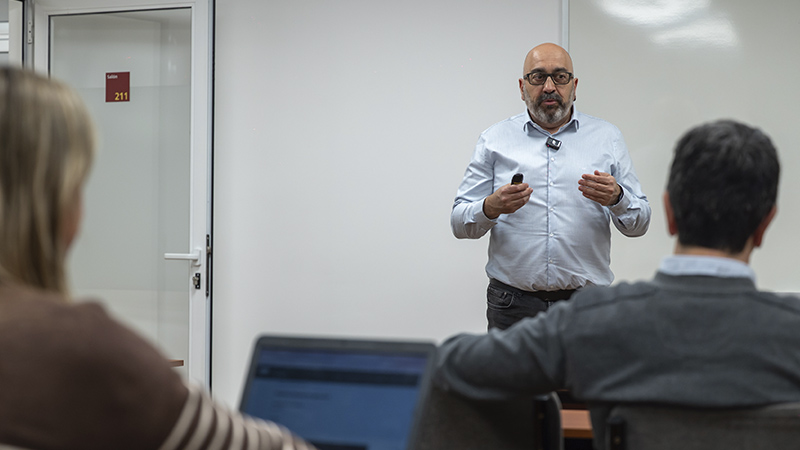
In addition, Bautista emphasized the importance of research, implement, and evaluate changes in educational settings. From his perspective, transforming the space does not necessarily mean renovating the entire facility, but rather in creating pilot projects that allow us to observe what happens, make the necessary adjustments, and gather evidence on their effects.
“We don’t go to these facilities with the intention of completely transforming the space, ”he clarified. The goal, he explained, is to create spaces that can be used to improve the experience, outcomes , and well-being of those who use them.
“Improving the environment improves well-being. And improving well-being improves learning and learning outcomes, ”he concluded.
Preliminary findings on digital skills and artificial intelligence
“This research focuses on giving a voice to individuals who play avery, very important role in the field of education, ”said Dr. Claudia Cabrera Borges, co-principal investigator of the project “Strengthening Teachers’ Digital Competencies.”
One of the distinctive features of this research is its participatory nature, as it involved public secondary schools in Uruguay located in vulnerable socio-educational contexts. Through a co-design process based on input from teachers, school staff, and academic experts, the aim is to develop a training program that emphasizes the use of artificial intelligence in assessment.
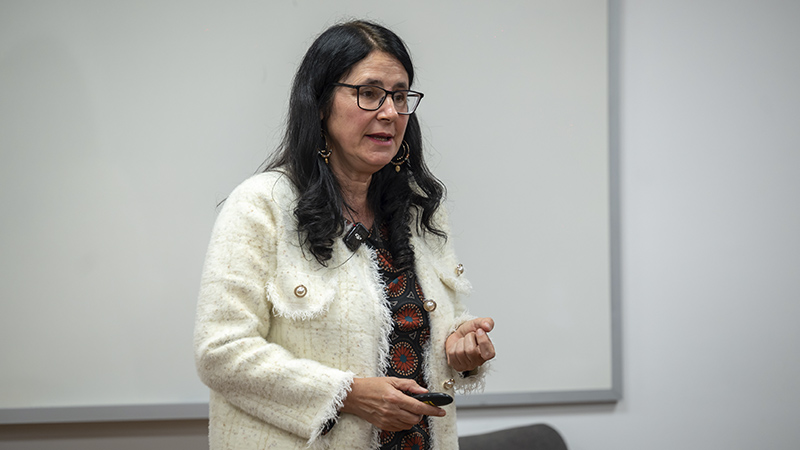
Among the findings shared during the conference, Cabrera Borges noted that most of the teachers surveyed fall into a intermediate level or in the process of developing their digital teaching skills. However, there is a positive assessment of generative artificial intelligence: 72% consider it to be “important” or “very important” for education.
This recognition coexists with still-limited use: 25% of teachers said they do not use these tools, while 35% said they use them only occasionally.
Assessment Using Artificial Intelligence: An Opportunity That Has Yet to Be Fully Explored
As for the use of artificial intelligence in assessment, while teachers recognize its potential, its use is still primarily limited to administrative tasks or the creation of assessment tools, such as rubrics and checklists.
In that regard, its use in educational processes —such as providing feedback to students— remains limited, although teachers themselves consider it particularly important.
“More than 80% of teachers say they need training in the use of artificial intelligence for educational purposes and in its application to assessment,” Cabrera Borges stated.
Training is also linked to two key aspects: self-directed learning and collaborative work among peers. The reason is that many teachers explore these tools on their own, but they also value physical spaces that are conducive to sharing ideas, exchanging experiences, and building knowledge together.
In this regard, the physical and temporal spaces for collaboration among teachers—for example, the workshops included in the “Strengthening Teachers’ Digital Competencies” project —can serve as safe spaces for trial and error with artificial intelligence, where exploration, questioning, and shared reflection are integral parts of the professional development process itself.
Image Gallery
