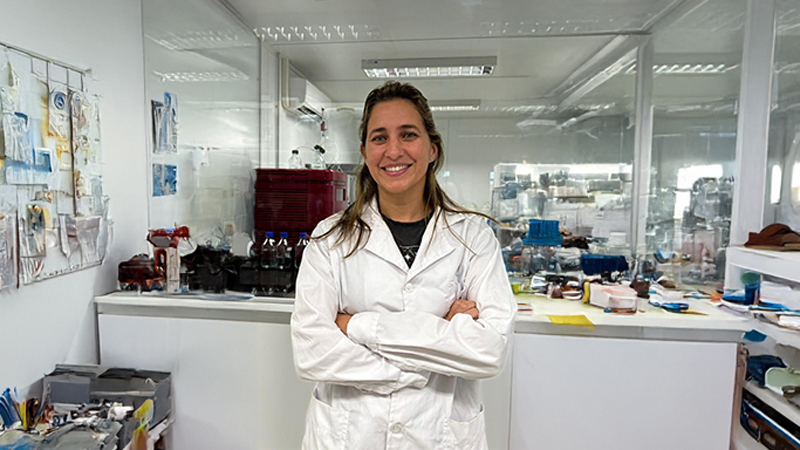
The initiative, which began as an academic research project, is now moving toward commercialization through a startup selected by the biotechnology accelerator GridX.
An unmet need
The idea arose from a concern that Ortiz began to notice among women in her circle who were going through menopause. Many shared the same feeling: a lack of effective and affordable options for managing the symptoms associated with this stage of life.
While researching the topic, he found scientific evidence pointing to a molecule with the potential to mitigate these effects. However, there was one major drawback: its high production cost. That was when he began exploring alternatives for obtaining similar compounds from soybeans, a raw material that is abundant in Uruguay and the region.
“Uruguay, Argentina, and Brazil are major soybean producers. It seemed like an interesting opportunity to develop an affordable solution using locally available resources,” he explained.

Synthetic biology to transform soy into a solution for women's health
One of the main challenges of the project was to find an efficient way to transform soy flour into a molecule with the potential to alleviate menopausal symptoms.
To achieve this, Ortiz decided to draw on two emerging fields of biotechnology: synthetic biology and metabolic engineering, disciplines that make it possible to reprogram microorganisms to perform new functions. “I was very interested in learning more about these cutting-edge technologies,” he said.
With that goal in mind, he contacted researchers at Spain’s National Center for Biotechnology, who are international leaders in these fields. The proposal sparked immediate interest and led to a scientific collaboration that continues to this day.
As part of this collaborative effort, Tomás Tejera, a biotechnology engineer from Universidad ORT Uruguay and a master’s student in biotechnology, completed a six-month internship in Spain to learn the necessary techniques and transfer that knowledge to the ORT laboratory.
Later, other undergraduate students joined the team—Victoria Viroga, Agustina Canclini, and Josefina Boado—as well as graduate students, including Guillermo Litvins, who holds a bachelor’s degree in engineering and a master’s degree in biotechnology and is currently pursuing a Ph.D. in engineering at Universidad ORT Uruguay, focusing on this line of research.
Thanks to these advances, the team was able to reprogram bacteria to produce a molecule that they do not naturally produce.
“These are bacteria that didn’t do that before, and we taught them how to do it. We also prepared them metabolically so they can handle this new activity.”
The results obtained made it possible to produce the molecule in significant quantities and at a cost considerably lower than that associated with traditional chemical synthesis.

A career dedicated to solving complex problems
The project also represents a natural progression in Ortiz’s scientific career. For much of his career, he worked in the field of drug discovery for neglected infectious diseases—conditions that primarily affect vulnerable populations.
Their work involved identifying vulnerabilities—so-called "Achilles' heels"—in the microorganisms responsible for these diseases and designing molecules capable of blocking them to eliminate the pathogen.
That experience allowed him to specialize in fields such as structural biology, biocatalysis, and protein engineering—skills he now applies to the development of new biotechnological solutions.
“The idea has always been to understand how biological systems work so that we can design concrete solutions to real-world problems.”
From the lab to the startup
As the results began to take shape, the team realized that the technology had the potential to become a biotechnology company.
“We realized that this couldn’t just be a scientific paper. We wanted it to reach people,” Ortiz said.
With that goal in mind, he presented the initiative to GridX, one of Latin America’s leading biotech startup accelerators, where the startup founded by Ortiz,FLAVANT.BIO, was selected from among more than 500 proposals.
Currently, in addition to continuing to refine the technology, the team is working with specialists from ATGen on the scaling-up processes needed to move production from the laboratory to future industrial applications.
The progress made so far has made it possible to validate the technology's feasibility and to continue optimizing the production process for future stages of development.
Science with a social impact
For Ortiz, the project also aims to bring attention to an issue that has historically received less attention in scientific research.
The initiative aims to develop an accessible alternative for managing symptoms associated with menopause, a stage of life that affects millions of women and which, according to the researcher, has received less funding and been given lower priority than other areas of healthcare.
“Women’s health often receives less funding, less research, and less attention. We also want to show that we in Uruguay can develop innovative solutions to these challenges.”
With promising results, an international collaborative network, and a team of researchers and students, the initiative continues to move forward with a clear goal: to transform scientific knowledge into a tool that helps improve women’s quality of life.