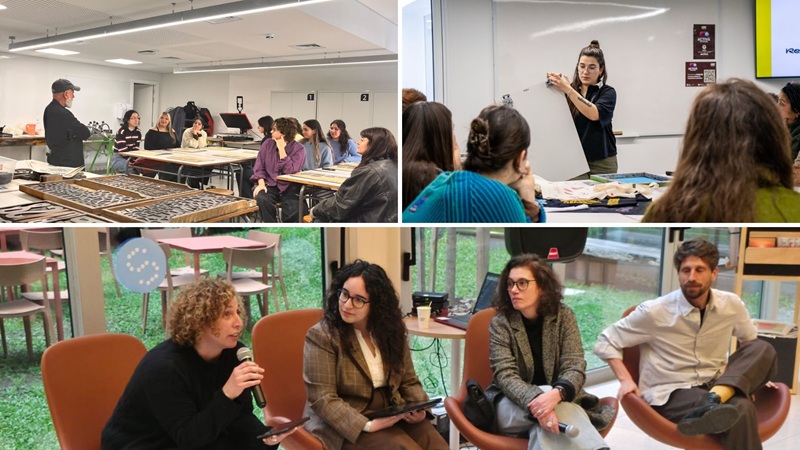
The welcome remarks were delivered by Oscar Aguirre, dean of the School of Design, and Tatiana Varela, CEO of SuperLocal.
The launch brought together the design community and kicked off a week of activities that included lectures, workshops, open studios, and meetings with professionals from Uruguay, Argentina, Spain, and the United States.
Universidad ORT Uruguay also hosted various festival activities, strengthening the ties between the School of Design, the local community, and the international professional community.
Movable-type printing and screen printing
On September 9, two workshops focused on exploring design techniques and trades were held at the Creative Hub.
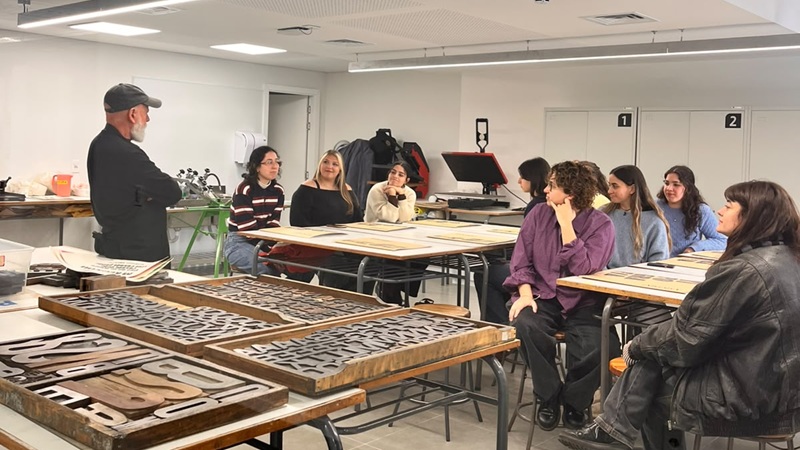
The workshop“Expressive Typography: Form, Texture, and Imprint” was led by Gabriel Pasarisa, director of Caja Baja and a former professor at the School of Design. The workshop invited participants to explore letterforms from a graphic and material perspective using wooden movable type, matrices made of various materials, and manual inking.
Participants experimented with rhythm, texture, and contrast through play, trial and error, and chance, creating prints that established a dialogue between analog processes and digital tools.
Caja Baja is Pasarisa's project dedicated to reviving typesetting and letterpress printing through a collection of movable wooden and metal type.
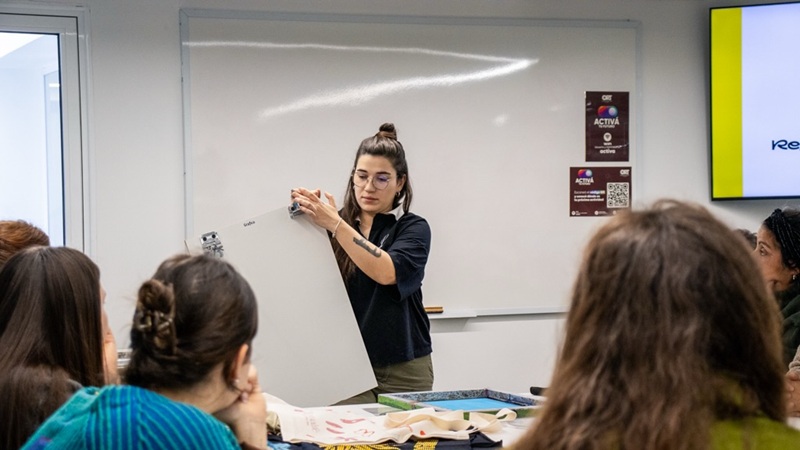
A screen printing workshop titled“The Craft Is Also a Manifesto” was also held, led by ISHO, a screen printing and design studio. The workshop covered the different stages of the screen printing process—from the conception and preparation of an idea to its printing—to give participants insight into the decisions and procedures involved in creating a piece.
Space as Narrative
On September 11, Pedro Lipovetzky, representing Elisava School of Design and Engineering in Barcelona, led the workshop “Space as a Story: Designing Through Exhibition Narrative” at the Creative Hub.
The proposal focused on the construction of narratives for exhibition spaces. Working in groups, the participants defined a central question, established a point of view, and organized a narrative into chapters. They then worked on selecting pieces, objects, artists, voices, and resources capable of transforming that narrative into a spatial and museographic experience.
Lipovetzky is an Argentine designer based in Barcelona, director of the Master’s Program in Design for Exhibition Environments at Elisava, and co-founder of the Gracias Grecia studio. His participation in SuperLocal took place as part of the Elisava 2026 Tour, which visited Buenos Aires, Montevideo, and Punta del Este.
Education and Future Professionals
On September 12, a panel discussion titled "Education, Design, and Future Professionals" was held at the San José Building of the Catholic University of Uruguay.
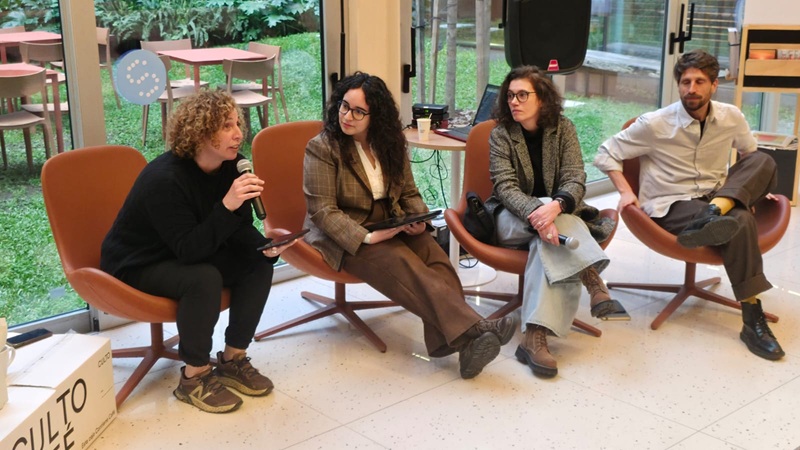
The event sparked a conversation about the connections between education, community, and work, and about the opportunities needed to develop one's own professional practice in design.
The panel was moderated by Agustina Espino, a professor in the School of Design, and featured M.ª Fernanda Núñez, associate academic coordinator of ORT’s Bachelor’s Degree in Graphic Design.
The event also brought together representatives Beatriz Fernández Cordano, from the Udelar School of Architecture, Design, and Urban Planning, and Felipe Reyno, from the Catholic University of Uruguay.
A Way to Experience Projects
The program for September 12 also included the talk“Connecting Nodes: A Way of Experiencing Projects,” presented by Fernando Díaz, Matías Fernández Di Iorio, Avril Ponce de León, and Camila Gómez, members of Reset Type Studio.
The four of them, all graduates of ORT’s Bachelor’s Degree in Graphic Design program, shared their experiences with the creation and development of an independent studio dedicated to typographic design in Uruguay.
Through experiences and anecdotes, they opened the doors to Reset to offer a behind-the-scenes look at some of their favorite projects, discussing design processes, budgeting, team building, and the constant tension between what people want and what they need.
More than just a talk on type design, the event invited participants to reflect on what makes it possible to design letters and, at the same time, make a living from it, focusing on how connections and collaboration shape every decision the studio makes.
The third edition of SuperLocal brought together a variety of approaches to the practice of design, ranging from craft and production techniques to exhibition narratives, education, and the development of professional projects. The activities served as a meeting point for institutions, studios, and professionals involved in local and international design.