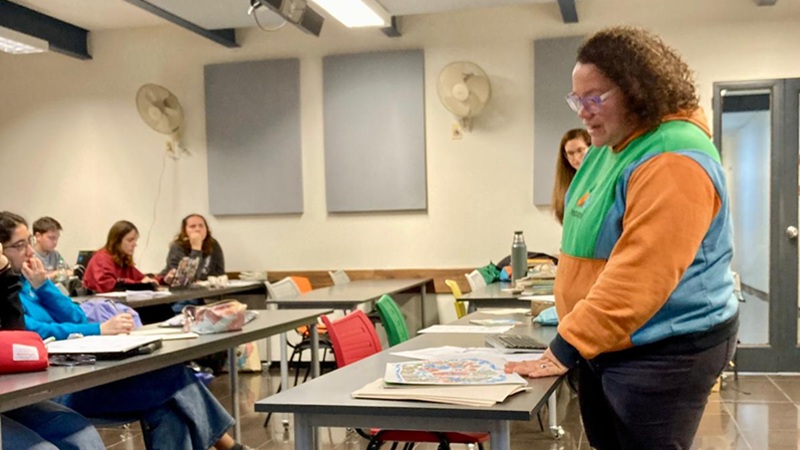
The class, taught by instructors Serrana Domínguez and Adrine Kechichian, was visited by Cecilia Laporta, head of the General Coordination and Partnerships department, andTania Fernández, head of the NGO’s Communications and Design department.
During the three-hour discussion, representatives from Repapel shared the organization’s history, reviewing its more than 25 years of existence, its evolution, and how it operates today.
Throughout the visit, they emphasized that their main goal is environmental education, beyond the production of recycled paper.
They also described the activities they carry out in partnership with schools and businesses, where they hold workshops and create opportunities for discussion to reflect on and develop ideas related to sustainability and environmental stewardship.
In addition, they presented a selection of variousgraphic works produced by the organization, primarily notebooks and, in recent years, calendars designed in collaboration with schoolchildren participating in their educational projects.
The event concluded with a discussion between the Repapel representatives and the students, providing valuable context for the development of the academic project.
The activity gave students a firsthand look at the work of an organization that promotes environmental education and circular economy initiatives in Uruguay.
In this regard, the initiative is linked to SDG 12: Responsible Consumption and Production, which aims to promote the efficient use of resources and the reduction of waste, and to SDG 4: Quality Education, which promotes the integration of knowledge and practices for sustainable development.
The Sustainable Development Goals (SDGs) are part of the agenda adopted by the United Nations in 2015 to address global challenges by 2030.
What is Repapel?
It is a nonprofit organization based in Uruguay that works to promote environmental education and the development of initiatives focused on the circular economy.
According to the Repapel website, they believe in environmental education "as the primary driver for helping to build a more just society that is committed to its present and future environment."
They work with companies, organizations, and educational institutions to promote recycling management systems, thereby recovering more than 750,000 kilograms of paperand other waste.
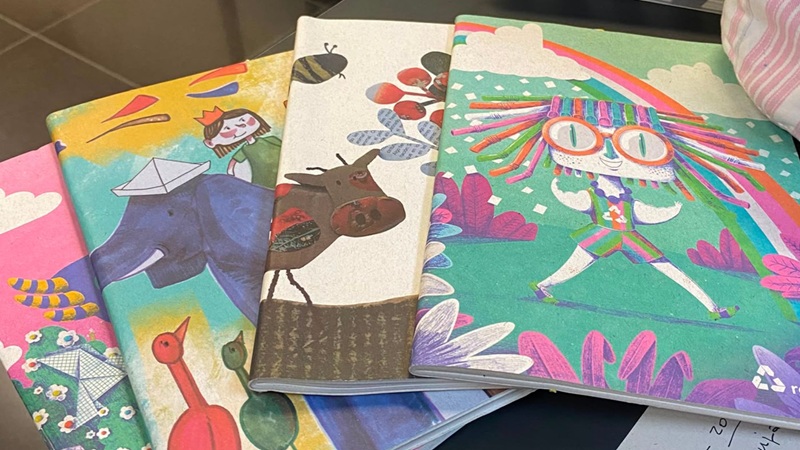
These, in turn, are turned into paper and plastic school supplies for educational institutions, with a total of 26,000 notepads, 48,000 notebooks, 5,500 reams of A4 paper, more than 288 rolls of toilet paper, and 53,000 sheets of cardstock, according to data collected from its website.