
Many of the emissions that contribute to a person's carbon footprint are not immediately obvious: they are linked to everyday decisions, such as how we get around, our use of electricity, or the purchase of products that later generate waste.
University life also involves the operation of buildings, the climate control of spaces, and the use of technological equipment.
Understanding where these emissions come from makes it possible to identify the activities with the greatest impact and to direct efforts toward reducing them.
What Is a Carbon Footprint?
A carbon footprint is a metric that estimates the total amount of greenhouse gas emissions associated with a person, an organization, a product, or an activity.
Greenhouse gases are compounds found in the atmosphere that trap some of the heat.
This natural phenomenon helps maintain a temperature suitable for life on Earth. However, the increase in the concentration of these gases due to human activities contributes to climate change.
A carbon footprint combines emissions from various sources into a common metric to facilitate their analysis and comparison.
Based on its name, one might think it refers only to carbon dioxide emissions. However, it can also include other gases that contribute to global warming, such as methane and nitrous oxide.
To compare the impact of these gases, emissions are expressed in carbon dioxide equivalent (CO₂e), a unit that takes into account each gas's ability to trap heat in the atmosphere.
In general terms, this indicator makes it possible to:
- quantify emissions in kilograms or metric tons of CO₂e
- identify which activities account for the majority of emissions
- compare modes of transportation, energy sources, products, or processes
- set priorities and focus efforts on the sources with the greatest potential for reduction
- notice changes when comparing results from different periods

According to the Encyclopaedia Britannica, a carbon footprint includes both direct and indirect emissions.
Direct emissions result, for example, from the burning of fossil fuels in transportation or heating; indirect emissions are associated with electricity and the production of the goods and services consumed.
The result obtained always depends on the limits set for the analysis.
Therefore, before interpreting it, it is necessary to know which activities were taken into account, over what period, and what information was used to make the estimate.
Which activities generate emissions?
According to the United Nations, human activities have been the main driver of climate change since the 19th century, due to the burning of fossil fuels such as coal, oil, and natural gas.
These activities release greenhouse gases that trap heat in the atmosphere and raise the planet's temperature.
The impact of an activity does not depend solely on what happens at the moment it takes place.
In many cases, emissions are generated throughout various stages, from the extraction of raw materials to the transportation, use, and final disposal of a product.
- Energy production and consumption include the electricity used to provide lighting, heating, and cooling, and to keep buildings, servers, laboratories, and equipment running.
- Transportation includes travel by private vehicles, buses, airplanes, and other modes of transportation that use fuel.
- The production of goods includes the extraction of raw materials, the manufacturing, packaging, and distribution of computers, furniture, paper, and other products.
- The food sector generates emissions during agricultural production, processing, refrigeration, and transportation.
- Waste management can generate emissions during collection, transportation, treatment, and final disposal.
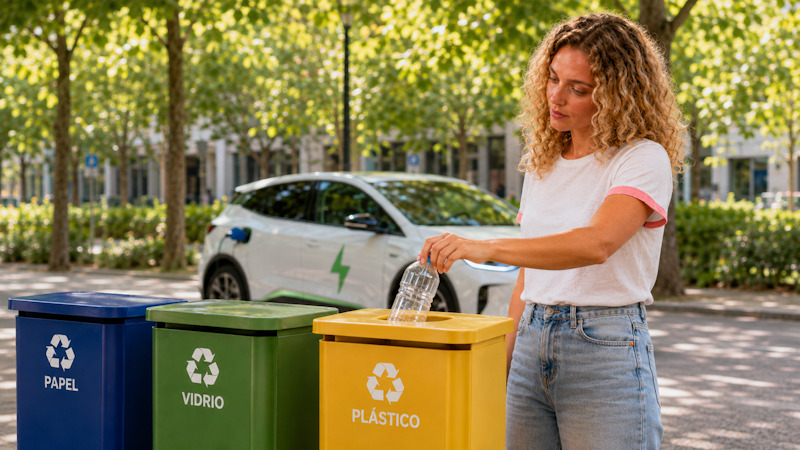
On the other hand, deforestation and changes to ecosystems can release stored carbon and reduce the natural capacity to absorb carbon dioxide.
The importance of each source varies depending on the subject being analyzed.
In an organization, for example, factors such as infrastructure, contracted services, and the energy consumption of its facilities may become significant.
In the university setting, these sources of emissions occur simultaneously.
The operation of buildings and laboratories, along with the mobility of students and faculty, affects the carbon footprint.
At the same time, students' everyday choices can help reduce the environmental impact of college life.
Personal, Organizational, and Product Carbon Footprints
Although the concept of a carbon footprint is the same in all cases, its calculation varies depending on the subject of analysis.
The same data or the same limits are not used to estimate the emissions of an individual, a university, or a product.
https://youtu.be/Hj5YY0UwfYI?si=EBUWJX95Z3F6CHZj
Personal carbon footprint
A personal carbon footprint estimates the emissions associated with a person's consumption habits and lifestyle.
It helps identify which factors have the greatest impact on emissions and guide behavioral changes.
Information is generally considered to include:
- means of transportation used
- home energy consumption
- Food and Shopping
- waste generation
The result is always an estimate, since it depends on the responses provided and the emission factors used. Therefore, it should not be interpreted as an exact measurement.
Organizational Carbon Footprint
An organizational carbon footprint analyzes the emissions associated with the operations of a company or institution over a specific period.
In the case of a university, for example, this may include building operations, energy consumption, and other services related to its activities.
These emissions are typically organized into three groups:
- Direct emissions (Scope 1): These come from sources controlled by the organization, such as vehicles or heating systems that use fuel.
- Indirect emissions (Scope 2): These are related to the generation of the electricity purchased and consumed.
- Other indirect emissions (Scope 3): These include purchases, suppliers, transportation, travel, waste, and other value chain activities.

This classification makes it possible to distinguish emissions from sources controlled by the institution from those associated with purchased energy or value chain activities.
These may involve vendors, community members, or other organizations.
A Product's Carbon Footprint
A product's carbon footprint estimates the emissions generated during the various stages of its life cycle.
It may include:
- extraction and processing of raw materials
- manufacturing and packaging
- transportation and distribution
- Use and Maintenance
- reuse, recycling, or final disposal
For example, a computer's carbon footprint isn't limited to the electricity it consumes while in use.
It also includes emissions associated with the sourcing of its materials, its manufacture, its transport, and its disposal when it is no longer in use.
Distinguishing between different types of fingerprints prevents incorrect comparisons.
The personal footprint analyzes individual habits; the organizational footprint examines how an institution operates; and the product footprint tracks the stages of a good or service.
Each one involves different questions and requires setting clear boundaries before performing the calculation.
How to Calculate Your Carbon Footprint
Calculating a carbon footprint involves identifying the activities that generate emissions, gathering information about them, and converting that data into carbon dioxide equivalents.
The level of accuracy depends on the object being analyzed.
A personal calculation provides a general estimate, while an organization needs a more detailed and documented inventory.
The calculation is usually based on a basic formula: activity data × emission factor = estimated emissions
Activity data refers to what can be measured, such as distance traveled, the amount of fuel used, or electricity consumption.
The emission factor indicates the average amount of greenhouse gases generated per unit of that activity.
For example, the following data can be used:
- kilometers traveled
- liters of fuel consumed
- kilowatt-hours (kWh) of electricity consumed
- kilograms of waste
- number of products purchased
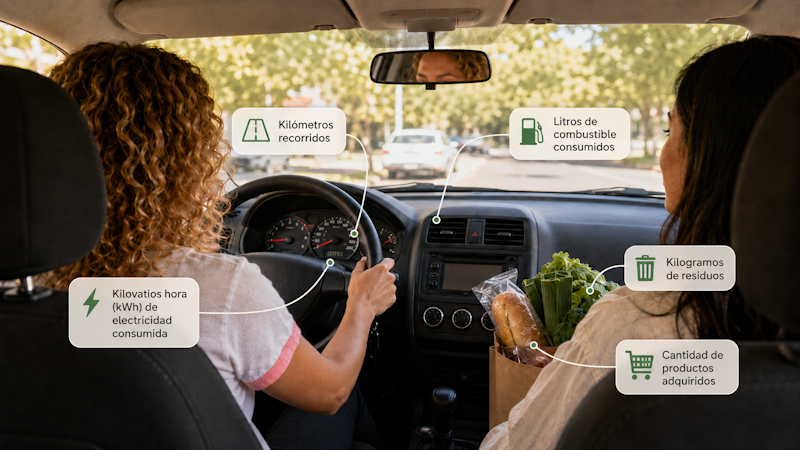
Before performing the calculation, it is also necessary to define the scope of the analysis: which activities will be included, over what period, and to what extent indirect emissions will be considered.
Two calculations involving the same activity may yield different results.
Variations may be due to the available data, the selected emission factors, the location where the activity takes place, or the defined scope.
A carbon footprint should be interpreted as an informed estimate, and the results should be compared over time.
Actions to Reduce the University's Carbon Footprint
Reducing the carbon footprint of university life requires combining personal decisions with institutional measures.
Everyday habits can help reduce emissions, but their impact is greater when they are part of a broader strategy.
- Mobility: Prioritize public transportation, biking, walking, or carpooling whenever possible
- energy efficiency: making the most of natural light, turning off equipment that is not in use, avoiding heating or cooling empty spaces, and properly regulating the temperature
- Use of materials: Limit printing, reuse available resources, and evaluate whether a purchase is truly necessary
- event planning: select accessible venues, accurately estimate the number of attendees, reduce the use of printed materials, and consider emissions related to transportation or food

Reducing emissions does not depend solely on students.
It also requires organizational decisions regarding the operation of buildings, the procurement of services, and the management of resources.
When individual and institutional actions are integrated, it becomes easier to reduce the carbon footprint in a sustainable way.
- If you're interested in sustainability, we recommend reading:“Recycling at College: Simple Habits to Reduce Your Impact”
More than just a single figure, the carbon footprint helps identify opportunities for improvement and measure the impact of actions taken over time.
The university community involves many people and is home to a wide range of activities.
For this reason, measuring one's carbon footprint can be a tool for promoting sustainability from a holistic perspective.
Are you interested in sustainable development but still not sure what to study?
Discover thedegree programs at the Universidad ORT Uruguay