Water is one of the most important resources for life and, at the same time, one of the most vulnerable. Showering, cooking, and cleaning are obvious ways we use water, but they represent only a fraction of the water used in our daily lives.
The production of food, clothing, electronic devices, and school supplies also requires water. That consumption—which is often invisible— is part of the water footprint.
What Is a Water Footprint?
The water footprint is an indicator that estimates the total volume of freshwater used directly and indirectly to produce the goods and services associated with the consumption of an individual, a community, an organization, or a country.
According to the Water Footprint Network, this indicator makes it possible to analyze water use throughout the entire production chain of a product, service, or activity.
It is not limited to water used directly; it also includes water involved in the production and consumption of goods .
The analysis distinguishes between direct consumption —such as drinking, cooking, or cleaning—and indirect consumption, which is associated with raw materials, manufacturing, energy generation, and transportation. It also takes into account pollution linked to production processes.
In addition to the amount of water used, the water footprint takes into account its source and the context in which it is used. The impact of the same volume of water can vary depending on water availability in each region and the time of year.
Blue, Green, and Gray Water Footprints
The water footprint is classified into three components —blue, green, and gray—that help us understand where water comes from and the pressure its use can place on water resources.
Blue Water Footprint
The blue water footprint refers to freshwater from surface and groundwater sources— such as rivers, lakes, and aquifers—that is consumed during a production process. It is considered consumed, for example, when it evaporates or is incorporated into a product.
This component may be present in activities such as:
- irrigation of crops using artificial systems
- food and beverage manufacturing
- industrial and manufacturing processes
- the water supply for homes, businesses, and institutions
When water withdrawal exceeds a watershed’s natural replenishment capacity, streamflow may decrease, pressure on aquifers may increase, and water availability for ecosystems and communities may be reduced.
Green Water Footprint
The green water footprint represents the rainwater that is stored in the soil and used by plants as they grow. Unlike the blue water footprint, it does not involve the extraction of water from rivers, lakes, or aquifers.
It plays an important role in activities such as:
- rainfed agricultural production
- forest plantations
- the production of natural fibers, such as cotton
Its importance depends on factors such as climate, crop type, and soil characteristics.
Grey Water Footprint
The gray water footprint refers to the volume of freshwater needed to dilute the pollutants generated during a production process until the water quality meets established standards.
It does not necessarily represent water that is physically consumed; rather, it serves as an indicator of the impact of human activities on the quality of water resources.
This component may be associated, for example, with:
- the use of fertilizers and pesticides in agriculture
- discharges from industrial processes
- wastewater generated by residential and commercial activities
A high gray water footprint typically indicates a higher pollution load and the need to implement technologies or practices that reduce the discharge of harmful substances into the environment.
Which products and activities require the most water?
Household consumption is only one part of the water footprint. Decisions related to study materials, electronic devices, food, and everyday products also have an impact on campus life.
Printing notes, buying supplies, replacing devices, or choosing disposable products can increase your indirect water footprint. For example, paper manufacturing requires water during the extraction of wood pulp and other production processes.
Reducing unnecessary printing and reusing materials can contribute to a more efficient use of resources.
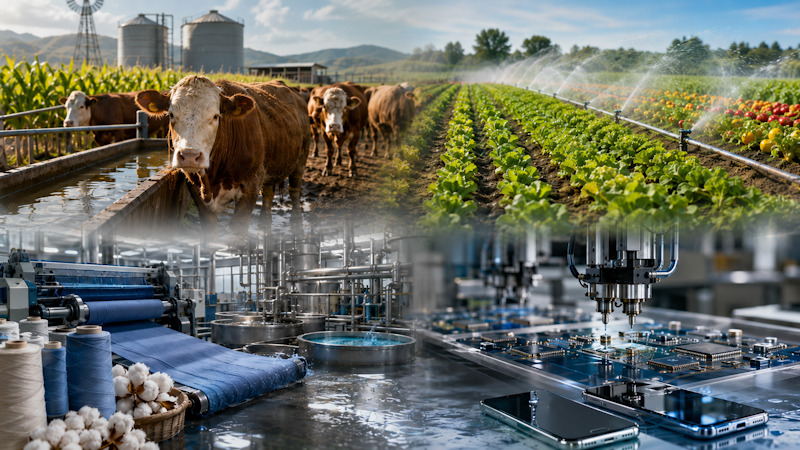
Sectors and products that may require large volumes of water include:
- Beef production: This can involve high water consumption due to the cultivation of livestock feed, the care of the animals, and the processing stages.
- Agriculture and food production: fruits, vegetables, grains, and other crops require water to grow, especially when they rely on irrigation systems.
- Textile industry: Clothing manufacturing requires water to grow natural fibers, such as cotton, and for processes such as dyeing and finishing.
- Manufacturing of electronic devices: computers, cell phones, tablets, and other technological equipment require water during the production of components and various industrial processes.
According to the European Parliament, producing a single cotton T-shirt can require approximately 2,700 liters of fresh water. This figure shows that a product’s water footprint depends not only on its end use, but also on the entire process required to produce it.
How Is the Water Footprint Measured?
The water footprint is defined as the volume of freshwater associated with the production of a good or the consumption of an individual or community. It is generally measured in liters or cubic meters over a specific period.
To ensure representative results, the analysis covers the entire process from raw materials to the final product.
It also takes into account regional differences, since water availability and climatic conditions can vary.
- Consider both the water used directly and the water incorporated at the various stages of production.
- It distinguishes between blue water and green water based on their source and calculates the gray water footprint based on the volume needed to dilute the pollutants.
- It takes the local context into account, because the same volume of water can have different consequences depending on the availability of the resource.
In the university setting, this indicator can also be used to assess the footprint associated with campus operations. Water consumption in buildings, laboratories, green spaces, student housing, and cafeterias is part of the institution’s water footprint.
Based on this data, institutions can implement water-efficiency measures and track the results of the actions taken.
Actions to Reduce the Water Footprint in University Life
Reducing the water footprint in a university community involves taking action on both direct water consumption and the habits that generate indirect demand.
Institutions can improve the efficiency of their facilities, while the university community can contribute through everyday decisions.
Many of these measures are simple and can be implemented without major changes:
- Prioritize digital documents, and when printing is necessary, use both sides of the paper
- reuse notebooks, swap books, share notes, and make use of materials from previous semesters
- extend the useful life of electronic devices through maintenance and repair
- use reusable bottles, cups, and other containers
- prevent food waste, the production of which also requires water
- report any water leaks detected on the premises

Reducing the water footprint can also be integrated into academic activities through research projects, awareness campaigns, volunteer programmes , and circular economy initiatives.
Universities have the opportunity to drive changes that extend beyond the campus and promote a more responsible use of water.
When these practices are consistently implemented , they help reduce water consumption and promote more responsible decision-making both within and outside the university community.
Are you interested in sustainable development but still not sure what to study?
Discover theundergraduate and graduate programs offered by the Universidad ORT Uruguay