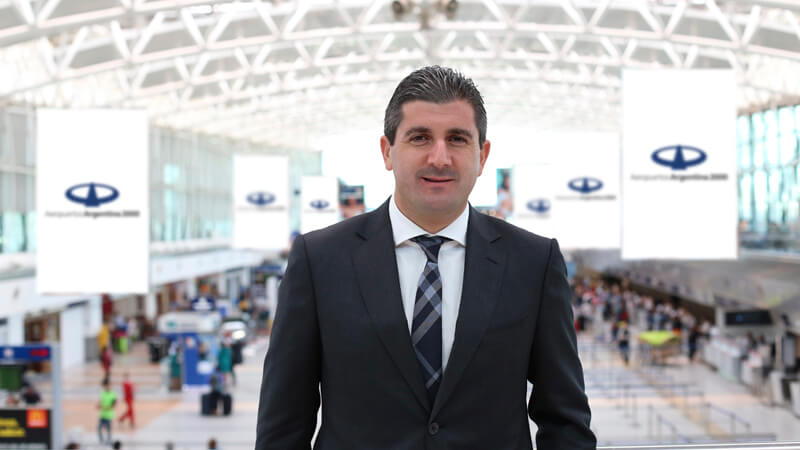
“The storm isn’t over; we’re still in pandemic mode.” That’s how Daniel Ketchibachian, a graduate of the Master of Business Administration (MBA) at Universidad ORT Uruguay CEO of Aeropuertos Argentina 2000, a company that operates a total of 33 airports across the country and employs some 2,700 people.
Ketchibachian sees “the light at the end of the tunnel” while ensuring the sustainability of one of the businesses hardest hit by the current situation.
“COVID-19 completely devastated us. From one week to the next, we had no flights, which meant our entire source of revenue was affected, with no sign of recovery in sight,” says the CEO of Aeropuertos Argentina 2000.
 But that wasn’t his only challenge. It also involved adapting to remote work without compromising operations. “At no point did we cease operations at any of the 33 airports we work with in Argentina, as humanitarian and repatriation flights continued to arrive in the country,” says the ORT MBA graduate.
Now, what was the biggest challenge you had to face in this context, where mobility was reduced to a minimum? “The first was financial. We had a full schedule of debt payments and commitments to suppliers, in addition to being a source of employment for 2,700 people whom we wanted to keep on. The financial challenge was immense to overcome without any revenue,” acknowledges Ketchibachian. In this regard, operating as a cargo terminal was essential to at least maintain a source of income.
The question of operational procedures was also on the table, given that remote work was supplemented by in-person work, with protocols being implemented as we went along and based on what we learned along the way.
"For a management or CEO position, an MBA is essential, and my experience at ORT was very positive. I would definitely recommend it."
A good pilot to weather the storm
According to the ORT graduate, planning and achieving results is what he enjoys most about his job. “It’s something that’s truly amazing for a professional. Setting a vision, a strategy, and seeing it through is deeply rewarding, as is teamwork, learning from others, and being able to change the lives of so many families; being part of the careers of many people who, like me, started from the bottom and are given opportunities by the company—I enjoy that just as much as if it were my own personal growth,” says the CEO.
 The company led by Ketchibachian was recognized last year as the most attractive place to work in Argentina, according to a report by the consulting firm Randstad. This raises the question of what qualities a leader must possess to establish themselves as such in a company like yours. “Empathy is essential. You’re a leader because of what you convey and what people can admire or see in you; that’s why it’s important how you communicate with different departments and various hierarchical levels within the company—so that people feel they’re part of a team, neither more nor less than anyone else, but rather someone who must contribute to achieving the goals,” he explains. In this context, he emphasizes that both honesty and transparency are inherent values of leadership. “People back those they believe in; if they don’t believe in you, they won’t follow you,” reflects the MBA.
No one is prepared to lead and navigate a storm of the magnitude of a pandemic; however, tools acquired early on can be a skilled leader’s greatest assets. That’s exactly what happened to Ketchibachian when he earned his MBA at ORT.
“Even if you’re an employee, it’s always important to approach your work as if you were an entrepreneur—with everything that entails. Starting with no budget, developing a minimum viable product, trial and error—I applied all of that at a large company like Aeropuertos Argentina 2000, and in my personal life as well,” says the CEO.
The graduate program turned out to be, in fact, an ideal complement to his business degree, providing him with a specialization in finance and a broader perspective on the business ecosystem. “The MBA is very helpful because it equips you with essential tools for a managerial role: strategy, finance—that big-picture view that the master’s program offers isn’t provided by an undergraduate degree. For a management or CEO position, the master’s degree is vital, and my experience at ORT was very good. I would definitely recommend it,” concludes Ketchibachian.
"Even if you're an employee, it's always important to approach your work as if you were an entrepreneur—with all that entails."