Since 2008, there has been a severe crisis of liquidity, solvency, and confidence in the real economy and financial markets. Now, in August 2013, the liquidity crisis appears to have been resolved, solvency has improved, and confidence is recovering. The latest macroeconomic data point to these improvements. However, austerity policies have not led to significant growth or a substantial increase in tax revenue. This has led us into a vicious double spiral: a banking and fiscal crisis, which has caused a certain degree of despair among citizens.
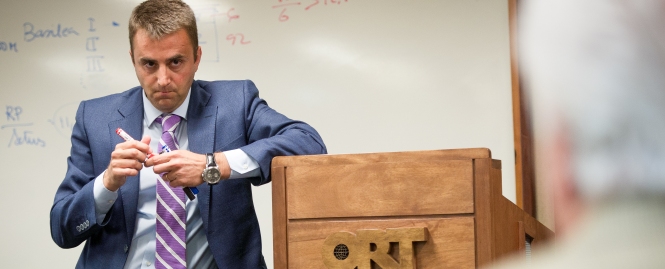
In this regard, Oscar Elvira, Ph.D. in Economics with a specialization in accounting and auditing, and Coordinator of the Master’s Program in Banking and Finance at Pompeu Fabra University, delivered a lecture titled “The Crisis of… Never Ending?” at the Faculty of Administration and Social Sciences of Universidad ORT Uruguay in Universidad ORT Uruguay on August 19, 2013. Elvira stated that “small signs of recovery” can currently be seen amid the crisis; however, these are due to external demand.
He provided an overview of the early days of the crisis, when “Spain was going around the world boasting that it had a central bank that was the envy of all of Europe.” “All of a sudden, savings banks began to be taken over,” he adds. One of the main triggers of this situation, he believes, is the irresponsibility of the executives at these savings banks. “In the end, their decisions don’t affect their own pockets, but they do affect those of their customers.”
Today, the savings bank model has disappeared, with only the most cautious ones managing to survive. On the other hand, the banking system is enormous, with numerous branches. “If you go to Spain, you’ll be surprised by the number of bars and the number of bank branches there are,” says Elvira. “It was inaction on the part of the Bank of Spain (she was referring to the bank that plays a role equivalent to that of the Central Bank of Uruguay). It had all the information but didn’t use it to put a stop to this.”
And the construction sector also played a leading role in this crisis. At one point, Spain realized that while in most countries this sector accounts for between 5% and 7% of GDP (Gross Domestic Product), in Spain it was 14%. “That’s way too high,” he said.
Many business owners turned their backs on their own businesses and found it much easier to get into construction. “I’ll sell my factory, buy some land, put on a hard hat, and start selling apartments,” Elvira explains. However, there are now a great many vacant homes, and, in Elvira’s opinion, the sector is unlikely to recover.
Elvira sees a major business opportunity in this sector. Her idea is, instead of looking for a home or a piece of land, to buy the debt (at a discount) that the bank has written off due to non-payment. What could happen? According to Elvira, two things. First, the debtor might not pay, and the buyer of the debt would end up with the land or the home. Or the debtor might pay, but the debt was still purchased at a discount.
He asserts that Spain is experiencing a significant rise in both public and private debt, which is causing growth to stagnate. “Why is public debt rising? Because the government is helping the private sector by issuing debt. So, it is Spain as a whole that is shouldering the entire burden,” he says.
In 2007, Spain’s debt-to-GDP ratio stood at 30%, and it is now approaching 100%, he added. However, he clarified that Spain’s problem is not its debt but the pace at which it is accumulating it. Spain is considering a bailout, but this comes with a political cost that Prime Minister Mariano Rajoy is unwilling to bear, he said.
Banking operations today are highly risky, and this has led many banks to close. Furthermore, debts are being paid off with the banks’ own funds, which is not advisable for the sector. Faced with this situation, there are two solutions: “Either you drastically reduce assets (by cutting off credit) or you raise capital, at a time when no one trusts me,” he says. “Those who are older should be careful. A world is being planned to ruin them because it won’t make sense to have money,” he noted.
Are Eurobonds the solution? “We’ve tried them before, and it just led to everyone going their separate ways. Germany is thrilled, and Greece is overwhelmed,” Elvira noted.
“Was 2012 a good year or a bad one?” Elvira asked herself at the end of the talk. “It’s the best year in history. Because never before has there been less hunger, fewer diseases, and more prosperity. Obviously, this isn’t coming from Western economies; it’s coming from the emerging ones. Maybe 2013 will be even better,” she says hopefully. “What’s wrong is getting complacent.”