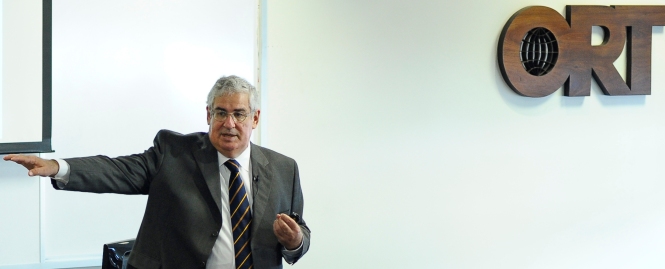
Universidad ORT Uruguay “Understanding Monetary Policy Trends in World Markets” was held at the Faculty of Administration and Social Sciences at Universidad ORT Uruguay was presented by David DeRosa, who holds a Ph.D. in Finance and Economics from the University of Chicago, is the founder and partner of DeRosa Research & Trading, and is a professor at the Foundation School of Engineering and Applied Science at Columbia University (United States).
The conference took place on August 20, 2013. Organized by CFA Society Argentina & Uruguay, the CFA Institute Research Foundation, and the School of Business and Social Sciences, it was a training event recognized by the Central Bank of Uruguay, which also awarded credits toward the CFA programme Continuing Education (CE) programme .
The talk was based on his book *Emerging Markets Central Banks*, commissioned by the CFA Institute Research Foundation.
“I finished writing this book just before the 2008 recession began. If I were writing a second volume today, what new topics would I include or expand upon?” he wondered.
And a number of things have changed since then. The broader issues of capital flows and “global imbalances” now seem even more complex, as was evident in the shortage of dollar-denominated financing following the collapse of Lehman Brothers.
Capital flows and global imbalances
DeRosa said that the determinants of capital flows were the most challenging topic when writing his book. Many economists (including some at the International Monetary Fund) are concerned that capital flows may be susceptible to sudden disruptions or even reversals. And the experience of many emerging market countries comes to mind, he said. But do global imbalances really exist on their own? Or are they created by a country’s financial policies, such as unstable exchange rate regimes?, he asked.
DeRosa discussed the shift of dollar-denominated assets. The accumulation of “dollar war chests” by central banks, an aging population driving strong savings motives, and the “Bernanke hypothesis” of global excess savings are some of the causes DeRosa attributes to this phenomenon.
In 2008, capital flows to the United States declined for a time. However, DeRosa notes that the risk was not of a sudden reversal or halt, but rather of what amounts to a contraction in financing. Furthermore, the real cost of dollar-denominated loans became exorbitant, he added.
2007–2010 “Dollar Squeeze”
The foreign exchange market, for its part, saw some interesting spillover effects, as local institutions turned to borrowing in their own currency (selling the local currency on the spot market to obtain dollars), he noted. In addition, dollars were simultaneously bought and sold at short-term interest rates. The situation was resolved when the Fed (Federal Reserve) and 14 other central banks established dollar swap lines, DeRosa stated.
The dollar swaps were conducted by the Fed and other central banks to ease what was described as "strains in U.S. dollar funding markets."
The expert then referred to a turning point in the economic crisis: the Lehman Brothers crisis. Lehman’s bankruptcy filing in September 2008 came as a major shock to the global financial system. The Fed and foreign central banks took proactive steps to ease tensions in the dollar funding markets.
The provision of dollar-denominated swap lines proved to be an effective policy, particularly in 2008, following the Lehman Brothers crisis, he said.
Quantitative Easing
Typically, a central bank implements its monetary policy by buying and selling short-term government bonds in the open market.
Monetary easing occurs when a central bank continues to expand the money supply by purchasing various types of assets.
This occurs in situations where the short-term policy interest rate is at or near zero, DeRosa said. This measure allows monetary policy to remain somewhat effective even when the short-term interest rate is near zero.
The big question, according to DeRosa, is when “quantitative easing” will end. Furthermore, several authors have reservations about this mechanism.
Conclusions
The Great Recession of 2008 has led central banks to pursue extreme, almost experimental monetary policies, Da Rosa said.
Dollar swap lines may have substantially eased the pressure on the dollar in 2008 and are now likely part of the standard central bank toolkit.
Monetary easing is a new and more radical monetary policy. Although it appears to have had significant and desirable effects on the stock markets—which ultimately hold the final say—the macroeconomic effects on output and employment are still difficult to discern. Furthermore, there could be serious side effects.
The crisis also made it clear that money is much more than just a medium of exchange; it is far more versatile and powerful than anyone ever imagined.