
At the 2014 edition of Salão Design Movelsul Brasil—Latin America’s largest product design competition—two entries by students in the Industrial Design program at Universidad ORT Uruguay awards in the Student Category. All award-winning projects can be viewed on the Salão Design Movelsul Brasil 2014 website.
A total of 585 entries were received from 15 countries; 93 projects from Brazil, Argentina, Colombia, Italy, and Uruguay were selected. In March, the winners will present their designs at the Bento Gonçalves Event Park (Rio Grande do Sul), where they will receive their awards.
FRANS Bank
Andrés Espina and Nicolás Noblía—students in the Bachelor of Industrial Design program—won first prize in the Outdoor Furniture category (student division) for their FRANS bench. Their instructor, Industrial Designer Pablo D’Angelo, received the Advisor Award for teaching the Industrial Design 3 course in the Bachelor of Industrial Design program.
The FRANS bench was developed as part of a family of urban furniture—for outdoor use, featuring a planter and a bike rack—and is an independent project by Andrés Espina and Nicolás Noblía.
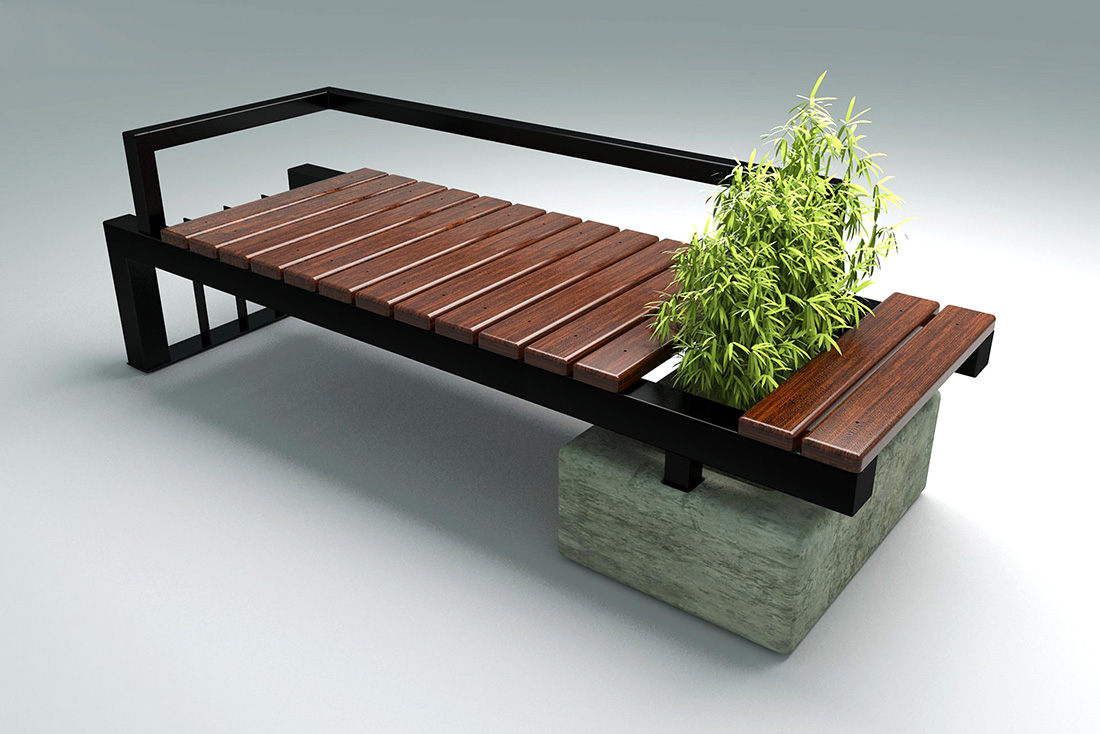
“Our goal was to design a line of furniture that breaks with tradition while maintaining a certain sense of restraint—furniture that serves as a subtle element in the urban landscape without clashing with its surroundings. Once we had the basic concept, we transformed the concrete base into a planter and added a bike rack to the bench, taking into account the prominence that bicycles have gained in recent years.”
The students said they traveled to Brazil by van, which was “quite an experience, given the weight and size of the pieces.” Once at the event hall, they weren’t able to see any other works: “Believe it or not, we were among the first to arrive, and the few projects that were there were still packed up; we won’t be able to see them until we attend the exhibition.”
Espina said that this recognition makes them very happy, but above all, it serves as “an incentive to continue growing in the professional path we have chosen.”
AVA Light Fixture
First prize in the lighting category (student division) went to the AVA luminaire, designed by Diego Chiola. In this project, DI Alejandro Trinidad was also recognized for his role as the faculty advisor for the Computer-Aided Design 1 course in the Industrial Design degree program.
Trinidad noted that AVA is essentially designed as a reading lamp. Among its strengths, he pointed out that it consists of two multiplex panels that snap together “very easily” and that “it can be placed in various spaces, such as the living room or bedroom.”
AVA has “very useful” has for reading, such as a shelf for books and magazines and an adjustable light height. In addition, AVA can be positioned in three different ways.
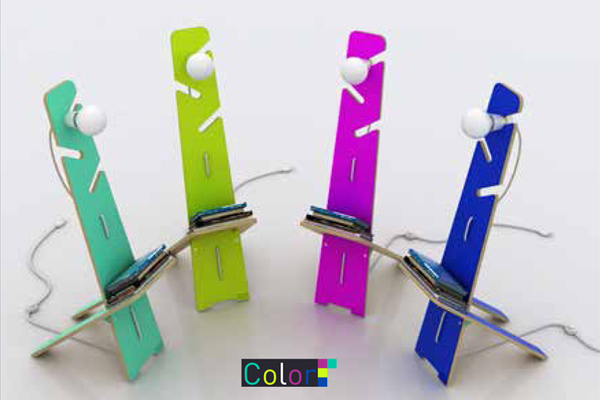 “I think it’s a very interesting light fixture,” Trinidad remarked. “It has a basic, simple design, though that doesn’t mean it was easy to create—quite the opposite: to achieve something simple that works well, you have to put in a lot of work. It’s also worth noting that it’s very easy to manufacture, and the graphic can be customized.”
Speaking about his role as a professor, Trinidad explained that he had to guide the design process, from the initial research through to the final design. “It’s not always easy. Often we have to discard proposals because they don’t work, because they don’t align with the initial parameters, aren’t productively viable, or are too complicated… and we have to come up with new options and solutions. We often stay after class trying to find ‘the solution’ to a specific problem.”
“In the case of AVA, I want to highlight the excellent design process that Diego carried out, from start to finish,” the professor noted. “Several study models were made, in cardboard and wood; specific details were examined, such as the joints, the overall dimensions, the shape and placement of the cutouts for the lamp, among others; and a great deal of work was done on the production side, aiming to make it simple to produce at a reasonable cost.”
The light fixture was developed in the Industrial Design 5 – Innovation course during the seventh semester of the bachelor’s degree program, and its prototype was displayed at the “Design Objects – Entrepreneurship” exhibition.