The Faculty of Engineering at Universidad ORT Uruguay activities related to video games, including a Scratch workshop led by Dr. Inés Friss de Kereki, a professor of programming at the faculty, and Marcelo Rubino, as well as a tour of the 3D prototyping lab, during an event attended by more than 40 students—both male and female—from the 10th grade at the German School and the 12th grade at the Escuela Integral.
By Thursday afternoon, the atmosphere in the lobby of Universidad ORT Uruguay changed.
Dressed in their high school uniforms, 43 students gathered at the School of Engineering, and from the very beginning, they were eager to participate in a fun and enriching activity.
Creativity and teamwork are two essential elements for learningScratch, a programming language developed by the Massachusetts Institute of Technology (MIT), which helps develop logical reasoning and teaches programming through play.
A small cat chasing a dinosaur or a car driving through the middle of the ocean are just two examples of the far-fetched stories created by the students’ imaginations. By using this tool, they saw the potential for applying it to the study of physics and biology, to name just two areas of knowledge.
"The goal of 'International Girls in ICT Day' is to encourage girls to pursue careers in technology, because the problem is that there is an increasing need for people working in this field."
Friss de Kereki explained the purpose of this event: “The goal of this day is to encourage girls to pursue careers in technology, because the problem is that we need more and more people working in this field. Given the current workforce and the pace of development, we don’t have enough people. We need to make sure that girls join the effort as well.”
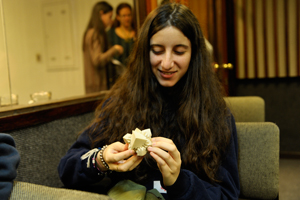 Following the Scratch workshop was a presentation by Sebastián Ruiz Díaz and Germán Canuti, both staff members at the 3D Prototyping Lab in the School of Communication and Design, who provided an in-depth look at the history and applications of this type of technology.
They then toured the lab and saw the Zprinter 150 3D printer (3D printing), the first and only one of its kind in the university academic sector in our country; as well as the CAMFIVE CMA6040KII laser cutter and engraver (2D laser) and the GULMI 600 CNC milling machine (3D milling).
The students were fascinated by the objects created in the lab and asked the experts numerous questions.
Before leaving, they visited the Videogames Station, where they tried out three games created by students from the Faculty.
At another booth, Mónica Carle explained how she created EduGames and the benefits she saw from teaching children to read using both the traditional method and the global reading method.
And at the end of the tour, they buckled up for a dizzying roller coaster ride using virtual reality goggles, which they unanimously described as “mind-blowing.”
This tour was led by the Simulation and Video Games Department, coordinated by Luis Calabria, M.Eng.
And so came to an end the adventure of the 43 high school students who visited Universidad ORT Uruguay. It was a day that combined learning and fun, and the experience was just as enriching for the students as it was for the teachers.
About “International Day of Girls in ICT”
The full-day event also included a panel discussion titled “Experiences of Women Working in ICT,” robotics activities, and visits to companies in the sector, held at LATU, Antel, the University of the Republic, and the Catholic University.
The event was organized by Antel, Plan Ceibal, the Uruguayan Chamber of Information Technology (Cuti), Greentizen, the IEEE (Institute of Electrical and Electronics Engineers), LATU/Espacio Ciencia, the Ministry of Industry, Energy, and Mining (MIEM)/National Directorate of Telecommunications and Audiovisual Communication Services (Dinatel), and Universidad ORT Uruguay.