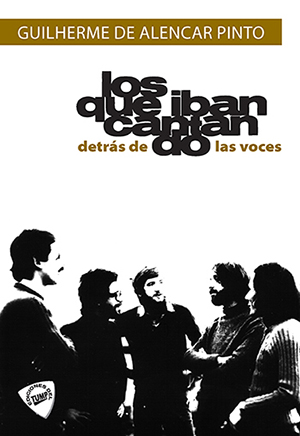
 Guilherme de Alencar Pinto was born in 1960 in São Paulo, Brazil, and has lived in Montevideo since 1986. He is a professor at Universidad ORT Uruguay , as a journalist, has contributed to various Uruguayan media outlets (primarily Gap and La diaria) and Argentines.
In this interview, the professor and cultural journalist reflects on the group Los que iban cantando and their contribution to Chilean music.
The book *Los que iban cantando. Detrás de las voces* was selected by the Ministry of Education and Culture’s Competitive Grants for Culture. It also received support from the National Music Fund and the Itaú Foundation.
What do you consider to be the greatest contribution of *Los que iban cantando* to Uruguayan music?
Los que iban cantando made a significant contribution to Uruguayan music. But if I had to choose just one thing to highlight, I would say it is the stance I call “political modernism.”
I borrow this expression from film theorist David Bordwell, and I find it perfectly applicable to the musical approach of *Los que iban*. Political modernism is the combination of left-wing political radicalism with the artistic avant-garde. It has its roots in formalism, according to which the form of a message also has its own content, and therefore is not merely a neutral vehicle for a message that exists outside that form, but rather is an inseparable part of that very message.
In political modernism, if I am opposed to the system, it is unsatisfactory and incomplete to write a conservative song whose lyrics say “The system is bad,” because it is assumed that, despite what the lyrics say, the poetic and musical forms are—at a deeper ideological level—supporting the system.
These principles led Los que iban cantando to seek out music and poetic forms that were out of the ordinary.
Many of those songs dealt with strangeness (an essential feature of all modernism or artistic avant-garde), but sometimes the unconventional took other forms: they could challenge the leftist aesthetic—which held that everything must be easy and immediately accessible—and produce some cryptic and/or complex songs.
But they also challenged the notion that only complexity has value, and wrote many songs based on the utmost simplicity. They challenged certain conventions in the categorization of musical genres and incorporated elements from genres that had previously been largely isolated—such as murga and tango—into popular music.
The approach of *Los que iban cantando* consisted, then, songs that not only “spoke out,” in words, against the dictatorship and the social factors that supported it, but also sought to shift deeper ideological structures, which were embedded in certain musical and poetic conventions that they challenged, with the primary goal of breaking down prejudices and opening up the possibility of perceiving connections that are normally overlooked. Always placing reflection and awareness as an essential condition, inseparable from agitation and action.
Normally, only a small elite is willing to listen to “strange” songs: most people prefer to find elements of confirmation in songs; it is neither pleasant, entertaining, nor comfortable to be challenged. However, under the dictatorship, with communication restricted by censorship mechanisms and other forms of repression, the public that shared the anti-dictatorial stance necessarily had to make a special effort to decode songs that, through subtle, uncensorable, somewhat cryptic means, conveyed what needed to be conveyed.
This gave rise to the very unique situation of a fairly large audience that did make the effort to engage with the songs of Los que iban. The group emerged in early 1977, and a year later, a massive and diverse phenomenon had already taken shape: popular song. Los que iban were a fundamental part of the formation of that movement and, within popular song, of a sector that I consider particularly valuable, which incorporated, following the example of Los que iban, the stance of political modernism: people like Leo Maslíah, MonTRESvideo, Rubén Olivera, Rumbo, and a few others. That movement was very strong for several years, constituting, in my view, one of the most interesting phenomena in global songwriting around 1980.
You are a scholar of music and sound. What are the main melodic innovations the group introduced during its most productive decade?
Los que iban cantando focused heavily on minimalism: creating maximum expressive intensity with a minimum of elements. As a result, the group’s repertoire features melodies composed of very few notes, articulated in a distinctive, fragmented manner designed to draw attention to their own mechanisms.
Why did the premise of *Los que iban cantando* resonate so deeply with you that you decided to undertake such an in-depth study?
The first Uruguayan music I ever heard was Leo Maslíah. The second was Los que iban cantando. Both captivated me right from the start. Perhaps because a somewhat experimental approach to music is like my musical “home.”
I’ve always loved music, but the first thing that really captivated me, when I was nine years old, was Stravinsky (through the dinosaurs Walt Disney used to “visualize” *The Rite of Spring* in his feature film *Fantasia*). So my childhood fascination with dinosaurs led me to Stravinsky and from there to an early familiarity with dissonant chords, non-classical harmonic structures, irregular melodies, and complex forms.
In my personal experience, being able to enjoy a simple, traditional folk song was quite an achievement, because it’s the other kind of music that tends to come more naturally to me.
Well, there’s a general consensus that, after the experimental spirit that dominated the sixties and seventies, the eighties tended to be more conservative, and I’d been feeling quite saddened by that wave of glossy pop conservatism. Discovering Los que Iban, Maslíah, and soon after Olivera, Roos, Mateo, Cabrera, and Darnauchans was a huge relief. I felt a strong connection to that unique little island in the global music scene that was Uruguay during those years.
I chose *Los que iban cantando* because of its seminal nature, and also because it was a group made up of soloists who were very different from one another, offering the chance to explore a wide range within that scene that interests me so much.
In the book, he mentions that he first heard them in 1980, a few years after the group was formed. How significant do you think the band’s expansion into other countries in the region was?
My familiarity with *Los que iban cantando*, and that of a few close friends in Brazil, was purely by chance. *Los que iban* and Uruguayan music in general are virtually unknown in Brazil.
The only country where Los que iban made an impact outside of Uruguay was Argentina, where they played a few times and had, for quite a few people, the same refreshing effect they had on me and my group of friends. It was a joy to discover, while working on the book, that Los que iban’s impact in Argentina—which I had thought was just a fleeting phenomenon—actually left a lasting mark and had lasting consequences.
These influences can be seen in the work of some younger contemporaries of Los que iban, such as the fascinating composer Carmen Baliero, but what’s most wonderful is finding them in a newer generation—people in their twenties or early thirties, the children of those who saw Los que iban in person: the duo ¡Ahí Vienen! chose their name specifically as a tribute to Los que iban, a major influence on its two members, Zelmar Garín and Eduardo Herrera. The Ensamble Chancho a Cuerda performs a beautiful rendition of Ciertas canciones de Los que Iban. Rodrigo Ruiz Díaz, a member of Chau Coco!, also acknowledges the group’s strong influence.
Among this younger generation, the influence of Los que iban is perhaps stronger in Argentina than in Uruguay, and has had a greater impact on the music scene.
I propose a thought experiment, not to invent a fictional account of what might have happened, but to try to understand a little better the place of *Los que iban cantando* within the landscape of Uruguayan music. If the group hadn’t emerged, would popular music have emerged in the country anyway? Under what conditions?
In this game of speculation—and making it clear that this is exactly what it is—I tend to think that everything would have been completely different without *Los que iban cantando*. That everything would have been more “normal,” with the most radically creative music confined to a tiny elite largely detached from the political sphere.
I believe that Los que iban decisively paved the way for a more aesthetically adventurous style of song linked to the sociocultural context of the dictatorship. They weren’t the only ones with that attitude, but they possessed a special strength rooted in the group’s internal diversity and variety, because each member was very different from the others. Jorge Lazaroff, Jorge Bonaldi, Jorge Di Pólito, Luis Trochón, and Carlos da Silveira are very different from one another. The group itself already seemed like the mother cell of a multifaceted micro-movement. Moreover, I tend to think (and I argue this at length in the book) that popular music in general (not just that “modernist” sector) needed Los que iban to fully take shape in the broad and representative form it eventually attained. Because several of those who would become important figures in popular music were already performing before 1977, and they did so with the same attitude they would later adopt in popular music. But none of them had—as Los que iban did—a rock background, an urban lifestyle with which a university audience could identify, and ties to a radical but non-communist left. It was as if that piece was missing to close the circle, and it is interesting to see how, starting with the emergence of Los que iban in 1977, everything began to come together toward the explosive growth of that massive movement that was popular music.
In the press of the time and in various accounts written a few years later, it is very common to attribute the origins of popular song to *Los que iban Cantando*. This is undoubtedly an incomplete view, but it is well-founded.
Today, more than thirty-five years after their emergence, where can we see the legacy of Los que iban cantando?
Starting with the most obvious: the albums they managed to record (both as a group and by individual members as solo artists), which are wonderful and are out there for anyone who wants to listen to them. Because the significance of Los que iban lies not only in their historical role or their exemplary attitude: whatever they set out to do, they did it with a rare technical virtuosity and dazzling imagination (in composition, performance, and arrangement).
Their legacy is also clearly evident in the work of the three surviving members who remain active in music—particularly Jorge Bonaldi and Jorge Di Pólito—but also in the work of Pitufo Lombardo (who joined the group during its final months in 1987). They were a major influence on several musicians who are still active today—and who likely wouldn’t be exactly who they are if they hadn’t been shaped by the impact of Los que iban—such as Maslíah, Mauricio Ubal, Rubén Olivera, and Fernando Cabrera. This extends to the younger generation, people who didn’t quite make a name for themselves in popular music but began performing later: Asamblea Ordinaria, Guillermo Lamolle, Fredy Pérez, Ney Peraza, Tercera Fundación, Gabriela Gómez, Riki Musso, Sergio Aguirre. Several of them were students of either Lazaroff or Trochón. And although none of these musicians is extremely popular, they helped maintain a space—a need, however niche it may be—for a more restless, less conventional music, which manifests itself in even younger people, some of whom are directly influenced by Los que iban and others who are not, they nonetheless breathe that same air: Diego Azar, Santiago Lorenzo, Andrés Mastrángelo, Alessandro Podestá, Cucú Rapé, Ximena Bedó, and others.
But there is one thing that has had a profound influence on all popular music today, on a massive scale: the connection to the murga. Those who were involved were neither the first nor the only ones to work in that direction. The first were Los Olimareños. But that path was interrupted by the 1973 coup, and those who picked it up again, simultaneously, during the first three months of 1977 (and as part of the same movement) were Jaime Roos, Los que iban, and Contraviento.
At first, it was the members of *Los que iban* who exerted the strongest influence. The murga’s presence in the song grew exponentially during the heyday of popular music and then during the height of Jaime’s success. But there’s more: Lazaroff played a crucial personal role in the formation of Falta y Resto, which, alongside La Reina de La Teja, represented a new type of murga—emerging from that era when murga was permeating popular song (1981)—and now reflecting it back like a mirror, in the form of a carnival murga deeply attuned to the Uruguayan songs of the time.
So, Los que iban are also present in La Falta and in murgas influenced by it. In fact, in recent times, much of La Falta’s music was composed by Felipe Castro (Lazaroff’s nephew) and by Andrés Lazaroff (his son) in a style in which I recognize a lot of Jorge Lazaroff and Los que iban (and which is, curiously, quite different from what Felipe and Andrés do outside the murga).
What’s more, Trochón was the founder of TUMP (Uruguayan Workshop of Popular Music), which has trained thousands of musicians for over thirty years. Among other things, TUMP conceived Murga Joven, and to this day coordinates the “mentoring” of young murgas. It is common to hear melodies by Lazaroff or Los que iban, or by soloists who were TUMP students, in young murgas. Consider La Mojigata, which emerged from Murga Joven (just one example among many). Lamolle—a student of Lazaroff and the TUMP—incidentally also leads one of the most creative murgas, La Gran Siete.
In addition, Bonaldi was part of the group *Canciones para no dormir la siesta*, where he helped pioneer a highly influential approach to children’s songs. He continues to work in the field of children’s music to this day, performing for thousands of children every year.
As you can see, even if it doesn't seem like it, the legacy of *Los que iban cantando* is enormous.
And then there’s the special case of Suri (Diego Cotelo), who wasn’t familiar with Los que iban cantando but read my book, felt inspired to seek out and listen to the group’s music, and was so deeply moved by it that he ended up recording *Mudanzar*, an album of covers of other artists’ songs, in which he explores that experience. And it turned out amazing! It’s available for free download. The joy that gave me more than makes up for the five years of intense work it took me to prepare this book.
Do you think that academia, the media, the public, and musicians in your genre have given you the recognition you deserve?
The music scene certainly doesn't. Generally speaking, Los que iban cantando seem to be off most people's radar. The press pays them very little attention, the public has forgotten about them, and young people aren't even aware that the group exists.
The musicians I was referring to are the ones who keep the flame alive.
But I recently learned that a book is about to be published in which the composer and musicologist Graciela Paraskevaídis compiles and annotates the texts written by Lazaroff. This is excellent news, and I hope it will help, along with my book, to reconnect the public with that treasure of Uruguayan culture—the music and spirit of *Los que iban cantando* and its members.