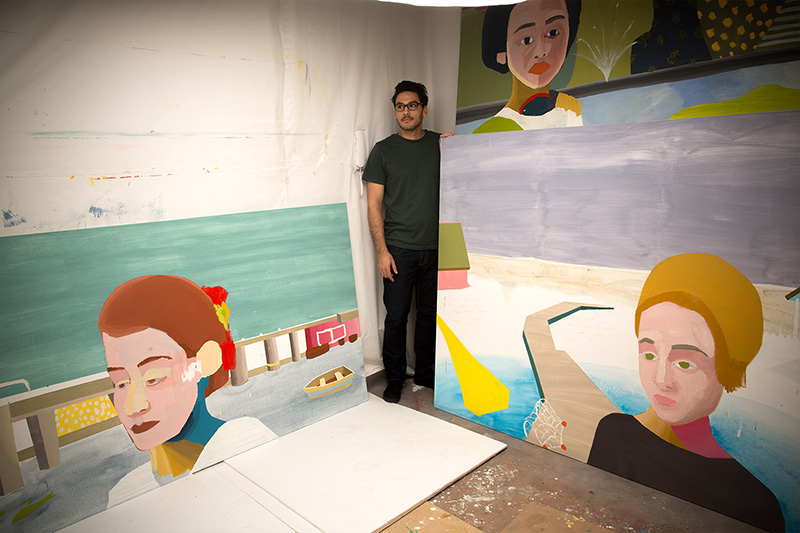
How has your training as a graphic designer influenced your development as a painter?
I've always loved design, but with painting, the two developed in parallel—it wasn't as if one influenced the other. Generally, as I begin to put things together, I realize that having studied design has had a major influence on me, not only in terms of how I prepare my work but also in terms of aesthetics.
These days I work in a more modular way. Usually, when you design, you place elements in a very deliberate way; you don’t leave much to chance. Visual art, on the other hand, often plays much more with that—with things that surprise you along the way. With design, we might have a very fixed idea and try to execute it in the best possible way. That’s how I’m working right now: I try to capture the idea quickly and work on the first draft.
How did Santiago Paulós become an artist?
I don't know exactly; it just happened very naturally for me. It gradually took shape, and I started to place more and more importance on it. In any case, the first recognitions that started coming in, like the Batuz Prize in Germany, made me realize I could do something with this and motivated me. Then the trip to Spain showed me something I didn’t know about and that interested me: young artists making a living from art, being able to study abroad, and seeing a little more of what was happening locally.
How would you describe your approach to work?
When I first started out, I might have used a poster, for example, as an excuse to begin working, and from there I would develop my ideas; formally speaking, what I did was add elements to arrive at something new. Today my methodology is completely the opposite; I’m working more from ideas and synthesis: I develop a series of images, then I ask myself why I made them, I try to see what they have in common, or what the point of interest is for me, and then I focus more on the theoretical aspect. My interest lies in saying the same thing but with far fewer elements.
What inspires you?
I believe in connection more than inspiration—in those moments when your thoughts are the clearest. That connection happens when you’re working on something; it can happen while you’re walking but your mind is focused on something else, and all you do is develop that idea.
In my case, those moments happen when I’m really inspired by my surroundings, when I’m absorbing all sorts of things, like reading about topics that interest me.
In your early days, many of your works featured faces. What did they convey to you?
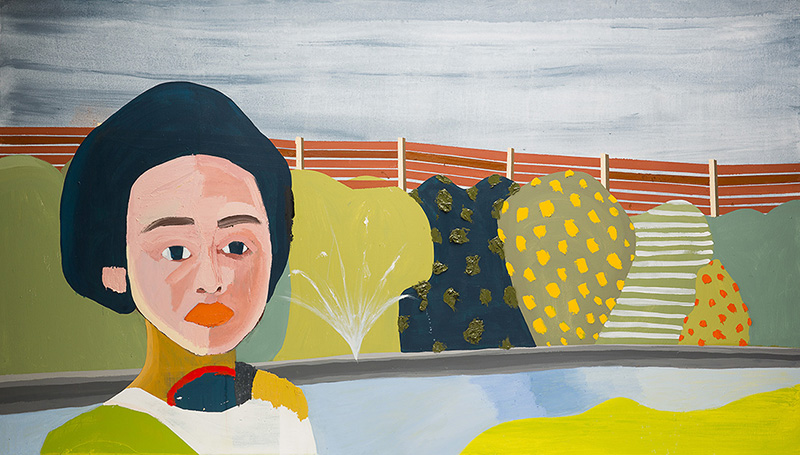
I started with the human figure because it was what appealed to me most and resonated with the image that was present within me and within people in general: faces are what we’re most accustomed to seeing. We associate that image with everything; it’s something deeply ingrained in us, and in that sense, I was trying to foster a sense of empathy with the viewer, so they would feel recognized.
Over the years, that idea gradually evolved; while the human figure remained, the process changed. Today, my work aims to eliminate the human figure, leaving only the settings so that the viewer can immerse themselves in the piece.
How did your opportunity abroad come about, and how did it change your perspective?
In 2008, I applied for a one-year fellowship at the Antonio Gala Foundation in Córdoba, Spain.
Experiences in other countries and with other cultures and languages always help you grow culturally and ideologically.
On a formal level, it gave me the opportunity to explore certain topics that I had previously approached more intuitively, and suddenly I discovered that other people had studied the very things I was interested in learning about, and I’ve been able to benefit from that.
When do you consider a project finished?
I think the time I devote to my work serves as a very good filter. Often, when something interests me, I set it aside for a while, look at it every day, and then decide whether it’s worth pursuing or not. That timeframe varies and depends on the demands I’m facing at the time.
Tell us about your next project.
I plan to continue my master’s degree in Edinburgh and, at the same time, work on a project in Florence through an opportunity offered by The Royal Scottish Academy to ten graduate students, based on research into the Italian painter Ghirlandaio, whom I find very interesting. Then, perhaps, I’ll develop something from that.
* This interview was conducted by Cinthia Torres, a contributor to the In situ website and a graphic design student.