The extensive use of wood in large-scale architectural and civil engineering projects has recently caught the attention of prestigious architects and engineers on the international scene, following the development ofcross-laminatedtimber (CLT), which, together with glued laminated timber and the use of structural analysis software, enables great flexibility in the design and construction of buildings and bridges.
This, combined with growing concern for the environment, has established wood as “the material of the future.”
These ideas are also beginning to take shape in Uruguay, albeit tentatively. In particular, this is happening through various initiatives that aim to position wood as an alternative yet complementary material to traditional construction methods.
Learn about all the degree programs offered by the School of Architecture
New diploma
Since 2009, the Research Department of the School of Architecture at Universidad ORT Uruguay working on research and development projects in the field of wood science and technology.
Together with faculty members from the Institute of Structures and Transportation at the School of Engineering of the University of the Republic (Udelar) and professionals and technicians from the Department of Forestry Projects at the Technological Laboratory of Uruguay (LATU), they have formed an inter-institutional research team that, since 2013, has been collaboratively developing projects related to the structural characterization of domestic woods and glued laminated timber, as well as the production of technical documents for wood structures and construction.
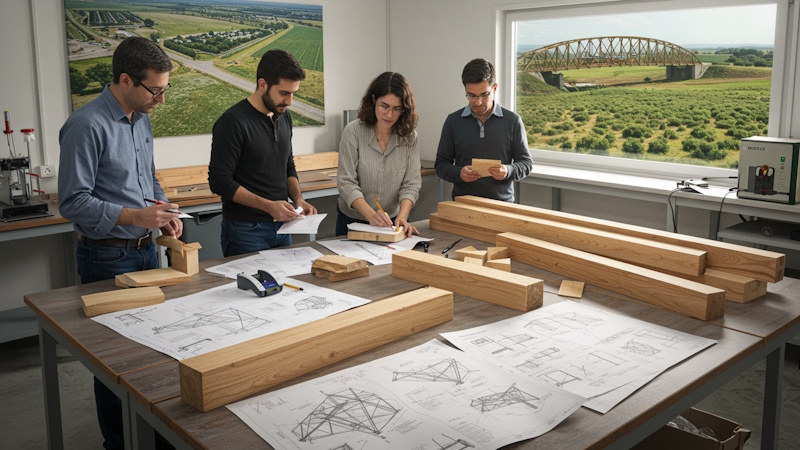
In addition, the ORT School of Architecture and the Udelar School of Engineering have recently completed a research and construction project involving a full-scale wooden bridge designed to accommodate heavy agricultural and forestry vehicles, located in Las Brujas, Canelones.
As a result of this collaboration, both schools have developed a graduate program leading to a Specialization Diploma in the Design, Analysis, and Construction of Wood Structures.
This diploma program, jointly offered by both faculties, is the first graduate-level academic program in Uruguay designed to train highly specialized professionals in the field of timber structures. It is a one-year program, scheduled to begin in August 2017.
Use of structural timber
There are several reasons behind the faculty’s decision to contribute to training, research, and the promotion of structural timber.
The extensive use of wood in architecture is consistent with the argument that natural resources should be used efficiently and that the negative effects of carbon emissions should be mitigated as much as possible.
The goal is to promote the use of a material derived from a natural, renewable resource whose production requires less energy than other materials; once put into use, it sequesters carbon throughout its entire lifespan, and its widespread use enables the construction of energy-efficient and environmentally responsible buildings.
Although until recently the supply of timber for structural use in Uruguay came from abroad, it is now possible to find domestically produced timber. This change is the result of government policies that have been in place since 1985, and in particular since the enactment of Forestry Law No. 15,939 of 1987, which promoted the planting of fast-growing exotic tree species.
As a result, Uruguay has one million hectares of planted forests (primarily pine and eucalyptus), of which about 80% are forest-certified (SPF 2016). Part of this forest area is harvested for industrial purposes, including the production of pulp, solid wood (sawn and roundwood), and wood-based panels (plywood and MDF).
Given that the minimum harvesting age for trees used in structural timber production in Uruguay ranges from 18 to 25 years—depending on the species, soil type and location, and climatic conditions, among other factors—it is likely that some of the forest stock planted three decades ago is now being harvested for structural timber and is available on the local market.
Given this supply of domestic timber and the goals of the Tripartite Forestry and Timber Sector Council to incorporate 100,000 m³ of timber into the production of housing and furniture (MIEM 2012), the development of wood-based construction technology presents both an opportunity and a challenge:
- For the forestry and timber industry, this presents an opportunity to add value to the raw material, as well as the challenge of bringing high-quality structural timber and engineered wood products to market.
- For the construction industry, there is an opportunity to build structures using renewable materials that contribute to carbon sequestration and, therefore, to environmental health, as well as the challenge of incorporating wood-based materials and related technologies as a viable alternative to traditional methods.
- For government agencies, this presents an opportunity to promote the use of a renewable resource that is readily available in the country, as well as the challenge of developing regulations and promoting the drafting of standards related to wood construction.
- For educational institutions, this presents an opportunity to stay up to date with the latest trends in design and construction, as well as the challenge of incorporating relevant courses into their curricula and developing programmes at training professionals, technicians, and workers who are familiar with or specialized in wood construction technology.
Wood construction
Construction systems that make extensive use of wood offer a number of advantages over other systems and materials.
It is worth noting the comfort and performance offered by a building with a wood-frame structure, which are comparable to or superior to those of a traditional building.
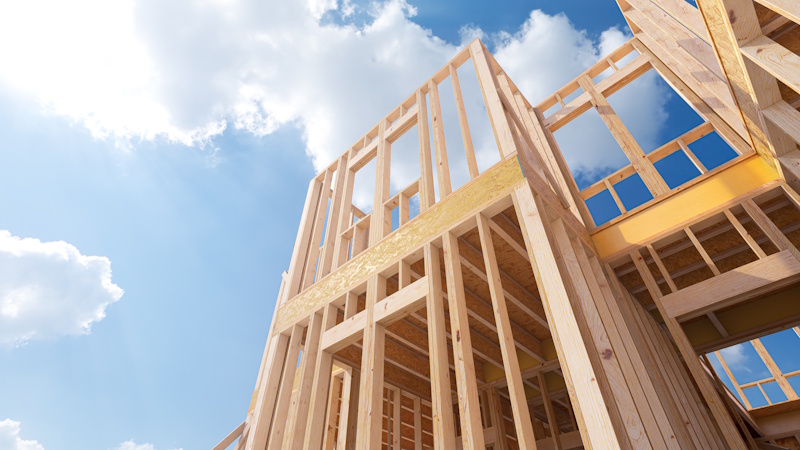
In particular, the light-frame construction system, typically used in programmes ranging from one to three stories in height, allows for the installation of thermal insulation materials in the spaces between the studs and in the gaps within the building envelope structure.
The construction system includes the installation of a water-repellent barrier that “envelops” the building and ensures its airtightness. The materials and technology used in this construction system prevent the formation of “thermal bridges” on the building’s facades—a result of the differing thermal conductivity of the materials used—and thus prevent the growth of mold and mildew.
Other key advantages include the ease of assembling the system’s structural components, thanks to their light weight and high strength compared to other materials, as well as the speed of assembly, since the joints between components are secured with nails, screws, bolts, and metal connectors.
Both of these factors help reduce construction time and, consequently, the final cost of the project. For example, in Uruguay, a 65-square-meter home built using traditional materials and techniques generally takes at least five or six months to complete, a timeframe that can be reduced by a third, particularly when using light-frame construction systems.
- You might be interested in:Master's Degree in Wood Construction
Architecture and Civil Engineering
Traditionally, the construction of buildings and civil engineering projects in Uruguay has limited the use of wood and wood products to a few isolated examples. However, in recent years this situation has been changing slowly but steadily, and examples of buildings with wooden frames can now be seen in various parts of the country.
In the public sector, the social housing projects carried out over the past five years by the National Housing Directorate (Dinavi) of the Ministry of Housing, Land Use Planning, and the Environment, in cooperation with the municipal governments of Rivera and Tacuarembó, are noteworthy for their quality and scale.
Since 2011, these institutions have adopted wood-frame construction technology for housing projects carried out under the Settlement Relocation Plan. To date, approximately 100 single-family homes with wood-frame structures have been built, all of which meet the quality standards established by Dinavi.
In the private sector, there are several examples in programmes and sports programmes . In most cases, wood construction technology is used for “second homes,” typically in resort areas, or for roof and mezzanine structures in “primary residences.”

Other programmes the use of engineered wood products, such as glued-laminated timber, in three-hinged truss structures for a pool at the Arapey Hot Springs, and glued-laminated timber beams for the roof of the pool at the Lawn Tennis Club.
Among the civil engineering projects built using domestic timber, the design and construction of the 8-meter-span wooden bridge for heavy vehicle traffic over the Las Brujas Creek—inaugurated in December 2016—stands out. The bridge, which features a cross-laminated timber deck and glulam beams made from domestic pine, was designed, engineered, and constructed in accordance with national and international standards.
Internationally, there are numerous examples of wood architecture. The global trend in residential architecture is moving toward the development of high-rise buildings, driven by the emergence of CLT. A pioneering example built in London in 2009 is the Stadhaus N1 residential building, a nine-story structure built entirely of CLT; other examples using the same technology include theForté building in Sydney and the Treet building in Bergen, both of which are 10 stories tall.
In Nashville, the Candlewood Suites on Redstone Arsenal was built in 2016, marking the first hotel in the United States constructed entirely from CLT. In Bordeaux, the construction of the Hypérion project was announced last year; it will include two 18-story towers, each 50 meters tall.
Learn about all the degree programs offered by the School of Architecture
Barriers
The main factors preventing the adoption of wood and engineered wood products as structural materials include: cultural biases, a lack of familiarity with construction technology among professionals and technicians, the absence of technical specifications for domestic structural timber, and the lack of a regulatory framework to support its use.
While the first two could be addressed through outreach and promotional strategies, the others require research as well as government support and leadership.
Need for research
Information on the structural properties of wood from tree species planted in Uruguay and of certain engineered wood products is still limited and requires further research. Based on this information, it is necessary to develop a quality system that establishes the requirements a wood component must meet for structural use.
These requirements include specific values for its mechanical and elastic properties (such as bending strength and stiffness) as well as for its density and moisture content, among others. In countries developing wood construction technology, there are “strength class” systems, where each structural class is defined by a set of structural properties. For practical purposes, this system is reflected in a “certification stamp” affixed to each piece of wood, which identifies its strength class and thus its properties.
Uruguay does not have a quality assurance system for domestically produced lumber, so it is not possible to find domestically produced structural lumber (sawn and glued-laminated) with a certification label. However, for several years now, certified pine lumber from the southern United States has been available on the Uruguayan market.
Award for Innovation
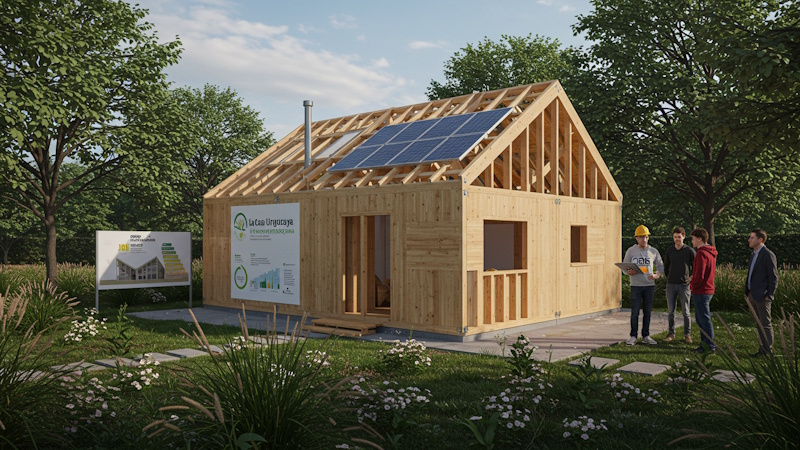
In addition to the Specialization Diploma in the Design, Structural Analysis, and Construction of Wooden Structures—a result of the Faculty of Architecture at Universidad ORT Uruguay wood construction—the following initiative was launched in 2015 La Casa Uruguaya, a project designed by a multidisciplinary team of 33 students and eight faculty members from the university, which wonfirst prize in the 2015 Solar Decathlon Latin America and the Caribbean international competition.
This sustainable architecture competition, considered the most prestigious internationally, was created in 2002 by the U.S. Department of Energy with the aim of educating, raising awareness, and promoting understanding of the importance of using renewable energy and preserving the environment. After several editions, the competition was held in Latin America for the first time in 2015.
In November 2016, La Casa Uruguaya the National Energy Efficiency Award in the Buildings category, presented by the Energy Directorate of the Ministry of Industry, Energy, and Mining. La Casa Uruguaya, which measures 75 square meters, was designed and prefabricated using a modular wood system, allowing it to be fully assembled in 15 days.
has “second skin” that acts as an insulating barrier, keeping heat out in the summer and cold out in the winter. The home has home automation system that allows users to adjust settings to create comfortable conditions using a smartphone or tablet with an internet connection.
Learn about all the degree programs offered by the School of Architecture