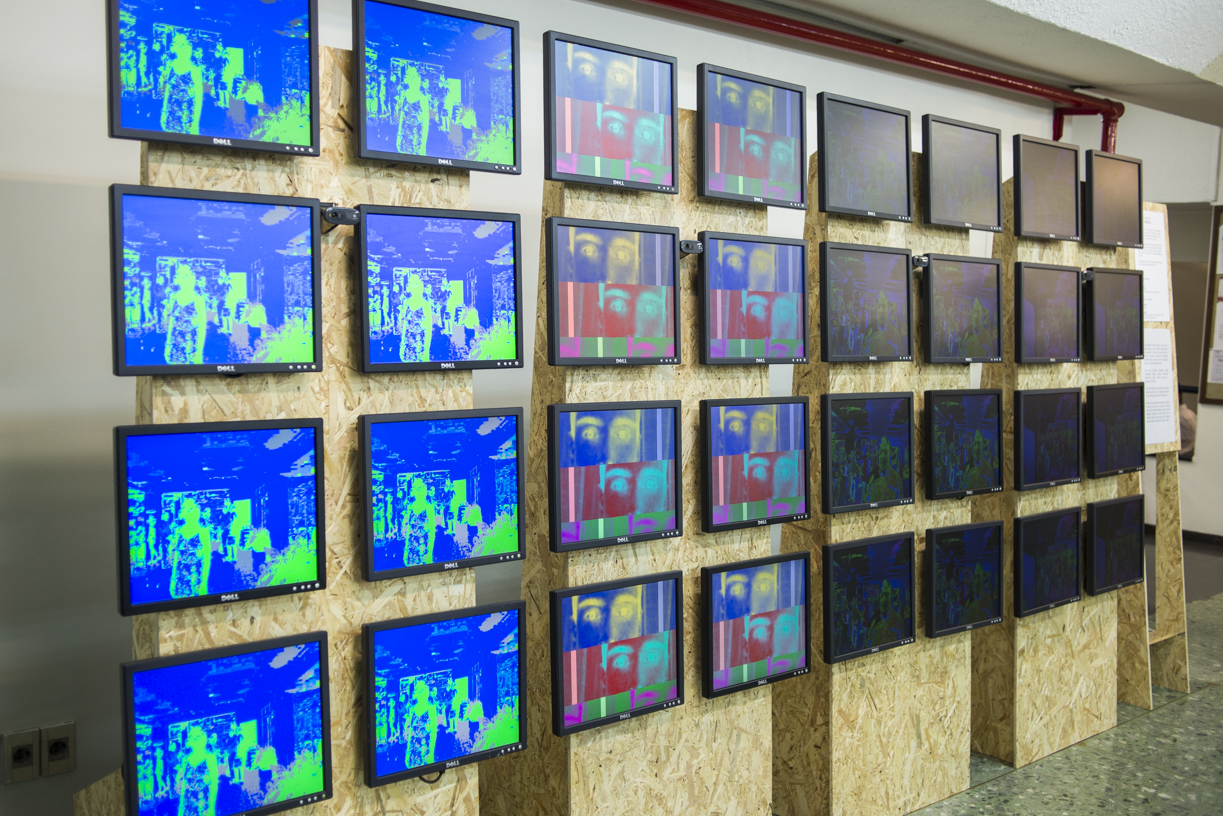
This is an interactive digital installation developed by Fabián Barros, Ph.D., professor of Multimedia and Digital Arts in the School of Communication and Design, in collaboration with students and faculty from the Engineering, Industrial Design, and Multimedia Design programs. The installation will remain on display through March 31, 2016.
In this context, electronic musician Hernán González, who teaches the Production Workshop, will perform a live set inspired by the images in the installation.
There will also be student works, such as multimedia projections on the walls of the central courtyard, during an evening focused on participant interaction with a variety of artistic and technological developments across diverse fields of design.
In the work Reciprocal Influence, the artist combines obsolete and current technology. “We use discarded hardware from our storage facility as a way to recycle materials and highlight the university’s historical connection to technology. At the same time, the software was developed specifically for the project, based on our own research and the adaptation of open-source code,” explains Mr. Barros, the project director.
A series of 32 monitors connected to four computers project manipulated images of students, faculty, staff, and alumni of the institution.
The images represent the trace, the mark left by each of these individuals. “There are more than 8,000 images that demonstrate a sense of belonging to the institution,” notes the project lead.
In addition, each computer is connected to a webcam, causing the installation to change its display pattern when a user approaches. The monitors stop displaying random images and begin showing the user’s image, which is also altered.
Once the user moves away from the interaction zone, their image is added to the series of altered images, so that person also begins to “leave their mark.”
The installation is made possible by the multidisciplinary and collaborative work of faculty and students in the fields of engineering, multimedia design, and industrial design. Roles and tasks were defined, and the first prototype was developed within 10 days. “Its creation relied on the contributions of diverse talents, and, like any multimedia work, it would not have been possible without the coordinated efforts of designers, programmers, and artists,” Barros explained.
The team in charge
Concept and overall direction: Fabián Barros
Programación:
Federico Márquez
David Rivero
Industrial design:
Carlos Galarraga
With the support of:
School of Communication and Design, School of Engineering, Gamelab, and the Center for Innovation and Entrepreneurship (CIE).
The event is organized by the department's Multimedia and Digital Arts Program. Admission is free.