The challenge lasts just over four hours. There are two groups of four people, and each group must lock themselves in a room with no internet connection and no contact with the outside world. The goal is for the group to work together to come up with a solution to the same problem and present it to a panel of experts, who will select the best proposal. Only one group will be declared the winner and will have the chance to advance in the competition.
Adrenaline is pumping, and all the senses are on high alert. It’s not a sport, nor is it a secret mission. It’s, quite simply, an intellectual battle. The occasion: the 2018 MBA International Case Competition, the most prestigious international case competition in the business world, which has been organized for 37 years by the John Molson School of Business (JMSB) at Concordia University in Montreal, Canada.
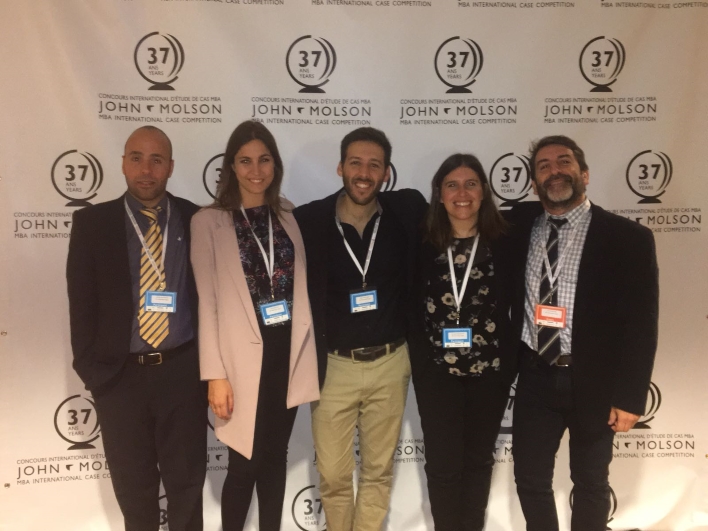
This year’s event, held from January 1 to 6, 2018, in Montreal, Canada, saw the first-ever participation of a Uruguayan team. The students from Universidad ORT Uruguay Elisa Marizcurrena, Gustavo Moreyra, Camila Pérez Basso, and Daniel Segovia, supported by Professor Dr. Luis Silva Domingo and the Zonamerica Innovation Fund.
Each year, the competition is open to MBA teams from top business schools, and this 37th edition featured 36 schools from 19 countries, including Smurfit Business School (Ireland), Schulich School of Business (Canada), University of South Carolina (United States), University of Pittsburgh (United States), FIA (Brazil), Xiamen University (China), Lund University (Sweden), Nanyang Business School (Singapore), Ben-Gurion University (Israel), and HHU (Germany), among others.
In total, the event drew nearly a thousand people, including 300 students and instructors (coaches), 300 business executives who served as judges, and more than 300 volunteers, with the support of sponsors who see this as a great opportunity each year to network and connect their brand with this community.
Just like the World Cup
"The format is similar to that of the World Cup," Silva Domingo explained. There are six groups, each consisting of six schools. In the first round, every team plays every other team in its group, so the first five matches of the tournament are guaranteed. The subsequent matches will depend on the results of each game. The teams that receive the highest scores from the judges advance to the second round, and so on until the final. Each match is played under the specified conditions.
In that edition, Uruguay was in a group that also included the Goodman School of Business (Ontario, Canada), the David D. Reh School of Business (New York), the Suliman S. Olayan School of Business (OSB) in Beirut (Lebanon), the Escola de Negócios da Universidade do Porto (Portugal), and the host, the local JMSB. Several of these schools have already won previous competitions, so, to use a soccer World Cup analogy, they could be considered favorites.
The four Uruguayan students, gathered for the allotted three hours in a secluded room, analyzed the five unpublished cases presented by the judges at the start of the session. These cases typically involve management situations at various companies. In one of them, for example, the scenario involved a company that delivers boxes containing various beauty products, and the challenge was to find a way to halt the gradual loss of subscribers, reduce high logistics costs, and define the best strategy to address growing competition resulting from technological advances in e-commerce.
Then—relying solely on their skills, knowledge, and experience—the team had to present their proposal to a panel of five business executives serving as judges, who evaluated the quality of the presentation, as well as the team’s ability to understand the problem and propose an innovative, viable, comprehensive, and strategically sound solution.
Each judge provided feedback detailing the team's strengths and weaknesses and compared its performance to that of the other group in each of the five cases analyzed.
The experience
The packed schedule of academic and networking events left no time for rest. The remaining time was spent taking advantage of the learning opportunities, which were numerous and enriching for everyone.
The students had to present their proposals in English to top executives from major companies (such asvice presidents from the Royal Bank of Canada and Bombardier), whom they were meeting for the first time; they also had to understand and develop a viable and innovative solution to a business challenge in unfamiliar markets.
But beyond that, learning also takes place through interaction with students and teachers from different countries and religious backgrounds, deepening their cultural awareness of both differences and similarities.
“It was an opportunity to put everything we learned into practice,” said Elisa. “It was definitely the best academic experience. Through it, we were able to consolidate our knowledge and apply the various tools we learned during the MBA, maximizing our potential,” added Gustavo.
The team from Universidad ORT Uruguay two of the five matches it played in the first round, a result that even the judges noted, since first-time teams generally don’t tend to win. It’s not just a matter of knowledge, explains Silva Domingo, but also of understanding the dynamics, knowing what the judges expect, and how information should be presented in these types of competitions, among other factors.
That’s why, for Camila, every part of the competition is a challenge. “It also gives you a broad perspective on the different problems you’re asked to solve,” she said.
Daniel agrees with his classmates: “The accumulated fatigue and the pressure of the competition add an unparalleled element to a demanding yet immensely rewarding experience. Without a doubt, it’s one of the best experiences of my academic and professional training,” he said.