When asked what a platform for booking a flight, ordering a pizza, or reserving a movie ticket have in common, the answer seems obvious: they are all globally successful software applications. The more interesting question would be: why are they so successful? And the answer lies in the users and their ability to interact with this software in an intuitive, natural way.
Information and communication technologies (ICT) owe their success not only to the technical aspects of how they work but also—and above all—to the psychological aspects, to the connection they can establish with their human users.
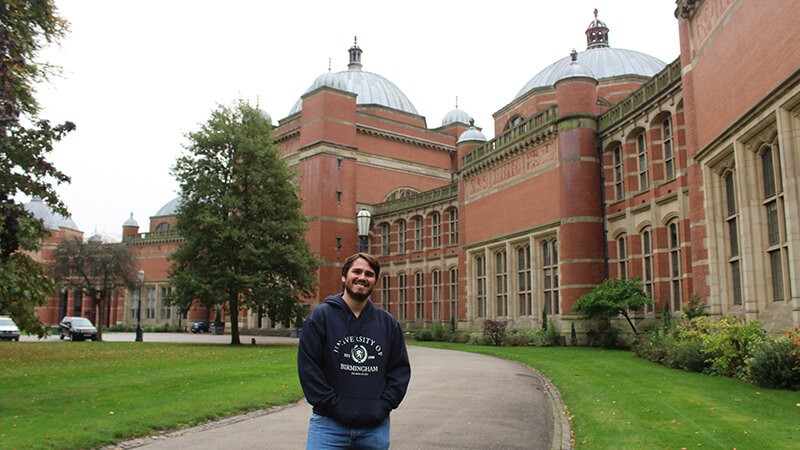
For Ignacio Rocca, an engineer who graduated from Universidad ORT Uruguay is currently pursuing aMaster’s in Engineering (Research Track) at the same institution, this connection is so important that he decided to delve deeper into the subject by pursuing a master’s degree in Human-Computer Interaction at the University of Birmingham (United Kingdom).
He went there in 2016—with the support of a Chevening scholarship co-funded by the National Agency for Research and Innovation (ANII)—and a year later, not only did he graduate as the top student in his class, but his thesis—titled "Cognitive Bias Modification on Tabletops"—was recognized as the best in his group.
Human-Computer Interaction is a discipline that investigates the design and implementation of the interface (i.e., the point of contact) between humans and computers, integrating technical knowledge with other fields such as psychology and ergonomics.
“Discipline has a lot to do with how people adapt to platforms and, in turn, how computers can change or influence human behavior,” Rocca explained. “You learn to understand why a mouse is a better tool for interacting with a computer than a trackpad,” he illustrated.
Although the Uruguayan industry has and expertise in this field, Rocca feels that studying in the United Kingdom gave him “the opportunity to interact with the world’s leading experts in the field,” and, in turn, instilled in him “greater rigor” and opened the door to new possibilities.
“The user is at the center,” he said, though he clarified that “that doesn’t mean software has to be for everyone; rather, it means identifying the platform’s target audience, designing it for those people, and finding the best solution to make it easy for them.”
For this reason, an app is considered successful when it is well-received by the audience for which it was designed, and that requires a thorough preliminary study of the target audience that will use the final product.
While pursuing his master's degree in the United Kingdom, Rocca focused on a line of research aimed at understanding how technology can help change certain human behaviors. This led to the topic of his master's thesis: reducing smartphone addiction through the use of a cognitive training technique known as Cognitive Bias Modification.
The research was conducted in collaboration with Charlie Pinder and Russell Beale, researchers at the Human-Computer Interaction Centre at the University of Birmingham.
The starting point was the psychological theory that distinguishes between the conscious and unconscious systems of the human mind. “We wanted to design simple apps that speak to the unconscious—to the intuitive animal within us—because that’s the fastest system,” he said.
The idea was to train cognitive biases—those beliefs that allow humans to make intuitive decisions—to reduce cell phone use, an issue that is becoming increasingly important among psychologists and psychiatrists around the world. Studies indicate that, on average, a person checks their cell phone between 80 and 110 times a day.
Rocca explained that this is due to the activation of a cognitive bias that causes people to reach for their mobile device rather than any other object. “With this experiment, our goal was to counteract that bias by offering an alternative—in this case, a book. We wanted people to unconsciously choose to pick up a book instead of checking their cell phones,” he said.
The experiment involved setting up a touchscreen table that displayed images of cell phones and books.
The experimental group (comprising 40 people) was instructed to move the images of books closer and push the images of cell phones away, as a treatment for this addiction. The aim was to measure the participants’ reaction times and how long it took them to move each of these images closer or push them away, on the understanding that a delay in pushing the cell phone away indicated a higher level of addiction.
https://youtu.be/7XUO8jNZrCw?si=zkftIcblLdFOGeRv
The author believes that the research was recognized because it is pioneering in its approach. “There is very little literature on the subject, but it is a very new field, and this work served as the first research on the topic. My task was to design and carry out the experiment. That was the value of the thesis,” the engineer reflected on his project.
Now back at Universidad ORT Uruguay, Rocca will apply the knowledge he gained during hisSystems Engineering degree programat the School of Engineering by joining the faculty teaching the elective course "User Interface Development."
“I think it’s important to raise students’ awareness of the importance of focusing on people’s experiences with technology. This way, future professionals will have a broader perspective and won’t limit themselves to just the technical aspects,” he said.
The engineer also expressed interest in exploring content creation with the aim of conducting more research focused on human-computer interaction.
Finally, Rocca raised the possibility of collaborating with other academic disciplines, such as the School of Design within the School of Communication and Design, with which there is a very close working relationship when it comes to software development.