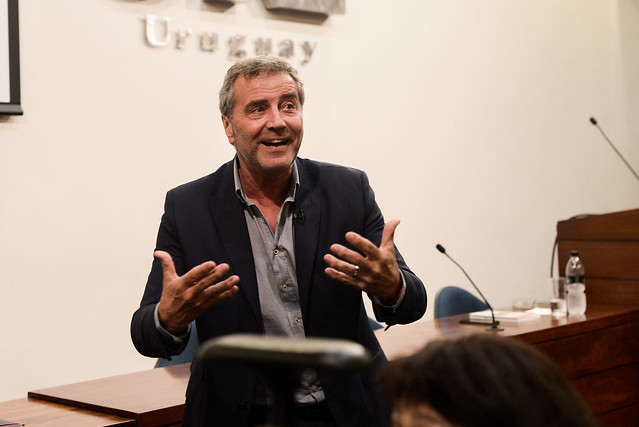
“To get a millennial to put in the effort, you have to entice them,” said Professor Norbert Monfort during the conference “A Journey Through the World of Management.” Organized by the Graduate School of the Faculty of Administration and Social Sciences, the event took place on April 16, 2018.
Norbert Monfort holds a Bachelor’s degree in Psychology from the Autonomous University of Bellaterra, a Master’s degree in Human Resources from the University of South Carolina, and a Master’s degree in Organizational Development from the GR Institute in Israel. He is also the founder of Monfort Ambient Management, a consulting firm specializing in organizational development and innovation, and a professor at ESADE Business School.
The event took place as part of the graduation ceremony for programme Management Development (PMD), a program for senior executives developed by ESADE and offered in partnership with Universidad ORT Uruguay.
Disobedience, Guides, and Generations
A jazz band drummer defies his conductor and improvises an epic five-minute solo that pushes him to his physical limits: the final scene of the film *Whiplash* served as a powerful opening to the conference.
“Blessed be disobedience,” said Monfort, who believes that always following the rules is a waste of energy and creativity.
The expert discussed influence management and made a point. “What is the difference between manipulation and influence? The goal,” he said. Influence occurs in a situation where both parties—the influencer and the influenced—benefit.
“As managers, you must serve as guides,” he said. According to Monfort, a manager must be able to deal with both teams and individuals at the same time.
He then outlined the evolution of the latest generations:
- baby boomers born in the 1950s and raised to value hard work;
- Generation X, born up until the 1980s, with uncertainty as their only certainty;
- Generation Y or millennials (born in the 1990s) and focused on immediacy;
- Generation Z, the first true digital natives.
Millennials, hard work, and the cat herder
In Monfort's view, millennials are unfairly accused of not working hard enough and failing to show commitment and loyalty to their jobs.
“To get a millennial to put in the effort, you have to win them over,” he said, noting that when different generations work together, a synergy is created that yields results. Before that happens, however, some friction is inevitable—something he described as necessary.
“The only way to grow is through conflict,” the professor said, adding that synergy alone is not enough to drive an organization’s growth.
“The manager of this century is a cat herder,” he joked at another point in the conference. “Most companies have been managed like sheep herding. They’ve just changed the animals for that same shepherd,” he said.
Retaining talent and millennial mobility
For Monfort, one of the key questions that leaders of organizations must ask themselves is how to retain all the talent within their organizations.
Millennials’ frequent job changes are a topic that often concerns company executives. The expert played down the situation and said that job mobility is fine—with one caveat. “You can leave, but all your know-how must stay,” he said.
Company executives and IT managers must therefore work together to ensure that knowledge remains within the organization, even if the people who generated it leave.
He also highlighted the importance of a shift in mindset among senior management and added that managers of millennials should rethink the traditional image of a leader and understand that, for that generation, “to lead is to serve.”
According to the expert, it is important to recognize the identity and needs of millennials, but it is also vital to set boundaries that allow for the development of a healthy professional and personal relationship.
Goals, processes, people, and possibilities
Monfort introduced the “whole brain” tool, a version of the 4Ps of marketing applied to the personalities of an organization’s members. He identified four primary colors—blue, green, red, and yellow—each associated with different characteristics.
After detailing the positive traits of the different types of people who make up an organization, the professor reviewed the negative aspects of each and explained the need for different personalities to coexist within companies.
- Blue: These are people who are focused on goals, setting objectives, and achieving results. On the downside, they tend to be extremely competitive and are determined to win at any cost.
- Green: These are people who are interested in processes. They prioritize rules and methods and strive for excellence. Their main flaw is that they tend to be rigid and perfectionistic.
- Red: These are people whose primary concern is other people. They prioritize team harmony and well-being above all else and strive to maintain healthy relationships. However, they tend to be hypersensitive and submissive, with a tendency to avoid conflict.
- Yellow: These are people who focus on possibilities. They have a broad perspective and are constantly seeking innovation. Their main drawback is that they get bored easily and lose motivation quickly.
“We’ve overused the term ‘generations,’” he said regarding the closure. “It sounds nice, it sounds cool, and it’s fun to say that millennials aren’t part of the ‘grit culture,’” but this doesn’t reflect reality; instead, we need to look at each case individually.
https://www.youtube.com/watch?v=Sf70xGLDwrA
Image gallery: