Two bars and a ball that moves across the screen. These elements, combined with the intention to mimic the concept of ping pong, form the basis of the first modern video game that became massively popular back in the 1970s: Atari’s Pong. Its commercial success was immediate, and it went on to become an icon of the 1970s. But Pong’s legacy didn’t end there; it managed to transcend generations, reaching all the way to millennials.
Among them is Emiliano Zapata, a graduate of the Electronics Engineering program at Universidad ORT Uruguay, who became interested in that first Atari video game and took part in the challenge of recreating it.
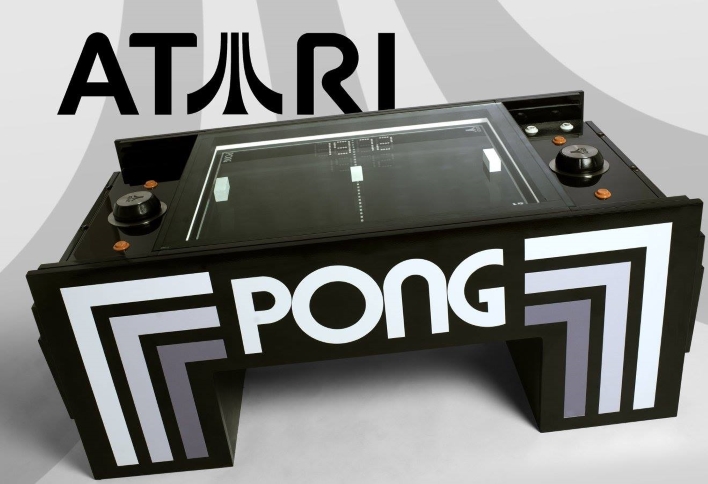
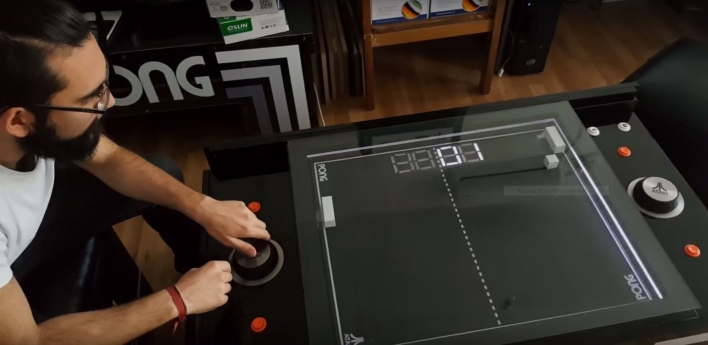
Impressed by the global impact of Atari’s first video game, Zapata got involved in a project conceived and led by Daniel Perdomo and Álvaro Salsamendi, who set out to reimagine Pong as a modern coffee table featuring LED lights, USB ports for charging cell phones, and even a Bluetooth speaker.
The idea started as a hobby, then turned into a Kickstarter project (a crowdfunding platform) that raised about $350,000, and later, numerous international media outlets helped it carve out a niche in the market. Today, the Atari Pong Table has produced has first few hundred units thanks to a partnership with a Chinese multinational that will distribute them in more than 80 countries.
Zapata talked about his work on the project and what’s next for Calinfer Inc., the Uruguayan firm he founded and through which he revolutionized the concept of Pong.

From your perspective, how would you describe the Table Pong Project?
There are two possible answers to this question. The first is that it started as a hobby that evolved into something more elaborate and serious. The more clinical answer would be to say that it is an adaptation of the first massively popular, commercially successful video game. It is a mechanical adaptation of what that virtual game was.
You're 25 years old, and Pong came out in the 1970s. How did you get involved in this project with a game that isn't from your generation?
The people who experienced that were Generation X—the Back to the Future generation—who lived through the Steven Spielberg boom. I’m from the Super Mario generation, but just for the sake of trivia—since I spend a good part of my free time playing video games—I knew about Pong. When I was invited to participate in a project involving Atari, with all the clout that carries in pop culture, I was drawn to it.
What was that project about?
For me, it all started about two years ago, when I joined a project that Daniel Perdomo—a publicist who, as a hobby, wanted to create a physical version of Atari’s Pong —had started some time earlier. What I found when I joined was the work of someone who had dedicated 20 years of his life to 3D animation in an effort to build this machine.
I remember Daniel telling me, “There are just a few details that need to be fixed, and then everything will work.” Obviously, there was a lot of work to be done, but the idea was there. He had come up with a prototype, but it served to conceptually demonstrate what the table was supposed to do. Getting it to actually work was another matter entirely… The first prototype I received had functional errors, but it was a start, and that way we could figure out what needed to be done right.
I joined after Marcelo Apa—who is now the project manager—and that’s when Atari Pong Table became a serious project. We began discussing licensing with Atari, and funding became available from the National Agency for Research and Innovation (ANII). That’s when our focus shifted from simply creating a product to actually bringing it to market.
How did you come to work with Perdomo?
I graduated in 2015, but I hit a rough patch and didn’t want to jump right into a career in engineering. The truth is, I love the whole world of engineering, but at the time I couldn’t find any job opportunities that motivated me. In the meantime, I taught at ORT and the Institute of Technical Education (INET) as a steady job.
I also took the opportunity to leave the country for a while because of my music (Zapata, under his stage name El Bastardo, is one of Uruguay’s leading DJs ). One day, someone called asking for engineer Zapata—something I wasn’t used to hearing—saying they wanted to talk to me about a project. It was a rather vague reference, but my name and that of Ismael Rodríguez—with whom I’d done all my projects in every course of my degree program—came up. He had just left to work in Germany, so I ended up getting involved on my own.
You mentioned that Perdomo had come up with the idea and a prototype, but that we had to start from scratch. What did your involvement bring to the table?
I contributed in the area of electronics—both hardware and software. He had put together some motors, two Arduinos, and a circuit board in a very DIY fashion. I always tell him it’s amazing that he got to that point without knowing anything about the subject. My main contribution was redesigning the whole thing.
Now that the table has been redesigned, completed, and is up and running, what is your role in the project?
We’ve all grown. We’re talking about a project that started in a loft with four people, and now there are five of us with a major deal with a multinational company in China. While my initial responsibilities involved developing hardware, programming, and wiring, we’ve secured funding, so I’m no longer doing as much programming and development. My role has shifted to something more like a manager; I have to handle human resources because we have hired people to help us. It’s a managerial position, but I’m still in charge of the technology side.
I’m the bridge between the two worlds, and it’s a fantastic role. I recently went to China to give them the final push they needed with their development there. There, I was 100% engineer. At night, I had meetings as a company partner where we didn’t discuss anything related to engineering. It’s a middle ground between business and technical matters. It allows me to understand what they’re proposing when they give me a quote, and I can negotiate it on a technical level to optimize costs.
This agreement with the Chinese company you mentioned means that it will distribute the tables to 80 countries. What happens next?
The Kickstarter campaign was a success. We received our largest injection of capital, and that allowed us to complete the development process. After developing the working prototype, which was already designed for mass production, we began searching for suppliers. That’s when we came across a Chinese company that approached us to sell us buttons; they asked what they were for and liked the idea. They sent an executive, and we ended up partnering with them not only for distribution but also for manufacturing.
So what's next for Calinfer?
We feel like the Atari Pong Table is our "Macarena"—the game that made us a huge hit. But we're not going to sit back and do nothing. We're currently developing another version of Pong for four players, a much larger table with no side bounces. The Chinese company saw that it would be a good idea to develop several Pong spin-offs, which could come together quite nicely in just a couple of months of development.
In that regard, how much responsibility will you have in terms of development? Will the Chinese be in charge of creating the prototypes for those byproducts?
My team and I developed both the hardware for the board and the software used by the table. After visiting China twice, you start to understand a lot of things. They’re very pragmatic and excellent at managing production lines; they’re highly efficient at mass-producing a finished product, but when it comes to creativity—developing new solutions or finding ways to solve problems—not so much. The responsibility is enormous because the development is 100% ours; they simply replicate it.
Have they started building the first tables yet?
We are at the stage where the first 200 production units of the model called Coffee have rolled off the assembly line.
Where will they be sold?
Our strongest market is the United States; we've already had a lot of pre-orders. It's a machine with a fairly high retail price—$3,000—so it's become a collector's item.
Those tables go to major distributors; we have a huge network of distributors. They aren't for testing, but the distributors are the ones who will take those tables and put them through their paces. Once those tables have been tested by all the major distributors, they send them on to their smaller distributors. All that information comes back to us, and we see if any adjustments need to be made. But those are just final tweaks.
The plan is for the system to be fully operational soon, for all pre-orders to start shipping, and for all distributors to be fully stocked.
Do you see Uruguay as a market?
Not at all. We’ve only sold one table in Uruguay through Kickstarter. Here, two companies were interested in buying a couple of tables from us: Movistar and Ironhide Game Studio, the developer of the game Kingdom Rush. Locally, we don’t plan to sell them. We’d love to, and we’ll do our best to sell them ourselves, even if it means selling them at distributor prices and losing some money, simply because we’re Uruguayan. But if we use the system we’re using abroad, the price would end up being around $4,500. There might be a market, but it’s very small.
What concepts did you learn during your engineering studies that you believe were essential when you took on this project, and what should students focus on if they want to achieve a success story like this?
That question brings out the teacher in me. What matters most are the skills you develop throughout your degree program, not so much the knowledge itself.
What should students pay attention to?
First and foremost, develop discipline. It’s essential—the program forces you to be disciplined in order to succeed, and it’s something you end up appreciating in practice. I graduated as an engineer, and I didn’t graduate appreciating the fact that I knew how to program a microprocessor; I graduated appreciating the fact that if someone presents me with a new problem, I’m not afraid to dive into research to solve it. I graduated satisfied with the patience and discipline I developed.
My advice is to embrace every bit of the struggle. In a controlled environment like college, the worst that can happen is failing a class. You have to make the most of that experience so that when you step out into the real world—where failure can cost you a fortune—you’ll be able to come out on top in every situation.