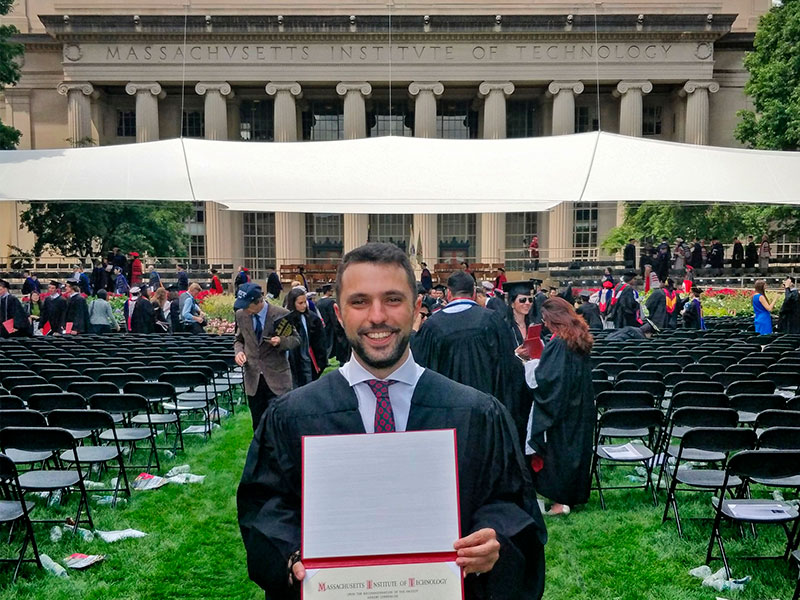
To make his dream come true, he knew he had to carefully consider every step that would bring him closer to his goal. He had to be crystal clear about “what to study, where, when, how, and above all, why,” he reflected at the time—and he still remembers that today, now that he has graduated from ORT and is just a few months away from earning his MBA from the MIT Sloan School of Management, the business school at the Massachusetts Institute of Technology (MIT).
After living in Boston for several years, enjoying the journey, and making the most of the experience, Diego is now reaping the rewards of his hard work. As soon as he finished his MBA, he began working at Bain & Company, one of the world’s leading strategic consulting firms. This new challenge also brings a new destination, as Diego will be working at Bain’s office in Buenos Aires.
As this new chapter begins, Diego shared his memories of some of the steps that led him to the finish line.
What was your transition from college to the local job market like?
An important part of the academic plan I set for myself was to enter the job market during the second half of my degree program. The goal was to complement my classroom and theoretical experience by putting many of those concepts into practice in a dynamic and challenging environment, thereby creating some kind of value.
During the summer between my fourth and fifth semesters, I began exploring the job market and applied to about four professional services firms that aligned with my medium-term personal and professional goals.
By April of that year, I had already joined KPMG, initially on the tax team, although a month later I requested a transfer to the management and financial consulting division for career development reasons.
I spent three and a half years at KPMG, where I learned a great deal and developed tools and skills that have been invaluable to me throughout my short professional career.
What do you appreciate now about your time at ORT that you didn't used to value as much?
There is definitely a need for teamwork in virtually every course, through the submission of so-called “required” assignments.
Perhaps at the time I thought it was only natural to meet a certain number of times a week, do some research, write a draft, flesh out the document, and turn it in, but the reality is that through that process, one develops skills that are essential for life: learning to delegate, empathize, recognize strengths and weaknesses, listen to other opinions, take responsibility, work under pressure, and many others.
Looking back, the ORT helped me grow in that regard, even though I may not have fully appreciated its value at the time.
What made you decide to study abroad, and specifically at Sloan?
For many years, I had dreamed of earning a master’s degree at one of the world’s top universities. What started as a vague idea gradually took shape until I finally decided what, where, when, how, and, above all, why.
I had been working on this idea since my fourth semester at ORT, and from then until I finally applied in January 2016, I sought advice from various people whose help and guidance have been invaluable. I also reached out to universities, read articles and forum posts, and attended several MBA fairs.
There are many reasons why I chose MIT Sloan, but the main ones are the fact that it is one of the best business schools in the world, its distinctive entrepreneurial ecosystem, the availability of resources and facilities, and, above all, the collaborative culture that defines the program.
One of my goals for the near future is to serve as an ambassador for MIT Sloan in the region, with the aim of helping to promote the program and make it more accessible to anyone interested in applying. That’s why I’m available to talk with anyone interested in learning more.
How did your training at ORT help you during your time at MIT?
The study methods that promote the development of personal skills were definitely extremely useful.
ORT’s accounting program is very comprehensive, not only because it offers a wide range of relevant courses, but also because of the caliber of its faculty, many of whom hold leadership positions at the most renowned firms in the Uruguayan market.
If I had to break down the MIT MBA into broad categories, they would be General Management/Strategy, Finance/Accounting, Operations, Communication, and Organizational Processes.
Because of the way the Public Accounting program at ORT is structured, I was able to bring a solid foundation in several of the areas mentioned to MIT, which allowed me to contribute to the class—something that is fundamental to the spirit of the MBA.
Similarly, I benefited greatly from everything my classmates brought to the classroom from their own experiences and life stories.
You were co-president of the Latin America Business Club at Sloan. How and why did you get involved with that group? What did the role entail? How did it benefit you while you were pursuing your MBA?
One of the most interesting things I discovered while studying in the United States was the vast network of student clubs that exist at universities.
For those who are unfamiliar with them, these clubs are student organizations dedicated to cultural, professional, recreational, and research activities, and are managed by a formal leadership structure. Depending on their mission, each club organizes events such as conferences, cultural activities, formal training sessions, study trips, and recreational outings, among others.
During the first week of the MBA program, MIT Sloan’s more than 65 student clubs held a fair where they introduced themselves and opened registration. For my part, I joined the Latin American Business Club, the Sloan Jewish Student Organization (which I also co-chaired during my second year), the Management Consulting Club, the Adam Smith Society, and the Systems Thinking Club.
The clubs are usually led by sophomores, supported by freshmen in more hands-on roles. Two months before the presidents were set to graduate, applications opened to club members, and the new team ultimately consisted of a Mexican friend, a Chilean, an Argentine, a Costa Rican, a Colombian, and me.
It just so happened that we were all friends to begin with, and we came together with a lot of energy and a strong sense of commitment, which made the experience even more enjoyable. Each of us had our own unique background and personality, which contributed to the group’s diversity and allowed us to complement each other very well.
My role was to manage fundraising efforts and maintain institutional relationships with companies in Latin America in order to serve as a bridge, helping them discover Latin American talent and vice versa, since one of our club’s goals is to facilitate job opportunities for our members.
If I had to single out one milestone from this experience that really stood out to me, it would definitely be organizing the “Latin American Conference 2018: Inspiring through Success,” where we managed to bring together renowned figures from the worlds of business, politics, finance, and research to share their stories of overcoming adversity and leadership, with a focus on empowering Latinos to build a better Latin America.
Everything went according to plan, even though it was a real test of our ability to work under pressure.
You're moving to Buenos Aires to start a new job. What does it involve, and what led you to get that job?
I joined the team at Bain & Company a month ago. Bain is one of the world’s leading strategic consulting firms, focused on addressing the most complex challenges faced by major players in every industry.
We work on projects related to strategy, operations, digital transformation, organizational structure, mergers and acquisitions, and various other areas for clients in the financial services, private equity, retail, consumer goods, telecommunications, energy, and agribusiness sectors, among others.
Bain has very strong MBA recruitment program, and is in fact one of the top five employers in terms of the number of graduates it hires from each MIT Sloan class.
It’s very common in MBA programs for companies to visit campus and organize events to promote themselves and meet potential candidates, and Bain was no exception.
Over the course of those two years, I met many "Bainies" who made a deep impression on me, both intellectually and personally, so I went through the application process, and in February of this year, I was invited to join the team at the Buenos Aires office once I had completed my MBA.