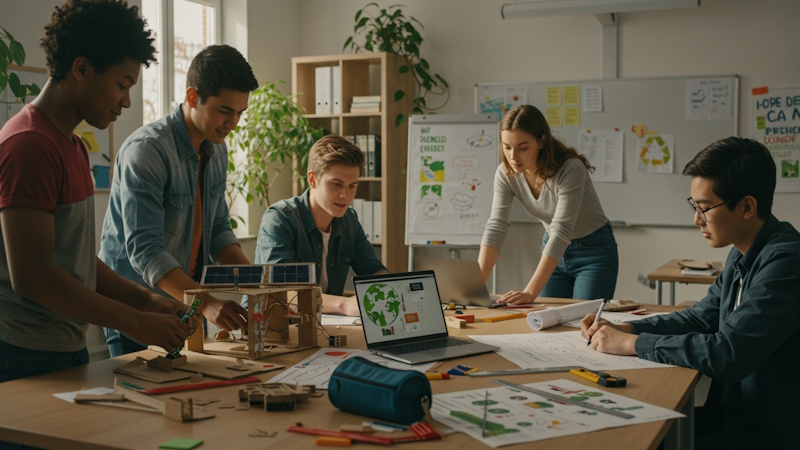
When information is just a click away, and increasingly advanced tools are becoming standard on computers and mobile devices, educational methodologies must constantly evolve.
Today, learning involves more than just memorizing formulas, dates, or definitions. People are looking for new ways to study that promote active, hands-on, and collaborative learning.
Still not sure what to study?
Check out all the university degree programs offered by ORT
Project-based learning
Project-based learning, or PBL, is an educational methodology developed in the late 19th century that places the student at the center of the educational process.
This method involves designing and carrying out hands-on activities, typically in the form of projects that seek solutions to a relevant challenge, problem, or question.
Instead of passively listening to a teacher's explanation in class, students research, experiment, and collaborate to arrive at an answer or final product.
Like meaningful learning, this method does not aim for students to acquire theoretical knowledge automatically.
Both approaches aim to ensure that learning goes beyond rote memorization and becomes a meaningful experience.
Unlike traditional teaching methods, PBL promotes active and participatory learning, in which students do not passively receive information but instead take an active role in their own learning process.
The teacher, on the other hand, takes on the role of a guide, supporting students as they work on their projects, rather than simply imparting knowledge in a one-way manner.
Origins of Project-Based Learning
“Learning by doing” is not a new concept. Twentieth-century thinkers, such as John Dewey, argued that practical experience is essential for meaningful learning.
According to Dewey, action should be an integral part of the learning process, and the school should become a space for interaction, experimentation, and experience.

In his book *Experience and Education* (1938), Dewey emphasizes the importance of grounding education in personal experience, with the aim of bridging the gap between theory and practice.
William Heard Kilpatrick, another key figure in project-based learning methodology, proposed organizing instruction around comprehensive and meaningful activities for students, rather than isolated lessons.
Benefits and Advantages
A number of benefits set project-based learning apart from more traditional teaching methods, with advantages for both students and teachers.
In short, project-based learning not only teaches content but also fosters more independent, critical, and collaborative individuals.
- Meaningful learning: By connecting content to real-life situations, knowledge becomes easier to understand, retain, and apply.
- Greater motivation: Working on practical projects sparks curiosity and fosters a more personal connection, which in turn increases the desire to learn.
- Developing soft skills: Working with others on projects helps you develop skills that are useful in any field, such as problem-solving, time management, and communication.
- Adaptability to learning styles: It allows each student to contribute based on their own strengths, whether through research, design, creation, or presentation.
- Preparing for the future: By working on projects similar to those they might encounter in their professional lives, students develop skills that extend beyond the classroom.
According to the study “Project-Based Learning in K-12 Education: Implementation and Benefits for Students’ Holistic Development,” published in the multidisciplinary scientific journal G-Nerando, PBL has the potential to foster collaboration and autonomy among K-12 students.
Still not sure what to study?
Check out all the degree programs offered by ORT
Challenges
Learning through projects has its benefits, but it also presents challenges that must be overcome.
One of the main challenges is time, since planning, researching, and carrying out projects requires more effort than a traditional class.
Another common obstacle is teacher training. Not all teachers have received specific training in active learning methodologies, which can lead to uncertainty when guiding students through projects.

Even so, these challenges can be overcome with proper planning, institutional support, and the commitment of teachers.
Ultimately, the benefits of PBL tend to outweigh the initial challenges, making it a sustainable long-term educational approach.
Learning styles
Not all students learn in the same way. Some are more visual learners, others are more auditory learners, and still others prefer hands-on activities or movement.
PBL recognizes and promotes this diversity, and provides a flexible environment in which each student can learn in the way that works best for them.
- Visual learners prefer to organize information using diagrams, presentations, and visual aids.
- Auditory learners can benefit from discussions, oral presentations, and group work.
- Kinesthetic learners find motivation in handling materials, building prototypes, or participating in hands-on activities.
A project that combines design, communication, and hands-on activities creates opportunities for all learning styles.
At the end of the day, learning isn't a one-size-fits-all experience; it's a personal and unique process that can be even more effective in collaborative settings.
In addition to ensuring a place for everyone, it also increases the chances of success for both individuals and the project as a whole.
Connection to meaningful learning
Project-based learning is linked to other similar pedagogical theories, which also place the student at the center of the educational process.
Psychologist David Ausubel argued that learning is meaningful when students are able to connect new knowledge with what they already know.
In other words, information is not stored in isolation, but is integrated into a network of prior knowledge that gives it meaning.

According to a recent article, Ausubel’s meaningful learning revisited, published in the journal Current Psychology, indicates that this integration of the new with the already known is key to achieving deep and lasting learning.
Project-Based Learning (PBL) fosters meaningful learning because projects are tied to real-world problems that spark interest and motivation.
When faced with a specific challenge, students seekto understand how theoretical concepts apply in real-world situations.
Still not sure what to study?
Check out all the degree programs offered by ORT
Examples of use
Project-based learning can be adapted to different educational levels, subject areas, and even learning styles, taking into account the students and the learning objectives.
For example, when it comes to environmental awareness, elementary school students can research recycling and design campaigns to reduce waste at school.
Meanwhile, in middle school, a science project could focus on creating small-scale renewable energy prototypes.
The key is to spark students' curiosity and motivation and instill in them a genuine sense of purpose, along with a desire to learn more.
In higher education, projects can address real-world community issues and even involve businesses, thereby fostering a connection between universities and society.
These examples show that project-based learning is not a rigid methodology, but rather a flexible approach that can be integrated into almost any educational setting.
Strategies for Collaborative Projects
For a project to be successful, it is essential that it addresses authentic questions, is grounded in a real-world perspective, and fosters collaborative work.
- Define a guiding question: The project should begin with a question that inspires everyone involved. For example, “How can we reduce our ecological footprint?”
- Planning milestones: By establishing phases for research, design, and development, teams can ensure they meet deadlines on time and manage resources effectively.
- Assign roles and responsibilities: Each student can contribute based on their interests and learning styles, whether as a researcher, designer, communicator, or coordinator.
- Incorporating technology: The use of digital tools expands the possibilities for research and the presentation of results.
- Evaluate the process and the outcome: the final result is just as important as the skills acquired along the way.

When implemented properly, project-based learning improves academic performance and transforms the school into a free and collaborative environment where the learning experience becomes more meaningful.
- You might be interested in: Study techniques that actually work (and why you should try more than one)
Project-based learning brings theory and practice together right in the classroom. This approach encourages students to have meaningful experiences and to make sense of what they learn on their own.
Completing a project, regardless of how successful it is, doesn't just mean delivering a final product.
Project-based learning, like meaningful learning, emphasizes the process of inquiry, collaboration, and creativity.
These strategies help build students' independence and confidence in their own abilities, preparing them for the challenges of the future.
Still not sure what to study?
Check out all the degree programs offered by ORT