
In an increasingly interconnected and ever-changing world, educational processes have evolved to meet new needs.
In this context, collaborative learning and cooperative learning emerge as two strategies with a common goal: learning with others. Both aim to foster teamwork, communication, and problem-solving.
However, even though they may seem synonymous, there are differences between them.
Still not sure what to study?
Check out all the degree programs offered by ORT
Learning from others
Learning in a group is not, in itself, a new idea. Since ancient times, knowledge has always been passed down within communities—in philosophical discussion groups, craft workshops, or research teams.
What's new today is that there has structured educational frameworks incorporating study strategies and techniques that guide and encourage this shared learning.
Simply absorbing and regurgitating information is no longer enough to succeed in today's academic or professional world.
Knowing how to work with others is crucial for finding creative solutions to today’s challenges and adapting to new environments and perspectives.
Whether it's a group project at college, working with clients, or collaborating with coworkers, empathy, communication, and the ability to take on shared responsibilities are skills that can make or break a team's success.
Both collaborative and cooperative learning address this need to acquire knowledge together.
What is collaborative learning?
Collaborative learning is a pedagogical strategy in which students work together in a flexible manner to develop shared knowledge.
Far from simply dividing tasks at random, this approach involves active participation in a collective process where everyone can contribute ideas, discuss, negotiate, and reach mutual conclusions.

According to the article “Collaborative Learning in Higher Education: Evoking Positive Interdependence,”, published in the journal CBE—Life Sciences Education, collaborative learning yields better results when tasks are challenging and when students have autonomy within the group.
Without a designated leader or fixed roles, the team is able to organize itself in whatever way it deems best, adapting to the needs of the project or the problem being solved.
Through dialogue, the exchange of ideas, and negotiation, participants learn in a more meaningful way than they would on their own.
Still not sure what to study?
Check out all the university degree programs offered by ORT
Characteristics of Collaborative Learning
- Constant interaction: Knowledge is not acquired unilaterally, but rather through an exchange in which opinions are challenged and concepts are continuously explained and redefined.
- Shared autonomy: There is no single leader or strict hierarchical roles. Instead, responsibilities are taken on spontaneously and may change as the project progresses, depending on the needs.
- Shared learning: The goal is not just to complete a task, but to learn in a way that benefits everyone.
- Focus on dialogue: In collaborative projects, critical discussion, active listening, and respect for different perspectives are valued.
Examples of collaborative learning include academic discussions in which students are given a topic to analyze and, through the exchange of ideas and different perspectives, work together to develop a collective position.

Group projects— whether artistic or scientific—are also popular ways to develop collaboration skills for people of all ages.
What is cooperative learning?
Cooperative learning is an educational approach in which students work in groups in an organized and structured manner to achieve a common goal.
According to the article “Cooperative Learning and Academic Performance, ” published in *Ciencia Latina*, cooperative learning not only improves academic performance but also increases motivation and reduces anxiety among students.
Unlike collaborative learning, each member has clearly defined roles and specific responsibilities within the team.
The success of cooperative learning depends on each member fulfilling their role. This fosters individual responsibility as well as collective commitment, since if one person fails to contribute what is needed, the overall outcome will be affected.
This approach is widely used in both schools and universities because it allows teachers to guide the process and assess both individual and group effort.
Characteristics of cooperative learning
- Defined structure: The groups operate with assigned, fixed roles, where each member knows exactly what tasks they are responsible for.
- Individual and group responsibility: Each student must do their part, but also make sure their classmates don't fall behind.
- Clear shared goal: The group works toward a specific, pre-established goal.
- Shared evaluation: Ultimately, both each individual’s contribution and the collective final result are considered and evaluated with equal weight.
Examples of cooperative learning include activities similar to a jigsaw puzzle, in which each student researches a specific topic and then presents it to their classmates, so that together they build the complete picture.

Outside the academic setting, online forums and virtual spaces also provide opportunities for collaborative learning, sometimes with people from all over the world and from diverse backgrounds.
Collaborative learning vs. cooperative learning
Although collaborative learning and cooperative learning share the idea that knowledge is acquired as a group, their pedagogical approaches and structures are not the same.
Identifying the strengths and weaknesses of these methodologies allows teachers and teams to select the most appropriate strategy based on their objectives.
This approach allows each member to contribute based on their personal interests and knowledge, which enriches the discussions and makes them more engaging.
In educational settings, collaborative learning is often most effective in advanced courses or in projects that require creativity, critical thinking, and independence.
For example, in college courses where students research a complex topic and must discuss different perspectives.
Cooperative learning, on the other hand, is useful in the early stages of education or in settings where the goal is to ensure equal participation for everyone.
With clearly defined roles and a more transparent structure, each team member is able to take responsibility for their individual contributions while feeling supported by the group, which leads to greater motivation.
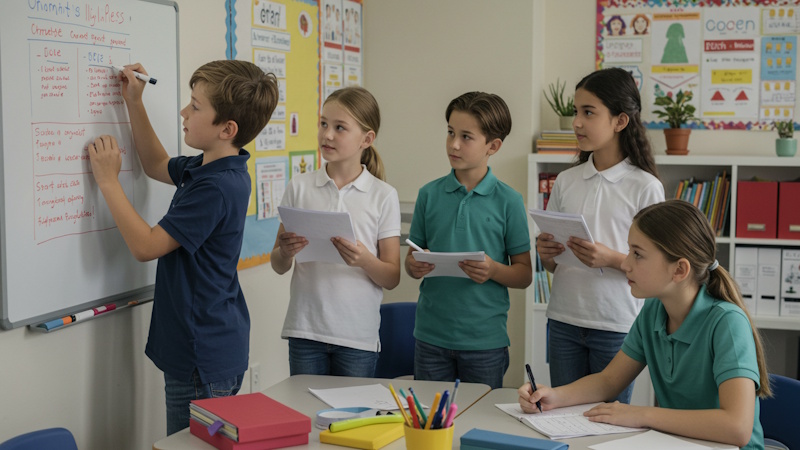
This makes it a suitable strategy for use in schools, corporate programmes , or community projects that require coordination to achieve specific goals.
In the article Cooperative Learning and Literacy: A Meta-Analytic Review, published in the Journal of Research on Educational Effectiveness, more than 30 years of research with students in the United States were reviewed.
In the studies analyzed, the groups that used cooperative or collaborative methods scored higher on reading comprehension, vocabulary, and reading skills compared to groups that used traditional methods.
Still not sure what to study?
Check out all the university degree programs offered by ORT
Which method should I choose?
While collaborative learning is characterized by its autonomy and flexibility, cooperative learning is based on an organized structure.
So, what is the best approach?
In many cases, a combination of both approaches may be the most rewarding path.
For example, you can start a project with an initial collaborative phase to generate ideas and discuss different perspectives, and then adopt a cooperative approach to assign responsibilities, thereby ensuring that the project is completed efficiently.
If the goal is to foster creativity, critical thinking, and negotiation skills, collaborative learning may be a more appropriate strategy. Working together on projects allows participants to decide how to tackle a complex task and contribute based on their own knowledge.
On the other hand, if the goal is to ensure that all members fulfill their responsibilities and work together toward a specific outcome, cooperative learning is the most effective approach.

Its structure, with clearly defined roles and goals, makes it easier to organize the group and assign tasks. It also allows less experienced students to contribute meaningful ideas or insights.
The key is to adapt the methodology to the group, the type of task, and the participants' level of autonomy.
Tips for implementing these methodologies
- Set clear objectives: Before starting any activity, it is important that participants know what is expected to be achieved.
- Strike a balance: In collaborative projects, it is important to allow for a certain degree of autonomy, while at the same time assigning roles to ensure that everyone participates to some extent.
- Promoting communication: Regular meetings, discussion forums, and ongoing feedback help maintain coordination.
- Process and outcome: Recognizing individual effort and group performance helps identify strengths and areas for improvement.
Implementing these practices improves the quality of learning while preparing students to thrive in complex work environments, where collaboration is an increasingly common requirement.
Adopting any of these methodologies involves a positive shift in how we understand education.
While studying on your own can yield good results, learning with others encourages us to grow in different ways.
This provides an opportunity to be more critical, creative, and supportive.
It also prepares us to face the challenges of a world that constantly demands that we connect with others.
Thus, both collaborative learning and cooperative learning become not only pedagogical techniques but also essential tools for developing individuals capable of learning in any context, working as a team, and transforming society.
Still not sure what to study?
Check out all the university degree programs offered by ORT