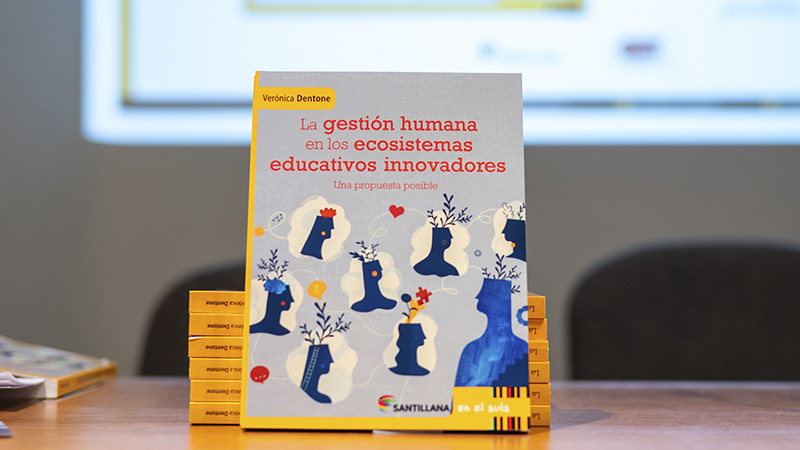
Verónica Dentone knows schools from the inside out. For years, she walked through classrooms, worked alongside many teachers, and developed educational management strategies rooted in the local context. From that experience emerged Human Management in Innovative Educational Ecosystems: A Possible Proposal, a book published by Santillana and recently presented at Universidad ORT Uruguay.
Throughout the book, the graduate of ORT’s Master’s Program in Educational Management invites readers to take a reflective look at educational institutions from a perspective focused on human resources management.
The book is available at the Universidad ORT Uruguay Library System.
A provocative yet sensitive book
“It’s a thought-provoking book, ”said Dr. Andrea Tejera Techera, academic coordinator of the Master’s Program in Educational Management, who wrote the foreword.
But also, as he noted during the book launch—which took place on Tuesday, September 9, in the Campus Centro Auditorium—it is a “highly sensitive” work that approaches educational issues “from the perspective of the ethics of care.” Each chapter emerges from the “virtuous intersection of practice and research,” and it is a text that “accompanies, guides, and moves,” while inviting dialogue.
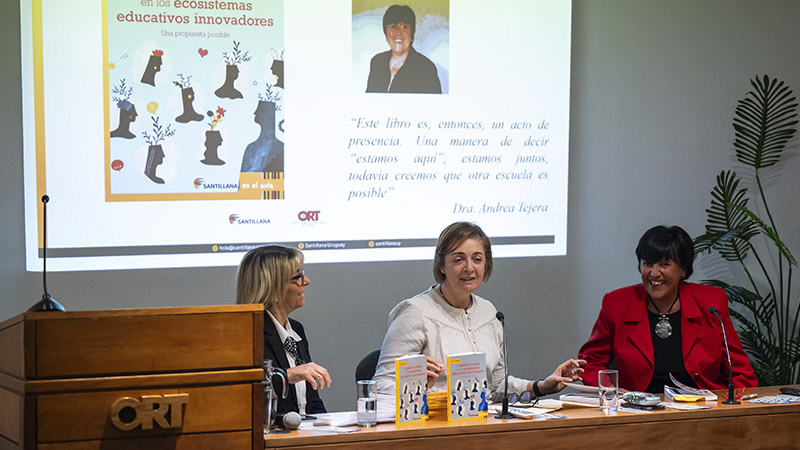
In the words of Tejera Techera, one of the distinctive features of this approach is that it proposes viewing management “not as control,” but as “institutional hospitality.” One of its central ideas lies in the conception of organizations as an ecosystem —in other words, a network of relationships, knowledge, emotions, and tensions.
“This perspective recognizes that learning requires connections and a shared sense of purpose. And Verónica offers us, in a realistic way, possibilities for moving forward in that process,” summarized Tejera Techera.
Contributions from and to academia
“We’re always delighted to see domestic production, ”said Tejera Techera. She immediately added, “For the university, it’s a tremendous source of pride that a master’s graduate is making this contribution.”
In addition, Tejera Techera emphasized that the book has “countless tools” to use when analyzing each situation: the improvement circle, the lotus flower diagram, the SAT framework, the analysis of practices as a thinking routine, SWOT analysis, and reflective capsules, to name a few. As such, it is a “treasure” for graduate students and will be included in the course reading lists.
This is a book that defies standardization. It is a powerful work that invites readers to engage with it from a variety of perspectives.
Dr. Andrea Tejera Techera
“I am this Master’s daughter, ”Dentone said, adding that, although she is now retired, education remains “her passion.”
As a new graduate, when she faced a classroom for the first time, she admitted that she felt she “had no tools at all.” Some time later, when she had the opportunity to continue her training at ORT, she noted that she met teachers who challenged her, that she gained “very important theoretical support,” and that she learned to “look beyond the surface.”
He also noted that the research process throughout the master’s program requires time and dedication. And, often, that work ends up “stored away in a thesis repository, never reaching a wider audience.” Her book, she explained, aims to break that cycle: “The path of writing is demanding and rigorous, but it’s worth it, because it’s the only way for others to access what I’ve done and also return to the field to continue engaging more people.”
Some key ideas
Dentone acknowledged that he needed to take some time to “blend theory with practice,” as he was very clear about one thing: he did not want to write a book that told others what to do, since no one within an educational institution should “parrot someone else’s script.” Nor did he intend for it to be a “light” text, based on the prejudice that “teachers don’t read.”
The author acknowledged that *Human Management in Innovative Educational Ecosystems* is a “provocative” book, as Tejera Techera described it. However, she noted that it provokes “out of respect” and to “awaken us, ” since at times the urgent, the demanding, and the external “overwhelm and numb us.”
And while, in Dentone’s view, the publication “raises far more questions than it answers, ”there are several key ideas that the author explored throughout the presentation, such as:
- A leader is an architect who is shaping the institution.
- We are all indispensable within the educational institution.
- Profound changes require conscious transformation.
- Conflict should not be swept under the rug; it must be addressed.
- Leadership is everyone's responsibility.
“It’s a book that everyone will make their own,” Dentone noted. Designed for all educational levels and systems, it does not require a linear reading experience: it can be explored according to the reader’s interests. In his view, it is an innovative approach that invites us “to look at what we have,” but which, at the same time, “looks toward the future.”
A call to “renew hope”
“Human management in innovative educational ecosystems goes beyond theory, ”noted Tejera Techera, adding thatit is a resource “rich in practicality” that offers insights for reflection and action.
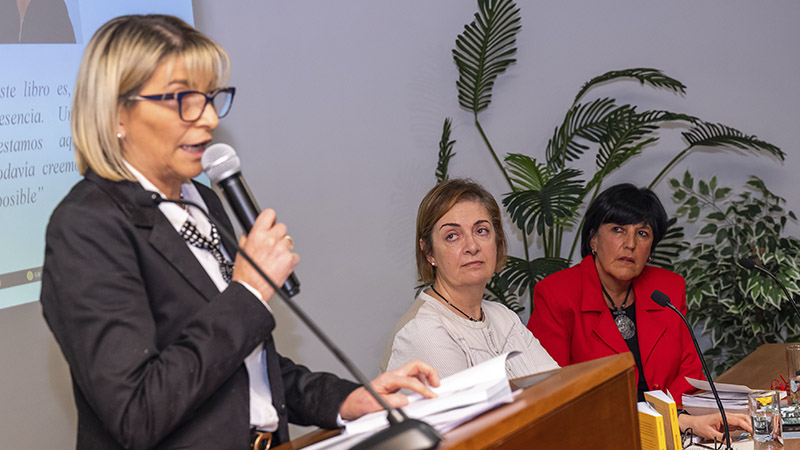
That dual dimension runs throughout the entire work. In fact, Dentone acknowledged that, while the book draws heavily on his background and the ethical stance he has chosen to take, it is written by “someone who walks the land.” “Education is about human connection and hospitality, and it’s also about being on the ground,” he added.
What matters and what Uruguay needs is a greater presence of teachers who write.
Verónica Dentone, Esq.
The book has a clear purpose: to improve education. During his remarks, Dentone highlighted the impact educators have on others, often without fully realizing its scope. With that conviction, he urged teachers to“renew their hope”: “Being a teacher is incredibly valuable, and we need many passionate and hopeful professionals to change our country.”
The author also reflected that true educational change does not always depend on material resources, but rather on human gestures. With that same sensitivity, she concluded her presentation with a simple yet profound wish: “May this book bring hope.”
Image Gallery
