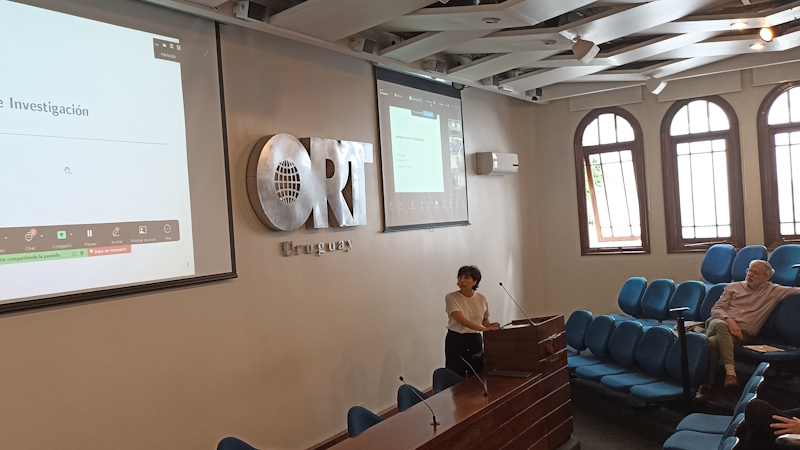
On Friday, December 6, the annual research conference was held at the Pocitos Campus, where researchers from the faculty gathered to review their publications from this year. They also discussed the topics they are currently working on in the short and medium term.
Meet all the researchers at the school
The academic research coordinator, Néstor Gandelman, PhD, opened the session by reviewing the benefits available to researchers under the university's policies.
He immediately gave the floor to his colleagues to make their presentations.
-
Marcos Segantini, PhD in Public Policy
He outlined several areas of research related to:
- entrepreneurship and human capital,
- business intentions and policies,
- business intentions and gender bias,
- entrepreneurial ecosystems,
- bibliometrics / science policy. -
Martín Pereyra, PhD in Economics
He presented the articles currently in the process of being drafted or published:
- Impact assessment of the b_IT program (job retraining program), funded by Inefop,
- Prevalence of public support and innovation behavior in Uruguay (2007–2015), i.e., how much do companies invest of their own money when they receive public aid?
- Prevalence of public support and innovation behavior in both Uruguay and Colombia,
- Sovereign bond spreads and ESG indicators (co-authored with students from the Master’s in Financial Management program and Nicolás Gambetta, academic coordinator of graduate programs in Accounting and Taxation). -
Francisco Rosas, PhD in Economics
He discussed the research he is conducting in the field of agricultural economics and natural resources:
- assessment of the economic and environmental impact of water use efficiency,
- the effect of irrigation on reducing income volatility,
- the evolution of technical efficiency in small and medium-sized livestock farms in Uruguay between 2011 and 2022, together with Santiago Acerenza,
- duality theory estimates with noisy datasets: the impacts of variable omission and aggregation. -
Flavia Roldán, Ph.D. in Economics
The projects submitted by Roldán focus on:
- the economics of innovation,
- competition, regulation, and market structure,
- applied microeconomics. -
Norma Pontet, Ph.D. in Accounting
The academic coordinator of the Graduate School of Business emphasized the importance of participating in international conferences.
He noted that he is currently working in two areas. First, decision-making costs, where he conducted an assessment of the cost of carbon sequestration in Uruguay’s forestry sector using Data Envelopment Analysis (DEA). Second, intangible assets, where he studied the recognition and measurement of carbon credits, as well as venture capital criteria for selecting investments in Uruguay, among other topics.
-
Santiago Acerenza, PhD in Economics
Broadly speaking, Acerenza has two main areas of research: Theoretical Econometrics and Applied Econometrics.
In Theoretical Econometrics, he presented his works in progress:
- Marginal effects of treatment with misclassified treatment,
- Was Javert right to be suspicious? Marginal treatment effects with censored data,
- Tests for identifying assumptions in Tobit models,
- Limits on treatment effect parameters with indirect effects, unrestricted choice, and strategic interactions: a computational approach,
- Diffuse regression discontinuity with censoring: an application to loans for poor households.In Applied Econometrics:
- How Does Public Support for Innovation Affect Cooperation Among Firms? —with Martín Pereyra and Flavia Roldán—,
- Neighborhood Impact on Human Capital (Education) —with Néstor Gandelman—,
- Partial Identification of the Average Treatment Effects for Snap on Mental Health Outcomes. -
Diego Telias, PhD in Political Science
He presented his doctoral dissertation: “Strategies for Dealing with a Superpower: The Alignment of Small Countries’ Governments with China.”
He discussed his three areas of focus:
- Foreign policy of small countries
- China-Latin America relations
- International factors and domestic policy -
Facundo Danza, PhD in Economics
The research team recently welcomed Facundo Danza, who is working on the following research areas:
- Environmental and natural resource economics,
- Agricultural economics,
- Energy economics. -
Rodrigo Lluberas, PhD in Economics
He listed the articles he published in 2024 (in *Review of Income and Wealth* and *Economic Modelling*), those that had been accepted but were not yet published (in *Econometrica*, considered one of the world’s leading economics journals), those submitted for publication (four additional articles), and five articles currently in progress. In addition, he wrote a chapter for the book Long-term Trends in the Distribution of Wealth and Inheritance, which will be published in 2025 in the Oxford Handbook of Income Distribution and Economic Growth.
In his published articles, he has studied:
- belief-dependent pricing decisions,
- wealth in Latin America. -
Nicolás Gambetta, Ph.D. in Accounting
Gambetta, who was promoted to Level II in the National System of Researchers in 2024, presented his two main areas of research: social and environmental accounting, and auditing and consulting.
In Social and Environmental Accounting, she worked on:
- The academic quality of universities and their contribution to sustainable development goals.
- Technology-driven sustainability in small and medium-sized enterprises: a systematic literature review.
- The role of board diversity in managing resource efficiency for sustainability: evidence from Latin American companies.In the "Audit and Advisory" section, the following questions were asked:
- Are material ESG issues gaining traction in key audit matters?
- How do auditor and company characteristics shape key audit matters in sensitive industries?
- What challenges do we face when verifying sustainability information? -
Néstor Gandelman, PhD in Economics
He presented the articles he has published or those that are about to be published, under three lines of research:
- Competition and market power: “Wages, Market Power, and Labor Productivity: Evidence from Uruguay,” “On the Use of the Factor Participation Method to Measure Power in the Labor Market,” “An Examination of Number Portability in Mobile Communications in Uruguay,” co-authored with Flavia Roldán, “The Impact of Multi-Acquisitions on the Payment System: evidence from the Uruguayan financial inclusion program,” also with Roldán.
- Financial Inclusion: “The Impact of the Financial Inclusion Program on Households’ Payment, Savings, and Credit Options,” co-authored with Rodrigo Lluberas.
- Others: “Trust in Migrants,” “Neighborhood Impacts on the Accumulation of Human Capital Among Adolescents and Young Adults in Montevideo,” co-authored with Santiago Acerenza.
-
Gonzalo Croci, Ph.D. in Security and Crime Studies
Although Croci was unable to attend, his presentation was given by Andrés Bancalari, the academic coordinator of International Studies.
The published papers were:
- A realistic assessment of homicide programmes .
- Understanding global and regional variations in homicide rates.
- Why is there so much homicide violence in Latin America?
- The impact of the criminal justice system on homicide rates.Meanwhile, the papers currently under review for publication are:
- The judicial process in Latin America from the perspective of detainees.
- Understanding organized crime violence in Latin America.
- How police, courts, and prisons influence homicide rates.
- Equity in the criminal justice system. -
Sebastián Moreno, Ph.D. in Political Science
Moreno presented several lines of research in the field of Social Sciences:
- Semiotic Theory
- Politics
- Identity / National Identity
- COVID-19 Pandemic
- Money and the Nation
- Collective Memory -
Erik Caseres, Ph.D. in Education
He published the article “University Students’ Perceptions of a Mathematics Course Taught in a HyFlex Format.” A study on the relationship between certain sociodemographic characteristics of university students and their anxiety toward mathematics is currently under review. Finally, he mentioned that he is working on a “descriptive, correlational, and epistemic network study” on the use of CEIBAL’s CREA educational platform.