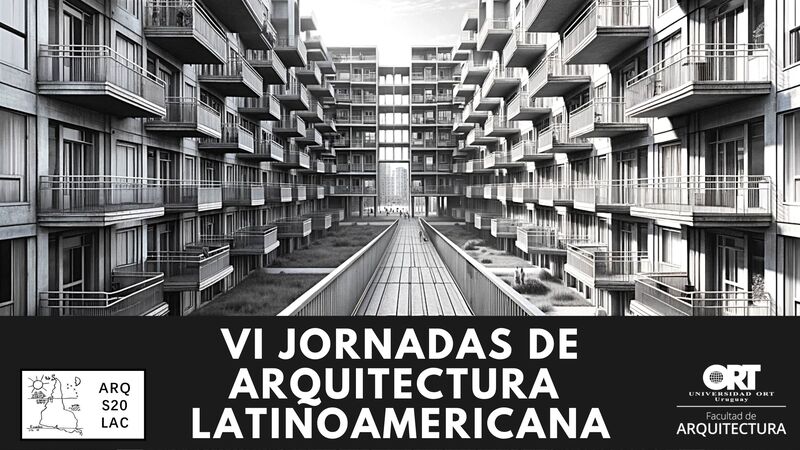
This event, which is of great significance in the field of Latin American modern architecture, focused on exploring modern housing in the region, covering both private and government projects.
Over the course of three sessions, coordinated and moderated by Ruben García Miranda, architect— a professor of Theory and History of Architecture at the Universidad del Salvador in Argentina, and a researcher on urban planning and city architecture—and architect Enrique Madia —an architect from the School of Architecture, Design, and Urban Planning at the University of Buenos Aires, as well as an Argentine-American writer, educator, and critic—expertsand scholars presented their research and perspectives, contributing to a critical dialogue on the conservation, management, and recognition of Latin American architectural heritage.
Modern Housing in Latin America
The first day focused on the evolution and impact of modern housing in Latin America. During this session, participants not only explored architectural designs but also delved into the social, cultural, and political dimensions surrounding them.
The speakers at this conference presented a variety of perspectives, each focusing on different aspects of modern architecture and its relationship to housing in the region.
The Architect Hugo Segawa, a master architect, Ph.D., and professor at the Faculty of Architecture and Urbanism at the University of São Paulo, Brazil, for example, provided a detailed analysis of modern collective housing in Latin America, exploring how its design and functionality have responded to sociocultural and political changes in the region.
Using specific examples, Segawa illustrated how these spaces reflect the complexities and contradictions of Latin American society.
On the other hand, the Architect Emilio Rivoira, an architect from the Faculty of Architecture, Design, and Urban Planning at the University of Buenos Aires, offered a fascinating perspective on the concept of inhabiting in modern architecture.
Their discussion focused on how architectural design influences daily life and the urban landscape, offering a critical analysis of the interaction between space, users, and cultural context.
- You might also be interested in reading our article: “Modern Architecture: A Paradigm Shift”
The Architect Pablo FrontiniMar who holds a Ph.D. in Architecture from ETSA Barcelona UPC and is a tenured professor of Design at the Faculty of Architecture of Universidad ORT Uruguay, linked modern architecture with urban planning, demonstrating how specific urban planning projects can serve as reflections of broader cultural and social changes.
His approach emphasized the importance of understanding architecture not only as a physical form, but as an integral element in the morphology of cities.
For his part, architect Mario Ferrada, in addressing the role of the state in the development of modern housing in Chile, provided a unique perspective on the intersection between government policy and architectural design.
His analysis highlighted the complex relationship between government housing programs and the resulting architectural forms, emphasizing how political decisions can have a tangible impact on the urban landscape.
- You might also be interested in reading: “11 Examples of Modern and Postmodern Architecture That Shaped the Aesthetics of the 20th Century”
The Q&A session provided a valuable opportunity to delve deeper into these topics, fostering a fruitful exchange between speakers and attendees. This exchange highlighted the importance of sustainability, social inclusion, and heritage conservation in the context of modern Latin American architecture.
The first day of the “6th Conference on Latin American Architecture” thus provided a solid foundation for understanding the many facets of modern housing in the region, highlighting its importance in architectural, social, and cultural spheres.
Watch the full video coverage of the first day:
https://www.youtube.com/watch?v=n4w-Wbehahs
Learn about the Architecture Degree
Adaptation and Context in Modern Architecture
Moderated by Maria Eugenia Puppo, an architect and professor at Universidad ORT Uruguay, the second session explored how modern architecture has adapted and evolved in different Latin American contexts, highlighting its interaction with cultural, climatic, and technological factors, among other topics.
- We also recommend reading: “A professor and architecture students received third prize in the Architectural Concept Competition for the Mariano Arana Cultural Center (IM)”
The Architect César Velandia, an architect and holder of a Ph.D. in Geography from the University of Alicante, Spain, who has also served as a professor and researcher at the Faculty of Humanities, Arts, and Social Sciences at the University of Ibagué, Colombia, presented an innovative approach to the digitization of architectural heritage in Colombia through a digital repository.
This project highlights the importance of preserving and promoting modern architectural heritageby using advanced technologies to capture and spatially represent significant buildings. This approach not only preserves the architectural legacy but also facilitates access to and study of these works on a global scale.
- We also recommend reading: “Architecture and cinema: a sublime artistic relationship through the great classics”
The Architect Andrea Castro, an architect with a degree from the University of Zulia, Venezuela, a master’s degree in the Laboratory for 21st-Century Housing from the Polytechnic University of Catalonia, and a master’s degree in Integrated Architecture Projects from Ramón Llull University in Barcelona, as well as the assistant academic coordinator of the Architecture program at Universidad ORT Uruguay, gave a presentation on the “La Pomona Complex” in Maracaibo, Venezuela. There, she illustrated the influence of Town Planning Associates on Venezuelan architecture.
Architect Castro’s insightful analysis highlighted how this project demonstrates a thoughtful adaptation to the region’s tropical climate and urban challenges. La Pomona thus stands as a prime example of how modern architecture can contribute to urban development and adapt to specific contexts.
The discussion on popular modern architecture in Costa Rica, presented by Architect Andrés Fernández, a Costa Rican researcher and critic, provided a unique perspective on the “Casa Pachuca.”
This type of housing, developed empirically by local master builders, represents a popular expression of architecture, adapting to the needs and available resources within the context of this Central American country. In this regard, Architect Fernández highlighted how these structures reflect a distinctive architectural style and a creative response to limitations in resources and technology.
Carla Nóbile, an architect with a Universidad ORT Uruguay from Universidad ORT Uruguay a master’s candidate in the History and Culture of Architecture and the City at Torcuato di Tella University in Argentina,focused her presentation on the relationship between architectural education and heritage preservation. Her analysis highlighted the importance of integrating the study and appreciation of modern heritage into architectural education programs, thereby fostering greater awareness and respect for the architectural legacy among future generations of architects.
- You might also find this article interesting: “On the significance of Heritage Day and the work of A. Jones, as seen by architect Gastón Boero”
The second day of the “6th Conference on Latin American Architecture” highlighted, among other things, the rich diversity and adaptability of modern architecture in Latin America, demonstrating how these projects respond to the specific challenges of their contexts and contribute to the region’s sustainable and cultural development.
Watch the full video coverage of the second day:
https://www.youtube.com/watch?v=xLwX7HbrENs
Learn about the Architecture Degree
Reflections on Modern Housing and Urban Development
Finally, on the third day, which featured a special appearance by Architect Gastón Boero, dean of the School of Architecture at Universidad ORT Uruguay , who spoke Universidad ORT Uruguay the opening, the focus was primarily on topics related to social housing and urban development. Particular emphasis was placed on how modern architecture has influenced the shaping of Latin American cities and their social fabric.
This conference stood out for its focus on projects and theories that approach housing from different perspectives, including both inner-city housing and suburban housing.
The speakers presented case studies and analyses that highlighted the complexity of modern housing and its interaction with socioeconomic, cultural, and environmental factors. Together, they addressed how modern housing has been integrated and evolved within the Latin American context, highlighting its interaction with urban planning, sustainability, and cultural identity.
- You might also find this interesting: “Architecture and video games: a partnership that is changing the way things are done”
The Enrique De Anda, Architect, an architect, professor, and Ph.D. in Art History from the Faculty of Philosophy and Letters at UNAM, renowned for his profound knowledge of art history, offered a critical perspective on social housing in Mexico, focusing on how the modern movement influenced the design and functionality of these structures. His analysis highlighted the role of architectural heritage in Mexico’s urban narrative.
Her compatriot, Architect Sara Topelson, an architect who graduated from the National Autonomous University of Mexico (UNAM), where she also teaches, presented a comparative study on intra-urban and peri-urban housing in the Mexico City Metropolitan Area.
His presentation shed light on design dynamics and planning challenges in various urban contexts, highlighting how these housing models reflect and respond to the social and cultural needs of the population.
With a focus on urban planning and heritage preservation, the Architect Leonardo Castriota, an urban planner and PhD in Philosophy from the Federal University of Minas Gerais, Brazil, shared his analysis on “Pampulha: The Curves of Time.” This presentation addressed not only the architectural significance of the site but also its evolution and the challenge of maintaining its relevance and functionality over time.
- You might also find this article interesting: “How Artificial Intelligence Is Transforming Architecture”
Finally, the Architect Fernando Freire, a professor and researcher whose work focuses particularly on Peruvian architecture, examined the modern form of single-family housing in Peru between 1950 and 1970.
His discussion highlighted how modern architecture, influenced by universal principles and technological advances, adapted to local conditions, giving rise to a distinctive style in Peru.
The third day concluded with an insightful look at the evolution of modern housing in Latin America, showing how these spaces not only meet functional needs but also reflect and contribute to the region’s social and cultural fabric.
Watch the full video coverage of the third day:
https://www.youtube.com/watch?v=Ozp9N0A-8SU