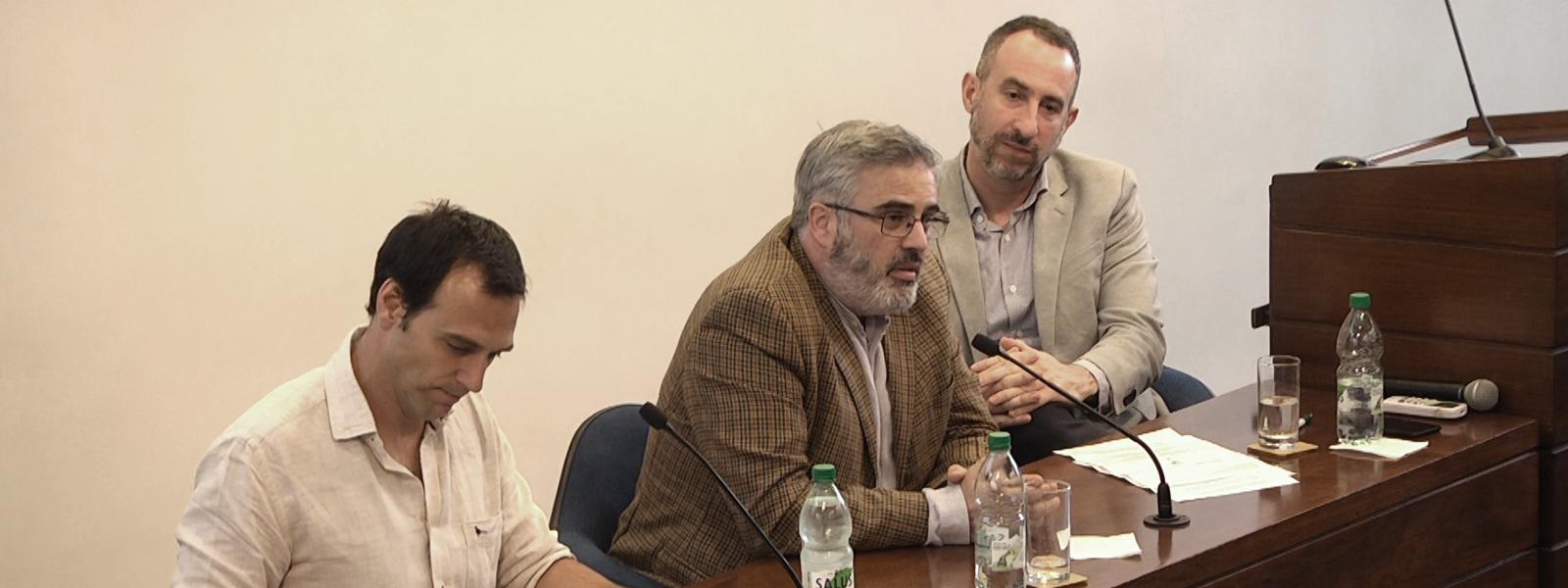
“Social media is not synonymous with the real world. What is discussed there does not necessarily reflect the priorities of the global population,” said Francisco Faig—editorial writer and columnist for El País—during the presentation of his book *Abriendo el hilo: Coexistence and Democracy in the Age of Social Media*.
According to Faig, the essay revisits fundamental questions about democracy and the characteristics of social media as opposed to the real world. It addresses the challenges facing citizens in this century, as well as the confusion that can arise from the variety of ways people can access information today. Published by Editorial Sudamericana, the book won first prize in the 2019 essay contest sponsored by the Freemasons of Uruguay.
The presentation, organized by the Department of International Studies, took place on Monday, November 25, 2019, at the Pocitos Campus of Universidad ORT Uruguay.
Faig earned his DEA in Political Studies from the Paris Institute of Political Studies (Sciences Po) and is currently pursuing a Master’s degree in Liberal Arts at Adolfo Ibáñez University in Chile. Until 2015, he was a professor in the School of Business and Social Sciences at Universidad ORT Uruguay.
During the presentation, Facundo Ponce de León—who holds a Ph.D. in Philosophy from Carlos III University in Madrid and serves as director of the Department of Humanities at the Catholic University and of the audiovisual production company Mueca Films—spoke about the book.
The Distortion of Social Media
Ponce de León shared his thoughts after reading the book:
- The essay raises the anthropological question of aggression: “We humans have a violent side that we need to let out,” said Ponce de León, who wonders whether social media might not be the very outlet —once attributed to the stadium—through which we are “releasing certain toxins.”
- Emotion is what works on social media: “Yet we are in an era of unemotional political leaders.”
- How prejudice takes shape: “Social media amplifies existing prejudices; it doesn’t create anything new. If anything, it makes them more obvious.”
- We need to broaden our understanding of politics and stop thinking that engineering is neutral: “We think that elections determine the next five years. That’s both true and not true. Politics is also shaped by what engineers are doing right now as they write software.”
- How to Use WhatsApp: Ponce de León wondered whether all the issues discussed regarding other social media platforms also apply to WhatsApp.
- The role of social media in the public sphere remains unclear: It is still unknown how digital natives will use social media in this context in the future. However, Ponce de León expressed optimism on the matter.
- It is important to remain measured and cautious: “While social media and the world today move at a breakneck pace, the challenge in education is to learn to slow down.”
Reason and emotion
Faig has been living in Chile since 2016. Since then, social media has played a major role in his life.
In January 2018, he made a mistake in one of his columns for El País. Following this, someone picked up on the incorrect information he had written.
“I started getting bombarded with a barrage of insults on Facebook and Twitter. People I’d never seen in my life were insulting me—sometimes anonymously, sometimes by name,” he said.
He said that this led him to reflect on social media as a communication tool, in the context of public debate, and in relation to more traditional communication systems.
The essay, which examines the characteristics of social media and democracy, emphasizes their non-rational dimension. In both, “emotion takes precedence.”
The relationship with reality is different on social media than when reading a newspaper. “In an age of information overload, digital natives face the problem of not knowing whom to trust for news.”
Some people don’t use social media; what’s discussed on social media isn’t necessarily what’s discussed in the country; there are issues that are priorities around the world but are hardly ever mentioned on these platforms. In other words, social media isn’t representative of reality.
“All of these aspects are new. Ten years ago, none of this was on the table. They call into question fundamental aspects of representative democracy: the role of lawmakers, the care with which issues that shape the direction of a society must be addressed, and the importance of networks in resolving matters that are central to the country’s public debate or to decisions that must be made collectively,” Faig said.
“Facebook friends don’t represent the world in the slightest,” Faig said. Facebook uses an algorithm to decide which posts to show each person. Everyone is connected to a community that shares their views—one that isn’t objective—which tends to polarize opinions.
“All of this means that we, as citizens, need to stay informed about what is happening,” Faig said, concluding that “society is more complex than social media.”