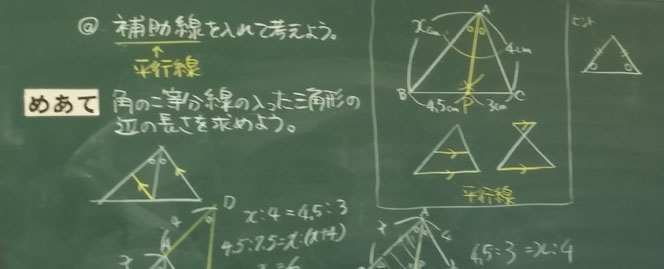
In October 2017, Ariel Fripp traveled to Japan. The instructor at the Universidad ORT Uruguay Institute of Education Universidad ORT Uruguay a scholarship that took him to Japan to study and analyze ways to improve mathematics education in secondary schools.
“It was extremely interesting; a very enriching experience both academically and culturally,” he said.
The Road to Japan
This was the second time he had received an envelope from the Uruguayan Association for International Cooperation. It was the second time Ariel Fripp had been invited to participate in the Japan International Cooperation Agency (JICA) program “Improving the Quality of Mathematics Education in Secondary Schools.”
The first time he read the call for applications, he thought it sounded interesting and shared it with the teachers he knew. It didn’t occur to him to apply. The second time, when he saw that the age limit was 50—and he was about to turn 50—he applied and was selected.
Fripp and a woman from Paraguay were the only South Americans, although he also shared the experience with participants from Nicaragua, Honduras, El Salvador, and Panama, among others.
He visited Tokyo, Hiroshima, and Okayama. He began his trip in late October and returned in late November 2017. For about a month, he took classes Monday through Friday at Okayama University, where he also stayed.
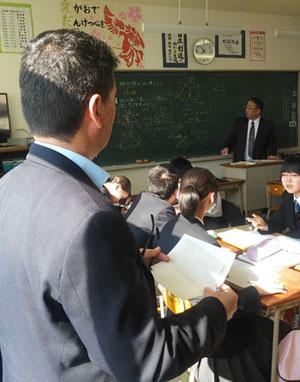
He also visited secondary schools to observe math classes.
Pre-boarding and preliminary ideas
 “Sometimes you have dreams. You say, ‘I’d love to go here or there.’ Japan had never even crossed my mind,” Fripp said.
The farthest she had ever traveled was to Turkey. She didn’t speak Japanese and didn’t know anything about the education system there. However, as soon as she was awarded the scholarship, she started reading up on the subject. In addition, throughout their stay, the program participants were accompanied by two translators, so language wasn’t an issue either.
“What would the Japanese level of math be like? Very different from Uruguay’s?” the teacher wondered. To his surprise, just like the curriculum, the textbooks, and the way math was taught, they were very similar.
He also thought there would be differences among the students: “The teenagers were just the same. They were in the hallways, chatting, laughing, and hugging each other. It was just like being in a classroom in Uruguay.”
He noticed the difference when the teacher asked for—as Fripp was told—a “working posture.” The students sat up straight and got to work until the end of class. In any case, he observed “a lot of warmth” on the teacher’s part and a “very pleasant” working atmosphere.
Destination: A Math Class
In Japan, math classes were not substantially different from those in Uruguay, despite the more than 18,000-kilometer distance between the two countries. However, Fripp was struck by the fact that the focus was on the procedure rather than on the mathematical solution.
According to what was explained to him, this is because the country found that students were having trouble expressing their feelings. As a result, educational efforts focused on reversing this trend: “In every class I observed, students were encouraged to put their reasoning into words and explain in detail how they had solved the problem.”
At the same time, he found that in Japan they follow a “learning guidance plan,” whereas in Uruguay they use “instructional planning.” “Words are not innocent,” noted the tutor from the Institute of Education, referring to the fact that the Japanese focus on what “students can and should learn.” That was one of the key ideas he brought back to implement.
“Those of us who have been in a classroom know that teaching and learning follow different paths. The teacher, with the best of intentions, sometimes teaches math, but the student has only just grasped the topic from the previous month,” he said.
Although he says that “in Uruguay, people have been talking for years about the need to focus on learning and the student,” in Japan he saw concrete steps being taken: “I think that’s the step we need to take.”
A field trip
 Upon completing the program, Fripp was required to submit a research proposal. He had only a month to put it together, so he thought of something that might be feasible. He decided to focus on “classroom-based educational studies”: a Japanese practice aimed at improving learning that began in the late 19th century.
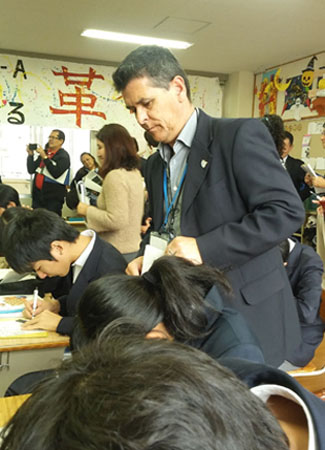
It involves a teacher planning a lesson under the supervision of a group of people: colleagues, supervisors, and administrators. This group observes the lesson, and once it is over, they hold a debriefing session to discuss and evaluate it.
Fripp participated in several of these sessions. He observed how the teacher introduced themselves, discussed their lesson, explained their intentions, highlighted its strengths, and pointed out its weaknesses. The teacher was then asked why they had chosen one particular activity over another. A discussion ensued, and the session concluded. If the teacher taught the same lesson to another class, they would implement the suggestions and later describe what had happened.
According to the teacher, the feedback is “entirely constructive”: “What I liked most was that openness to hearing criticism. There’s no bad blood because each member feels that this process benefits both the teacher they’re working with and themselves.”
“From here, one might think, ‘How intrusive,’ but it’s a well-established practice that has fostered strong communities of teachers who observe each other’s classes, share best practices, open their classrooms to one another, and grow professionally together,” he added.
The landing and the return
For Fripp, the classroom study is an interesting model that he wants to apply to the Uruguayan context, particularly in full-time high schools. However, when he arrived—in late 2017—he was unable to put it into practice.
“Sometimes, it’s better not to rush things. It’s essential to see the value in growing as a group,” he said. But he is convinced that things happen for a reason. They will not only conduct classroom studies among math teachers but will also apply them to the sciences: biology, chemistry, physics, astronomy, and computer science.
He is currently adapting the original project: creating a background document so that institutions can understand the intent and apply.
Fripp's goal is to conduct two or three classroom studies in 2018. He is currently focusing all his energy on that.