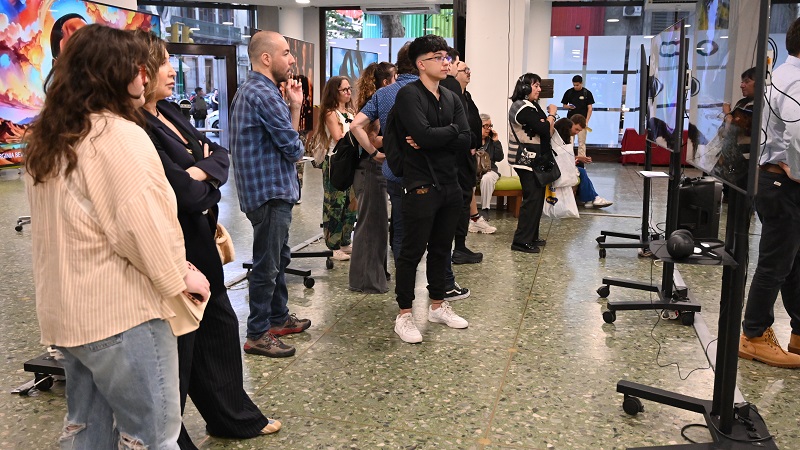
The event was organized by the French Embassy and the Alliance Française, with support from the Institut Français, in collaboration with the Universidad ORT Uruguay, through its Bachelor’s Program in Design, Art, and Technology.
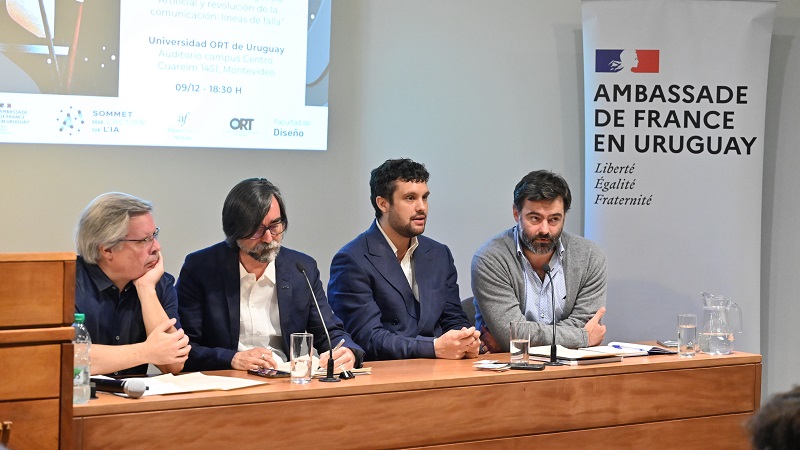
During the event, a panel discussion titled “Artificial Ethics in Digital Art” was held, featuring Valentin Schmite, PhD, an AI and culture specialist, author, researcher, and co-founder of Ask Mona from France; and Enrique Aguerre, director of the National Museum of Visual Arts (MNAV) in Uruguay.
The event was moderated by Fabián Barros, MA, academic coordinator of the Bachelor’s Degree in Design, Art, and Technology.
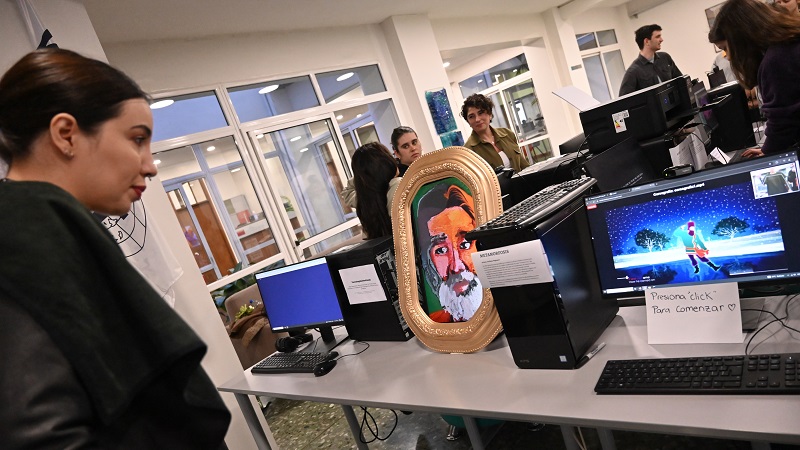
At the same time, an exhibition featuring art and artificial intelligence was held, curated by the following Chilean artists : Leticia Almeida, Marcelo Vidal, Pedro Corso, Diego Miranda, Guido Iafigliola, Mathías Chumino, Silvina Cortés, Camila Rodríguez, Carolina Zunino, Diego Fernández, and Fabián Barros.
Works by students in design, art, and technology were also on display.
Panel on Ethics, Art, and Artificial Intelligence
The discussion, held in the auditorium of the School of Design, brought together students, staff, and university officials to address the impact of artificial intelligence on art and its ethical implications.
The key questions were: What impact can AI have on art? Is AI a new creator of art or a new tool for creation? How are copyright issues handled when machines are involved in the creative process? And finally, can AI democratize access to art?
Valentin Schmite defined artificial intelligence as a field aimed at replicating the functioning of the human brain through machines, noting that its ability to create something new is what makes it similar to the human creative process.
However, Schmite emphasized that AI should be viewed as a tool:
It is an extremely powerful and versatile tool that allows us to do many things, but it is still just a tool.
Regarding ethical challenges, he mentioned the danger of deepfakes and reflected on the crucial role of artists, who enable us to "question reality" and "unreality" in a world increasingly shaped by technology.
Enrique Aguerre, director of the MNAV, took a different stance, suggesting that machines could replace humans in the role of creator.
Referring to Gottfried Leibnizand advances in machine learning, he argued that the machine, beyond being a tool, could be viewed as a “machine of machines, ” capable of performing multiple functions simultaneously.
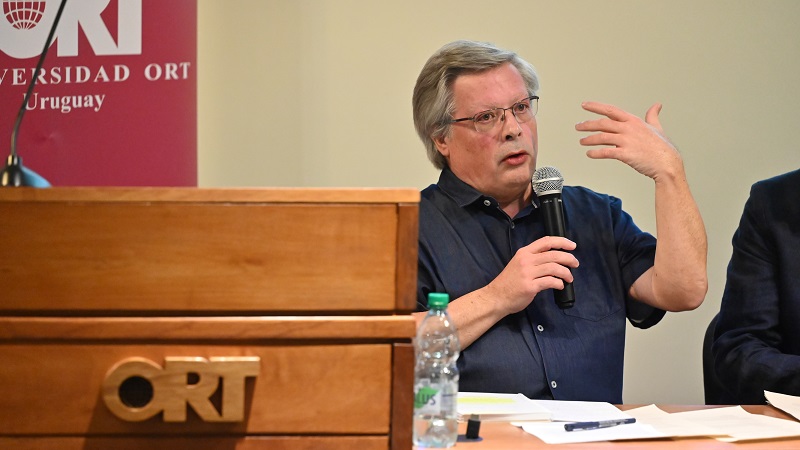
Aguerre also emphasized the importance of understanding how these technologies work, citing the philosopher Vilém Flusser, who advocated for demystifying the opacity of machines and gaining access to computer code.
He also emphasized the need to consider the viewer’s aesthetic experience and how technology is not foreign to human beings, but rather an integral part of our nature.
The conversation turned to copyright, an issue that is being challenged by AI. Enrique Aguerre argued that, just like open-source software, new technologies require innovative licensing models that acknowledge changes in creative processes.
According to Aguerre, not everything generated by AI should be considered art, since deep creativity remains a human quality that requires effort and reflection:
Just because we have a camera doesn't make us great photographers; the same goes for artificial intelligence.
The question of whether AI can democratize access to art was also raised. Schmite warned of the risks of technological centralization and standardization, noting that relying on a single tool like Midjourney or ChatGPT would not foster true democratization.
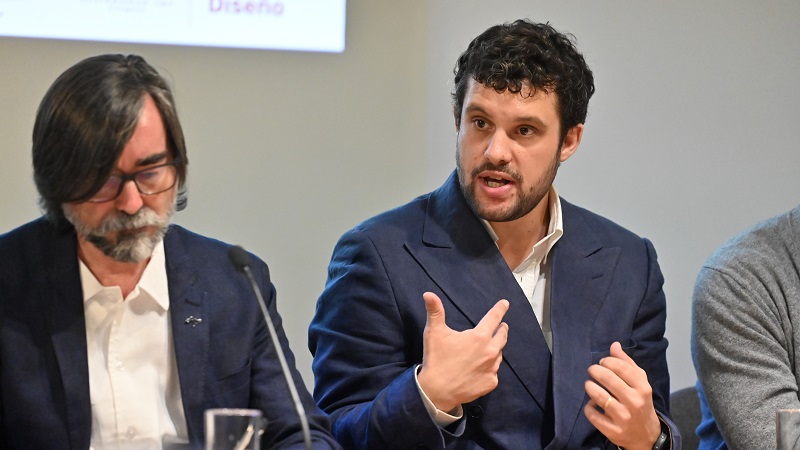
According to Schmite, it is essential to engage with and explore these tools critically, which, in itself, can be an artistic act.
Aguerre agreed that, in order to transform culture and artistic expression, artists must move beyond the role of mere users and become developers, understanding and questioning the tools they use. Education, he said, is key to ensuring the conscious and creative use of AI.
The panel concluded with a critical reflection on the future of artificial intelligence in art, a constantly evolving field that raises questions about authorship, creativity, and the democratization of access to culture.
What is Ask Mona?
During the forum, Valentin Schmite presented Ask Mona, the platform he co-founded seven years ago that uses generative artificial intelligence to enhance the visitor experience at museums and cultural venues.
Ask Mona allows users to interact with a virtual assistant in real time, getting immediate answers about the exhibitions. Using QR codes, visitors can access personalized content related to artworks, artists, or historic sites. In addition, the platform simplifies reservation management and optimizes customer service.
The system does not require users to download any apps, allowing visitors to take photos of the exhibits, which are then identified and described by AI in 90 languages. The descriptions are drawn from a database provided directly by the museums, ensuring accurate and contextually relevant information.
Schmite emphasized that Ask Mona views a visit to the museum as an ongoing conversation that begins before visitors enter and extends beyond the tour, fostering a connection between the public and the art.
The ethical standards or principles applied at Ask Mona
During the forum, the French writer was asked about the core ethical principles that guide the development of Ask Mona in the cultural sphere.
The first principle focuses on preventing the spread of false information and maintaining strict control over the data used. Schmite emphasized that, in the context of generative AI tools such as ChatGPT, there is a risk of "hallucinations" or erroneous responses.
To prevent this, Ask Mona works exclusively with databases verified by historians and subject matter experts, thereby ensuring the accuracy and reliability of the information provided to users.
The second principle is strict respect for copyright. The platform maintains a firm policy in defense of intellectual property, ensuring that all information it receives and uses is properly credited and compensated.
Every time content is added to the Ask Mona database, it ensures that the original creators are compensated:
As an artificial intelligence company, we cannot create systems and steal other people's intellectual property.
Works by students in the Bachelor's Degree Program in Design, Art, and Technology presented at the exhibition
- ID. Isforia by Sebastián Tranquillo.
- "Collective Resonance " by Alexandra Zeballos.
- Metamorphosis by Giuliana Bagnasco.
- Microbiot ART by María Kachadourian.
- "Mutant " by Tomás Fort.
- A vision by María Pía Cea.
- Those on the other side of Francisco Abásolo.
Learn more about theBachelor's Degree in Design, Art, and Technology at the University of the Pacific (
).