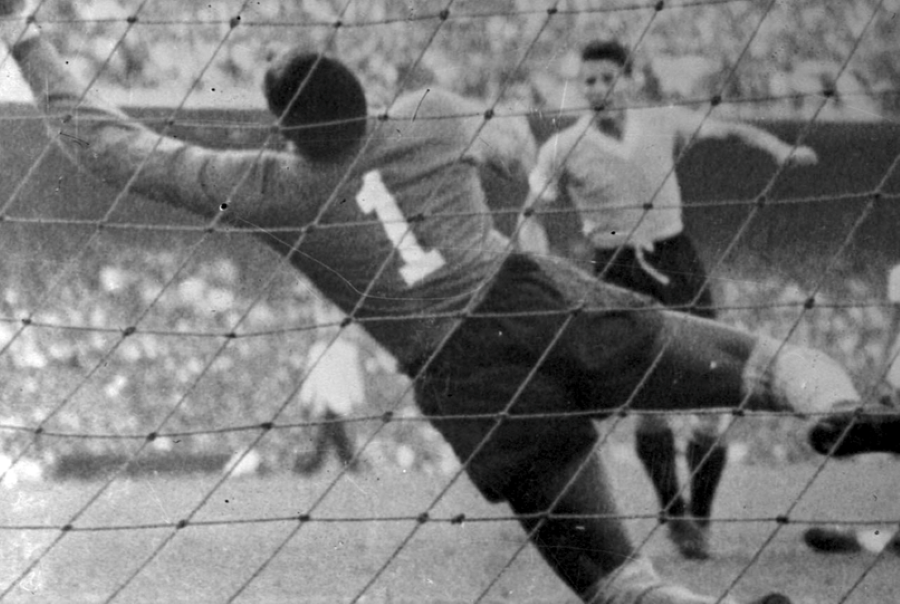
“Brazilians, I kept my word by building this stadium; now do your duty by winning the World Cup.” With these words, the Mayor of Rio de Janeiro, Mendez de Morais, concluded his speech on the day of the final of the World Cup hosted by Brazil in 1950, just five years after the end of World War II.
It’s a presidential election year in Brazil, and all the candidates are looking to capitalize on the country’s sporting success to bolster their campaigns. Goalkeeper Moacir Barbosa takes the field as one of the most popular mayoral candidates in the upcoming elections, and—like the rest of the Brazilian national team—he wears a jersey under his uniform that reads “BRASIL CAMPEAO.”
In the other locker room, Uruguayan captain Obdulio Varela was preparing to lead his team into a match that would forever remain etched in soccer history. A few months earlier, he himself had spearheaded the players’ general strike; this period would lay the groundwork for a team that would find in its captain a leader capable of uniting the squad and guiding it to victory. Among them was the young rookie Alcides Ghiggia, who, 78 minutes later, would be at the center of the greatest tragedy and feat in the history of soccer.
"Maracanã" is a metaphor for the manipulation of people through sports and the determination of individuals to assert their dignity in the face of external forces that seek to subdue them.
These paragraphs can be read on the website for *Maracaná*, the documentary that chronicles Uruguay’s most important World Cup victory.
Drawing on Atilio Garrido’s book *Maracaná: The Secret History*, filmmakers Sebastián Bednarik and Andrés Varela set themselves the challenge of bringing this story to the big screen. Bednarik and Varela had previously collaborated—always in the documentary genre—on *La Matinée* (2006), *Cachila* (2007), and *Mundialito* (2010).
For *Maracaná*, they enlisted Guzmán García, who holds a degree in Audiovisual Communication from Universidad ORT Uruguay; he was responsible for editing the documentary and, prior to that, wrote the screenplay. He explained how the screenplay was adapted to the existing footage, rather than the other way around.
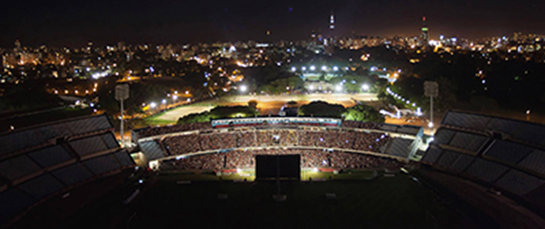
Let's start with the latest news: How did the film premiere go at Estadio Centenario, which drew a crowd of over 10,000 people?
It went really well. The crowd reacted just as I expected—in fact, at times their reactions went even further than I had anticipated: cheers when a goal was scored, applause, and moments of silence.
As a screenwriter, you faced a challenge when dealing with various sources of information, such as the Cinemateca archive. What was it like working with the directors?
The whole process took more than two years. The first step was to put together the script: I wrote several drafts until it was just right. But the problem was that what was in the script didn’t necessarily translate into visuals. So we began the next phase: trying to obtain the materials needed to tell that story, and adapting the story to the archival footage that was coming to light.
At that time, Sebastián and Andrés managed to obtain some excellent footage from the Cinemateca.
Then came a third phase in which other footage from abroad began to arrive, and we had to adapt the film as new material came in.
It was an interesting and fun process, but quite challenging.
How did you find working on *Maracaná* after directing *Todavía el amor*?
*Todavía el amor* is a documentary I worked on for three years. It’s about romantic relationships in old age. I’m happy with how it turned out. It did very well at festivals, screening at the most important international documentary film festivals. In Uruguay, the preview took place at DocMontevideo, and it was released in theaters last November. It’s now part of the Efecto Cine touring program, and it will be released on DVD in a couple of months.
I take both documentaries very seriously; I think I put a similar amount of work into both films. The difference is that I put together *Maracaná* more in line with Sebastián and Andrés’s style and sensibility. Still, now that I’ve seen the finished film, I was struck by the fact that some elements felt more like my own than I had imagined.
What are you working on right now?
I'm currently shooting my new documentary, tentatively titled *Looking Up at the Sky*, a film about a group of community theater actors. It explores the relationship between theater practice and the life stories of the company's members.
I'm working with a great team: Patricia Olveria is in charge of production, Arauco Hernandez and Marcelo Rabuñal are handling the cinematography, and Andrés Borotra is editing. The rest of the team consists of people from Coral Films, with whom we've been working on various projects.
I hope to wrap up filming in the next couple of months and have the movie finished by the middle of next year.
Maracanã Trailer
https://youtu.be/JrVAl4jASeA?si=FClEz0L5v0usL7aV