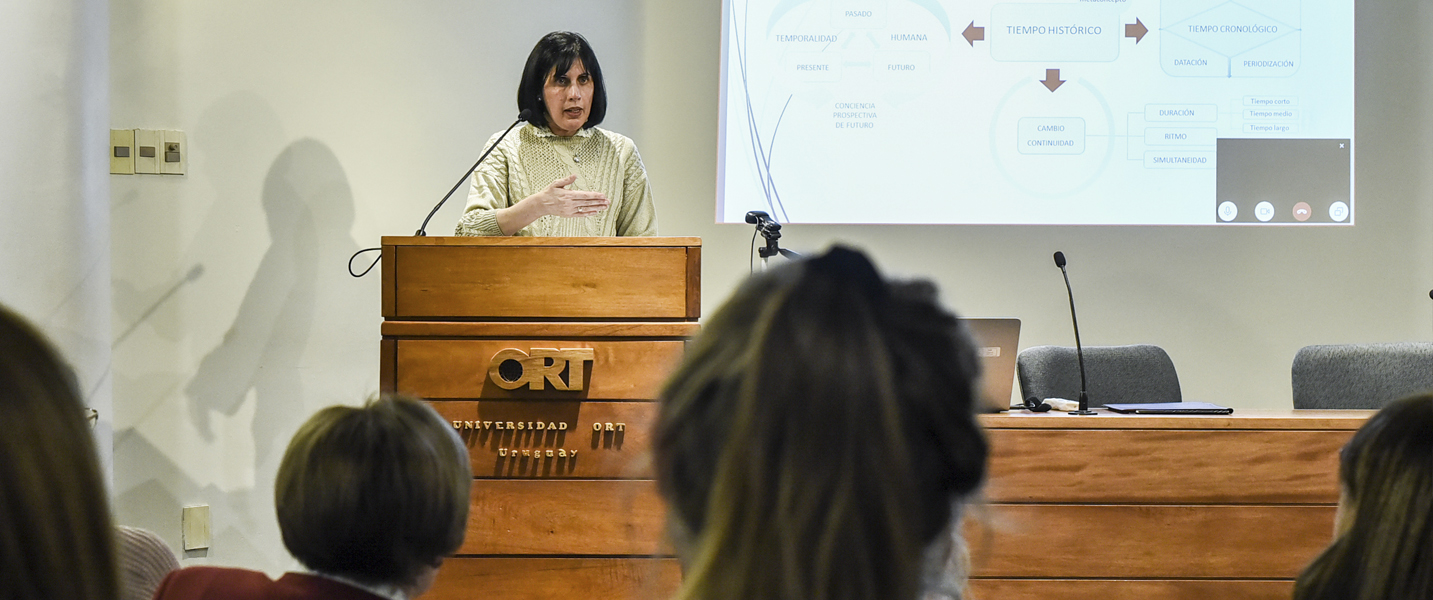
“The integration of ICT into the teaching practices of history teachers remains a complex issue,” noted María Guadalupe López Filardo during the defense of her doctoral dissertation, titled Conceptions and Practices with ICT: The Didactic Construction of Historical Time in the Initial Training of History Teachers.
According to research conducted by a graduate and instructor at the Institute of Education, the integration of ICT—in a pedagogically meaningful way—into initial teacher training remains “a challenge yet to be addressed.”
"What are the reasons behind this? What teaching strategies and technological resources do Uruguayan history teachers use? How often do they incorporate ICT into their classes? How do they approach the teaching of historical concepts?" These were some of the questions López addressed.
How do history teachers integrate ICT?
“Based on the cases studied, it could be said that teachers perceive themselves as limited in their ability to use ICT creatively,” said López, who noted that this is due to several reasons. These include insufficient experience using technological tools, a lack of innovative practices that promote new forms of learning, and the absence of adequate criteria to demonstrate their usefulness from an educational standpoint.
Although both novice and experienced teachers reported having taken ICT training courses at some point, López noted that “curiously, and although it may seem paradoxical, it is the younger teachers who feel most limited when it comes to incorporating ICT into their subject areas.”
Functional, structural, and pedagogical factors are among the elements that explain this. Above all, however, López found that it is due to a lack of training, which makes it impossible to incorporate technology into the classroom. “This underscores the need for technology-based pedagogical training for history teachers,” he said.
Teachers recognize that ICT promotes motivation and independent learning, which is why they incorporate it into their classes to teach historical content, primarily for informational, semantic, and communicative purposes.
However, their frequency of use is “fairly limited,” and even more so when it comes to teaching historical time: “When it comes to the pedagogical construction of historical time, digital resources are often underutilized.” López noted that there is a “moderate presence of ICT resources specifically designed for this purpose,” as well as a limited variety of tools.
“There is a lack of role models and guidance to encourage a thoughtful and innovative use of technology,” he added.
The Teaching of History
“Generally speaking, the collective imagination—and even in many educational settings—has viewed historical knowledge as a mere rote accumulation of facts, dates, and concepts about the past,” said López, who noted that this idea is “quite far removed” from current approaches to the teaching of history.
In his words, one of the primary goals of history is for students to acquire a set of “tools for analysis and interpretation that help them construct their own representations of the past, so that they can gain an understanding of historical and social phenomena.” Therefore, in this context, historical understanding involves engaging “a series of complex processes and lines of thought.”
In order to teach historical concepts, teachers should, as he put it, not only have a solid epistemological understanding of the discipline, but also possess “pedagogical skills that contribute to a better understanding of the phenomena.”
In the cases studied in his research, López found that there are no differences between novice and experienced teachers regarding the nature of historical knowledge, how it is taught, and the purpose of history. “They have a modern view of history education, focused on developing interpretive skills regarding the past, which enables students to critically analyze historical reality,” he added.
For her, historical time is a concept “essential to the interpretation of historical phenomena”: “It refers not only to chronological time, but above all to other concepts linked to historical temporality, which takes shape over the course of our lives, in a dialectical relationship between past, present, and future.”
Unlike the findings of some international studies—which conclude that most teachers teach historical time in a rather reductionist manner—the participants in this study demonstrated a “very good understanding of the various dimensions of historical time.”
https://youtu.be/cQf0OY7hIIY
About the research
Through an analytical, descriptive, and empirical study, López set out to identify and understand the views of a group of history teachers on the teaching of historical time and the way in which, based on their training and professional experience, they use ICT to construct this concept in the classroom.
Why conduct research on teaching historical time in relation to ICT? “The thesis originated from my own personal interests—not only as a history teacher but also as a trainer of future teachers—which led me to question the way certain concepts are taught or should be taught, concepts that are key to the construction of historical knowledge, as well as the role that ICTs play in that process,” López explained.
To this end, she opted for a qualitative methodology because, in her view, it allows for “a better observation of situations in their natural context, from the perspective of the subjective meanings attributed to them by the teachers themselves.” In turn, she adopted different approaches: the phenomenological and the hermeneutic, with an emphasis on the ethnographic. She also combined four techniques: in-depth interviews, focus groups, non-participant classroom observation, and document analysis.
López conducted a multiple-case study. He selected a purposive sample consisting of a group of 12 teachers from a teacher training center in Montevideo: six instructors of future teachers—three history education instructors and three adjunct instructors—and six novice teachers—three teachers who had graduated in the previous three years and three student teachers who were completing their final practicum at the time of the study.
A New Doctor
Guadalupe López’s doctoral thesis defense took place on Wednesday, July 31, 2019, in the auditorium at the Downtown Campus. After presenting and defending her research, she was awarded a Doctorate in Education from Universidad ORT Uruguay.
The committee consisted of Dr. Denise Vaillant, academic secretary of the Institute of Education; Dr. Jesús Manso, visiting professor at the Institute of Education; and Dr. Rosina Pérez Aguirre, director of the Master’s Program in Education with a concentration in Curriculum and Assessment at the Catholic University of Uruguay. Dr. Carina Lion, a visiting professor, served as thesis advisor.
“For those of us who share a passion for teaching history, this may have been yet another opportunity to exchange ideas and share our successes and uncertainties,” concluded López, who expressed his gratitude for the opportunity to pursue a doctorate in education and, in doing so, further his professional development.
