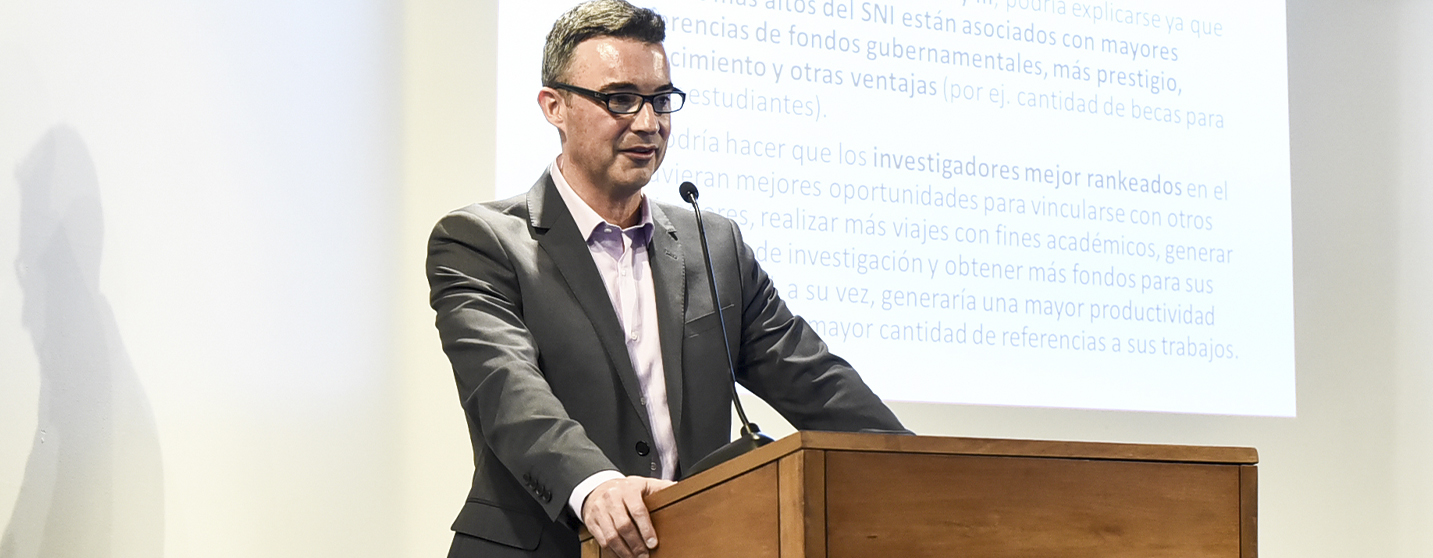
The lack of scale, insufficient infrastructure, limited budgets, limited time, and the absence of a framework for building a strong research team are some of the factors that put Uruguayan research at a competitive disadvantage on the international stage.
That is one of the findings from Marcelo Gambetta’s doctoral dissertation, titled Effects of Research Social Networks and Knowledge Management on Research Productivity.
Some conclusions
“Measuring researchers’ productivity has become a major trend in recent years, worldwide, but especially in developing countries, which aim to track and compare the success of their research centers,” said Marcelo Gambetta, a graduate of the Doctor of Education program and professor at the School of Engineering at Universidad ORT Uruguay.
For this reason, the study set out to examine the impact of research social networks, as well as the role of knowledge management, on the productivity of Uruguayan researchers who are part of the National System of Researchers (SNI).
Her thesis—which combined qualitative and quantitative methods and included a sample of 75 active researchers at SNI Levels II and III—showed that, in general, researchers tend to cluster within the same SNI level, as well as within the same institution, department, and field. As she put it, “spatial proximity tends to generate social proximity.”
He also pointed out that, although 45% of those interviewed acknowledged working with local colleagues or students, Uruguayan researchers also collaborate with foreign academics. The reason lies in the lack of a critical mass and the lack of accumulated expertise in certain fields.
The graduate also concluded that women are underrepresented in the system and that there is a causal relationship between research networks and knowledge management on the one hand, and research productivity on the other.
Regarding the percentage of time spent on research tasks, the results indicated that respondents spend, on average, 50% of their time on research tasks. Finally, Gambetta observed differences in productivity across departments and areas.
The Socialization of Knowledge
According to Gambetta, knowledge is “managed as a network.” Therefore, during his doctoral defense—which took place on Monday, November 18, 2019, in the auditorium of Universidad ORT UruguayDowntown Universidad ORT Uruguayhe pointed out that it is impossible to “ignore social media when discussing knowledge.”
https://www.youtube.com/watch?v=vZpBwLYIoVU&
However, what methods do researchers use to network? Attending conferences, seminars, and workshops is the preferred method: 85% of those surveyed said they do so.
Interestingly, however, 35% said that the most valuable aspect of a conference isn’t what happens in the exhibition halls, but rather what takes place in the hallways or during the networking events organized throughout the event.
On the other hand, 95% of those interviewed said they shared their knowledge—and the remaining 5% said they did so only rarely. In Gambetta’s words, this is an activity “essential to their professional standing and to the dissemination of their work.” In this regard, publishing articles in peer-reviewed journals is the primary method used by researchers.
When it comes to how knowledge is acquired, 50% of those surveyed said that it is a process that takes place mainly through attending seminars, lectures, or presentations.
The glass ceiling
In his research, Gambetta found that women were underrepresented, which he explained could be related to the challenges they face in science-related professions.
In addition to being underrepresented, women rarely network with one another. In fact, of the sample, only two women had a collaborative relationship with one another; the rest interacted exclusively with men.
Contrary to the findings of international studies, the researcher found no differences in productivity between women and men: “That doesn’t mean that women in Uruguay are doing great and don’t face the same problems they do abroad.”
One possible hypothesis, according to Gambetta, is that women, in order to overcome these barriers, seek to forge ties with centers of power and with influential figures, or build social networks among women to surmount these challenges.
Finally, one thing that caught the graduate’s attention was that it wasn’t any of the four women interviewed who brought up the issue of the glass ceiling, but rather the men: “These aren’t issues that only women champion; men are also aware that they contribute to the problem.”
During the course of the doctoral program, one learns to become a researcher. In my case, I learned even more because I had the opportunity to interview highly respected researchers in Uruguay, which gave me a deeper insight into the work researchers do and how to approach research projects.
The Challenges of Research
What barriers did the study participants encounter in forming research networks? Gambetta identified 14: geographical, economic, scale-related, cultural, lack of human resources, lack of time available for research, political, institutional and bureaucratic, the academic system itself, personal networks, ego and jealousy, language, intellectual property, and, finally, the glass ceiling.
According to the findings, the ranking is dominated by geographical barriers. However, in contrast, ICTs are a tool that, according to the researchers interviewed, facilitates knowledge sharing.
In addition, the graduate emphasized the importance of individuals having more time available for research and a positive organizational climate: “In institutions where researchers’ autonomy and self-esteem have been eroded, it is very difficult to create productive research groups.”
“Reality sometimes falls far short of our intentions,” Gambetta said. During his doctoral defense, he also added that it is essential to reevaluate the role of research, given that, in addition to generating benefits, it helps foster an “ecosystem that prevents researchers who are curious and perform their work well from ending up leaving the country.”
“We need to strengthen collaborative networks, connectivity, and partnerships, because greater collaboration leads to greater productivity. Support for research must be more than just talk—it must become a reality,” he concluded.

Marcelo Gambetta defended his dissertation, *The Effects of Research Social Networks and Knowledge Management on Research Productivity*, to earn a Doctor of Education degree from Universidad ORT Uruguay.
The panel consisted of Dr. Eduardo Rodríguez Zidán, associate academic coordinator for graduate programs at the Institute of Education; Dr. Cecilia Rossel, director of the Political Science, Sociology, and Social Work programs at the Catholic University of Uruguay; and Dr. Juan Pablo Zorrilla, president and co-founder of the Uruguay Chapter of the Global Network of Qualified Mexicans Abroad.
Dr. Carlos Marcelo, a member of the Academic Committee for the Doctor of Education program at Universidad ORT Uruguay, served as Gambetta’s thesis advisor.