Sebastián Amorelli isn't your typical architect who designs houses or buildings.
After initially pursuing a degree in Systems Engineering and later graduating with a degree in Architecture from Universidad ORT Uruguay, he always intended to combine both fields: computing and design. The university’s exchange program allowed him to discover a branch of architecture in Italy that would enable him to achieve that goal.
That is how Amorelli entered the world of computational and parametric design, a path that has led him to head the Computation department at External Reference in Barcelona, Spain, where, thanks to the use of new technologies, he has been able to develop cutting-edge urban projects as well as innovative proposals for retail brands such as Bershka, Duty Free, Presented By, WOW Concept, Pinko, Expo Dubai, and Nova Bocana.
This Monday, November 27, on National Architect Day, Amorelli discusses the opportunities and challenges of using technologies such as artificial intelligence, and the path he took to become a non-traditional architect.
What are the key factors today in the retail industry for creating a space that can attract customers and offer them a meaningful experience?
In recent years, the debate surrounding retail has been marked by doomsday predictions: people predicted the end of brick-and-mortar retail and the rise of online shopping, suggesting that all in-person transactions would eventually go digital. Then the pandemic hit, and everything changed.
The pandemic showed us—or reminded us—that we are a social species and that the online experience is still a far cry from what the real world has to offer. Retail has always been part of the social fabric of cities; in Europe, it is more closely associated with the street, while in the American and Middle Eastern models, it is concentrated in the large stores of shopping centers or malls. In this sense, brands and retailers have begun to focus not only on attracting consumers with their products, but also by creating physical experiences and spatial narratives that turn the moment of purchase into a unique and memorable event. We see this in all the major brands of the Inditex group with their new flagship stores, such as Primark, Westfield centers, and the Spanish startup WOW Concept, among others.
Design becomes a distinguishing feature capable of creating unique, dreamlike spaces, and the seamless integration of technology completely transforms the shopping experience. The key lies in turning narratives into spaces capable of creating memorable and unique experiences.
When it comes to design, what are the benefits of using technology?
I believe that technology is now an indispensable tool in design. Traditional methods of design and construction are no longer sufficient to meet the efficiency and deadlines demanded by the market. The emergence of artificial intelligence, such as LLMs (large language models) and generative algorithms, is opening up new horizons and bringing about a massive paradigm shift—one that we are already beginning to experience.
Parametric design strategies are extremely powerful when it comes to design. They involve conceiving the design as a series of rules or instructions conditioned by various parameters. These instructions, encoded in an algorithm (in my case, I use Grasshopper), allow us to explore an infinite number of design possibilities and visualize them instantly. This makes the process much more efficient and, at the same time, more enriching, as it allows for the rapid testing of various ideas. Furthermore, they facilitate the implementation of quick changes in response to modifications in the context, regulations, design, or client preferences—something that could take days using traditional methods. These tools also allow for environmental studies, simulations, and the application of natural laws such as philotaxis in design.
When combined with digital manufacturing technologies (such as CNC cutting, large-format 3D printing, and robotic manufacturing, among others), these tools allow us to create customized solutions for each project, in which every element can be unique, without incurring additional costs. They automate many processes and enable the generation of files for mass production through the creation of just a few algorithms.
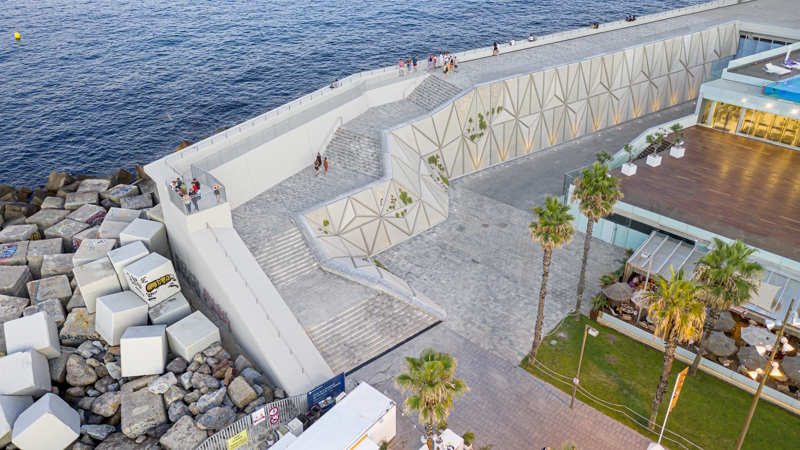
For example, in our latest collaboration with Presented By—a brand dedicated to collectible sneakers—for their store in Riyadh, we created an interior entirely printed in 3D using 366 unique pieces. For the Barcelona waterfront project, we optimized the geometry to manufacture all the concrete panels using just 15 different molds, without compromising our design vision. Both projects were nominated for this year’s World Architecture Festival, which will take place in late November.
On the other hand, we are currently integrating artificial intelligence into our processes, primarily in the creative phase—a field that is still quite experimental but holds enormous potential.
Does the use of technology, on the other hand, pose any challenges?
One of the major challenges is the learning curve, since these tools are very complex, especially at first. Furthermore, their constant evolution means you have to stay up to date. Their widespread adoption is also a challenge, because although instruction in them is starting to become more common, it’s still limited to a few specialized schools. I believe they should form the foundation of any design education program.
When you think of an architect, the first thing that comes to mind is someone who designs houses or buildings. In your case, you’ve broken away from the traditional architect’s mold not only by focusing on computational design, but also by working for retailers. What has that journey been like, from college to the present day?
Before starting my architecture degree, I spent a year studying systems engineering, but I felt something was missing—a creative element—so I decided to switch majors. However, I always looked for a path that would combine computing and design.
During my studies, I had the opportunity to participate in an ORT exchange program, which led me to spend a semester at the Politecnico di Milano in Italy. There, I discovered the world of computational and parametric design. Although it wasn’t part of the official curriculum, I saw students experimenting with these tools and professors encouraging them to use and explore them. From that moment on, I knew there was no turning back.
In Uruguay, I couldn’t find anywhere to study or pursue this path, so once I graduated and was working on renovation projects, I looked for opportunities to develop my skills in this field. That’s how I ended up at the Institute for Advanced Architecture of Catalonia (IAAC) in Barcelona, where I enrolled in the Master of Advanced Architecture program. There I met Carmelo Zappulla, founder of External Reference and my professor at the IAAC, who invited me to work at his studio, which was actively implementing and experimenting with these methodologies and tools.
At External Reference—a multidisciplinary studio whose work ranges from product design to urban-scale projects—I have worked on projects of all scales, including 3D-printed furniture design, retail spaces, hotels, and urban projects, such as the one for Barcelona’s waterfront.
In addition, I am currently a professor. I teach parametric design tools in the Master’s in Interior Design program at the LCI Barcelona School of Design and Visual Arts, and, together with Zappulla, I lead one of the Introductory Studios in the Master’s in Advanced Architecture program at the IAAC. This year, I am also collaborating with Novatr, an online platform and startup that aims to democratize the teaching of design tools for architecture students.
As the Team Leader of the Computation team at External Reference, what are your responsibilities? What does a typical day look like for you?
As a Team Leader in the Computation department at External Reference, my role is to coordinate the teams to achieve the objectives of each project. This involves meeting client expectations and ensuring that the studio’s design schedule is followed.
My daily work involves coordinating with all stakeholders: clients, consultants, suppliers, and our team. I organize design meetings where we discuss project progress, explore creative alternatives, and develop strategies to implement the decisions we’ve made. Every day is different, as projects vary greatly depending on the stage they are in. I am usually involved in projects at various stages, from the competition phase through to construction.
Which project on External Reference taught you the most? What did it involve, and what did you learn?
It’s hard to pick just one project at External Reference from which I’ve learned the most, since each one is so different from the others. But if I had to single one out, it would be the Manglar furniture set (table and chairs), our first project using large-format 3D printing.
Through this project, I discovered the true potential of combining computational design with digital fabrication, which opened up a world of endless possibilities for me. However, we also had to learn to work within the limitations of the material and the fabrication method to ensure that our designs were printable, without losing sight of the aesthetic and functional aspects of the pieces. There was an intensive prototyping process in which we would print a part, test it, and then adjust the code to improve and iterate on the design. Thus, with each iteration, we moved closer to a design we considered ideal.
Another project I’d like to mention is the Vela Staircase and Lookout. This project presented a challenge due to its unique location on the Mediterranean coast, as we had to adapt to a wide range of existing conditions. Thanks to parametric design, we were able to develop an algorithm that incorporated all these constraints, allowing us to precisely control our design intent.
Is there any specific knowledge or advice you received at ORT that you still use today?
The high standards and rigorous approach of the History department at ORT’s School of Architecture taught me to be extremely meticulous in my work and opened up a line of research that I continue to draw on in every project to this day.
What advice would you give to an architecture student who is thinking about following a path similar to yours?
I would advise you to always stay curious and keep exploring new trends, technologies, and processes—even beyond their direct application in your day-to-day work. It’s essential to look beyond architecture and explore different arts and disciplines, such as biology, the natural sciences, technology, and psychology. You never know how this knowledge might help you develop future projects.