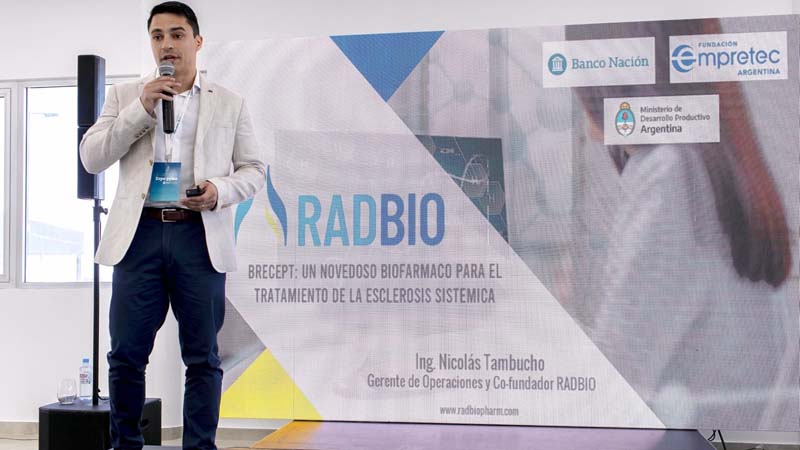
In 2018, Nicolás Tambucho, a graduate in Biotechnology Engineering, was offered the opportunity to serve as CEO of a startup, RADBIO.
A biotechnology startup aiming to develop an innovative biomolecule for the treatment of incurable fibrotic and autoimmune diseases, such as systemic sclerosis.
At that time, he settled in Sunchales, Santa Fe, Argentina, where the CITES incubator (Center for Business and Social Technological Innovation)—part of the Sancor Seguros Group, which took him in—is headquartered.
This biomolecule they discovered and developed could be the cure for the more than 2.7 million people living with this disease, which affects individuals between the ages of 25 and 50. It could eventually be applied to other fibrotic conditions, as it binds to and neutralizes a cytokine called TGF-beta, known as the “master regulator of fibrosis.”
“It is characterized by fibrosis of the skin and joints, which causes pain, physical deformity, and disability. It then spreads to other organs, such as the lungs, reducing the patient’s respiratory capacity, leading them to require respiratory support; pulmonary fibrosis is the leading cause of death,” explains Nicolás Tambucho regarding the disease.
For the past four years, research has been ongoing, and they have gathered increasing evidence of its effectiveness in various models of fibrosis, such as skin and lung fibrosis (in the context of systemic sclerosis), liver fibrosis, and wound healing; they even have evidence of its antitumor effect in colon and breast cancer.
In addition, Nicolás highlights the safety studies already conducted on the molecule using animal models. “This information will be useful when conducting the subsequent studies required by regulatory agencies.”
But starting a business in biotechnology is a bit more complicated than in other fields—or at least more expensive—and requires more funding from companies and incubators.
“The research we conduct and the various regulatory stages involved in developing a biologic are very expensive,” explains Nicolás, “which is why we’re now heading to San Francisco in the United States to seek funding and will be setting up shop at the MBC Biolabs incubator.”
They’ve already taken the first step by being accepted into this incubator, which admits between 8 and 10 startups per year. Nicolás calls it a “soft landing,” because it’s not easy to settle into a new country and tap into local business networks if you don’t have any contacts.
MBC Biolabs has incubated 246 startups that have raised approximately $11 billion. “Its partners and sponsors include major pharmaceutical companies such as Johnson & Johnson, AbbVie, and BMS, among others.”
The challenge for Nicolás, who will be moving there, will begin in February. At that point, he will start building business networks and showcasing their full range of technology.
“We need to attract the interest of venture capital firms, and the good news is that these investors specialize in high-risk investments in pharmaceutical development.”
“All investments in biotechnology are long-term; investors cannot expect a return in two or three years, but they are undoubtedly among the most profitable—the initial investment can increase twenty- or thirtyfold within six or seven years.”
Awards and News
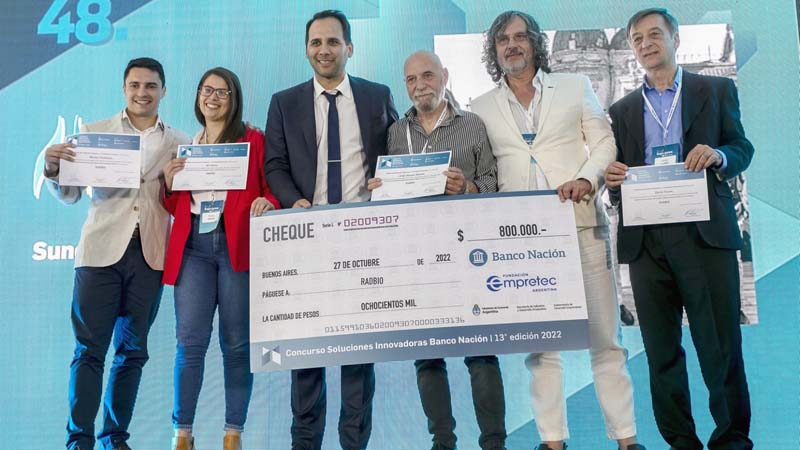
But before embarking on this journey, RADBIO has received public and private investments in Uruguay and Argentina, including funding from the National Agency for Research and Innovation (ANII). In December 2021, they won the César Milstein Award, presented in Argentina for biotechnology research with an impact on human health, and in October of this year, they received the Banco Nación Award for Innovative Solutions Focused on People.
Furthermore, the timing couldn’t be better, as the Uruguayan government aims to position the country as a hub not only for technology but also for biotechnology. This was stated by the president at the Test & Invest Uruguay Business Summit in Punta del Este, organized by the Inter-American Development Bank (IDB), and was emphasized by Omar Paganini, Minister of Industry, Energy, and Mining.
During the event, Lacalle Pou noted that progress has already been made on some technology-related issues and that “we now need to move on to the next frontier—those who continue to think outside the box, the Internet of Things, biotechnology, and many other areas of interest to our country.”
Very few drugs are discovered and developed from scratch and go on to dominate the global market; in fact, you can count the number of such projects in Latin America on one hand.
Nicolás.
“I believe that our trip to the United States in search of investment can serve as a bridge for other biotech startups and also help put Uruguay and the region on the global biotech map.”