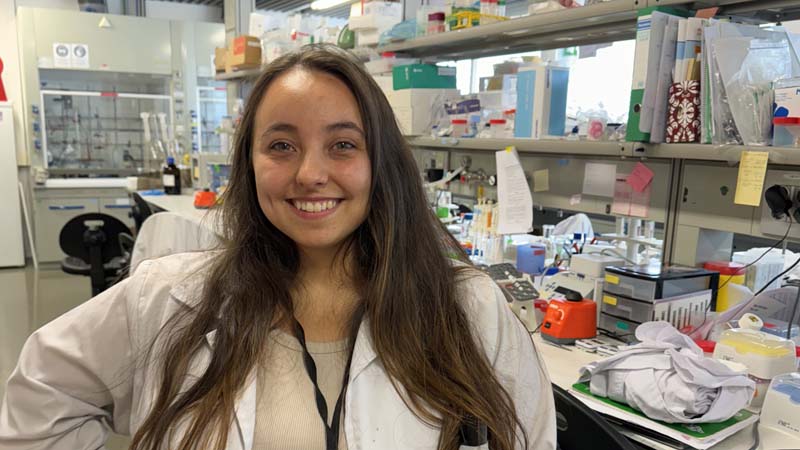
Under the supervision of Dr. Lorena Betancor, professor of Protein Technology at the ORT School of Engineering; Dr. Cecilia Ortiz, associate professor; and Dr. Margot Paulino, from the Bioinformatics Center at the Udelar School of Chemistry, Lucía is pursuing her graduate studies on the integration of cytosine deaminase into hybrid nanomaterials.
The graduate program focuses on the integration of cytosine deaminase into hybrid nanomaterials. Cytosine deaminase is an enzyme capable of converting one molecule into another. In this case, it converts a molecule into 5-fluorouracil, a potent anticancer agent.
“The general idea is to create a nanohybrid by combining the enzyme, magnetic nanoparticles, and a silica coating. When an alternating magnetic field is applied, the magnetic nanoparticles generate heat, which activates the enzyme, causing it to produce the antitumor molecule. We will continue working on developing an antitumor therapy based on this mechanism.”
What made you decide to major in biotechnology?
I’ve always been drawn to science, and the biotechnology engineering program combined all the subjects I was passionate about, from math and physics to chemistry and biology. The opportunity to combine different fundamental sciences to develop technological solutions was simply what led me to choose this as my major.
What was your experience studying biotechnology like?
The program helped me develop my skills as a researcher and scientist. In addition to the theoretical courses, each semester includes a different hands-on lab, where students acquire all the skills needed to become professionals.
In addition to this, my degree in Biotechnology Engineering allowed me to develop another area that has always been a passion of mine for as long as I can remember: teaching. Being able to convey complex knowledge in a more accessible way—and doing so as a qualified professional—is very rewarding.
Currently, in addition to pursuing a graduate degree, I am a member of the Biotechnology faculty, where I teach both theoretical and practical courses, such as Biochemistry and Enzymology.
What motivated you to pursue a graduate degree?
After earning my degree in Biotechnology, I didn’t want to stop studying, learning, and developing my skills as a scientist. I needed to earn my Ph.D. So I decided to pursue a graduate program in Uruguay and went to speak with Dr. Lorena Betancor to find a research topic that interested me.
One of the topics that always fascinated me during my undergraduate studies was macromolecules—proteins and enzymes. Lorena told me about the opportunity to work on the “Nanohybrids for Antitumor Therapies” project, which she is part of along with Dr. Valeria Grazú, and I immediately knew what I wanted to research.
What was your experience like doing an internship in Spain? What differences did you notice compared to Uruguay?
During June and July, I am completing an internship at the Institute of Nanoscience and Materials of Aragon in Zaragoza, Spain, under the supervision of Dr. Valeria Grazú. It has been a very valuable experience, where one not only learns new techniques, new procedures, and how to work with different equipment, but also learns to collaborate with new researchers from diverse academic backgrounds.
The main difference, I believe, was the scale of the operation, since I went to work at a very large institute where there are different departments working in various fields of science. All the departments engage in both practical collaborations and collaborations on the publication of scientific articles.
On the other hand, this internship allowed me to gain a better perspective on the Biotechnology Laboratory at Universidad ORT Uruguay realize just how well-equipped it is. Specialized areas such as the Cell Biology lab and the Proteins section, the various modern pieces of equipment we have, the stock of reagents, etc. This internship made me realize how fortunate I am to be able to work and teach in the Biotechnology Laboratory.
What skills and knowledge have you gained during this internship that you consider valuable for your future career?
Learning to navigate a new laboratory always provides us with new tools. I was able to work closely with top-level researchers who taught me various techniques for synthesizing the nanohybrids I needed for my graduate studies. I also really enjoyed working alongside researchers from different fields—such as chemists, biotechnologists, biologists, physicists, and others—who collaborate with one another. Learning to propose new ideas, listen to other scientists, and put everything into practice has been, I believe, a very enriching experience.
You won the award for best presentation at the conference in Belgium. Can you tell us more about your presentation and what you think made it stand out?
I had the opportunity to travel with Dr. Margot Paulino to the city of Namur in Belgium to attend the QUITEL/CHITEL 2024 conference (International Conference of Latin American Theoretical Chemists). I presented a poster on a structural bioinformatics study of cytosine deaminase, presenting hypotheses regarding its quaternary structure and results from a coarse-grain molecular simulation.
I think what set it apart from other presentations was that, when I presented my work, I didn’t just talk about the in silico study I had conducted, but I also drew comparisons with my in vitro results—that is, the experiments I perform in the lab in Uruguay. This allowed me to present a more comprehensive picture of my work to the conference evaluators.
Learn more about Biotechnology Engineering