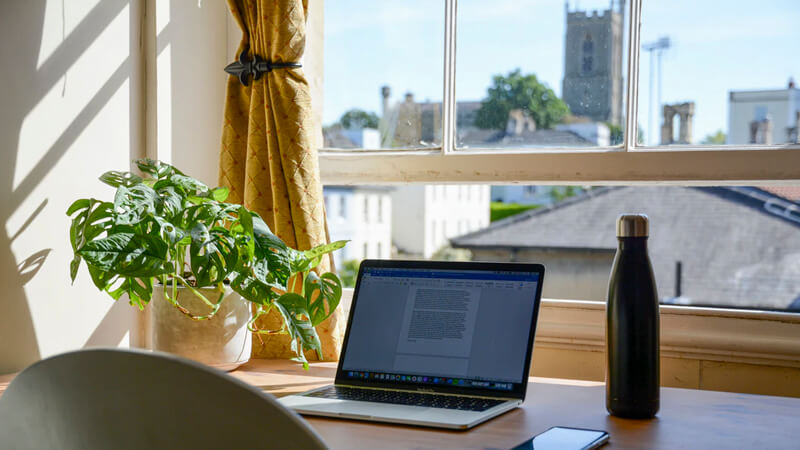
Remote work, as a way of working within organizations, has taken on an unprecedented prominence in our country (and around the world) as a result of the health crisis. Although it initially seemed like a temporary measure, more and more companies are committed to maintaining these work arrangements once the pandemic is over, or are opting for hybrid models (a mix of remote and in-person work).
These changes, which are taking hold in many organizations, are having an impact on people’s daily lives and, of course, on the real estate market as well. To understand how the sector is being affected, the professor of the Specialization Diploma in Real Estate Business at Universidad ORT Uruguay, offers her analysis in this article.
A first jolt
 “The acceleration of the Teleworking began to have an impact on real estate demand“...but it will likely end up affecting the entire real estate sector,” Fleitas begins by explaining how the impacts are becoming apparent amid a process marked by change.
In this regard, the professor explains that the increase in the supply of office space was the first clear sign. She notes that many businesses realized they no longer needed large office spaces, since certain tasks can be performed remotely.
However, most organizations believe it is important to have a physical space, even if it serves a new purpose. On this point, the ORT professor believes that working in person in the same building creates a unique synergy among teams and fosters a sense of cooperation and camaraderie among individuals who share workspaces.
The option of shared spaces
Coworking spaces—places that facilitate shared work in open-plan offices—have been gaining ground in recent years as a low-cost alternative with great potential to boost team synergy and foster collaboration. However, the onset of the pandemic temporarily halted this trend. But what does the future hold?
According to Fleitas, from a building design perspective, coworking spaces are an efficient use of floor space, and this advantage will remain relevant even after the pandemic ends. In this regard, the instructor for ORT’s Specialization Diploma in Real Estate Business notes that small startups and smaller companies—which are able to perform some of their work remotely—may be the primary groups interested in this alternative.
In addition, Fleitas points out that the option to rent coworking spaces on a short-term basis is another key factor: “Many small businesses can do without physical offices and, when needed, choose coworking spaces that meet their needs and can be rented for short periods of time.”
"Key indicators show that the number of lease agreements and sales of commercial spaces or offices has declined," says Fleitas.
New needs in households
 For over a year now, families have been navigating a new reality in their daily lives. Now, many people spend most of their time at home and have realized that their homes no longer meet their new needs. “Many people are rethinking their relationship with their current home and are opting for brighter homes with more outdoor spaces—such as patios, terraces, or gardens—and more areas that offer privacy,” says Fleitas.
However, the ORT professor emphasizes the importance of recognizing that these new demands may stem from the pandemic itself or from remote work. Therefore, once the current health crisis has ended, it will be appropriate to assess the market situation. In this vein, Fleitas argues that the increase in demand for green spaces may be a result of the pandemic and that, for example, the rise in demand for homes with recreational space is a consequence of remote work.
The Future of the Real Estate Market in Uruguay
Since March 2020, the real estate market, like other sectors of the national economy, has faced a number of challenges. Fleitas explains that, in his line of work, key indicators show a decline in the number of lease agreements and sales of commercial spaces and offices.
However, the professor believes that opportunities have also arisen in the sector for those who have been able to recognize them. “Although buyers were initially hesitant at the start of the pandemic, deals began to materialize again within a few months,” she notes.
As we move toward a new normal, new demands may arise, and consequently, new offerings. The industry is facing complex challenges, but opportunities abound. Creativity, new options, and the ability to adapt appear to be key to the development of the real estate market.