Life is made up of intertwined stories, many of which are only fully understood or resolved much later. When, in the midst of World War II, that little girl arrived in a small French village with a group of Jews fleeing the Nazis, life would bring her into contact with a priest who played a decisive role.
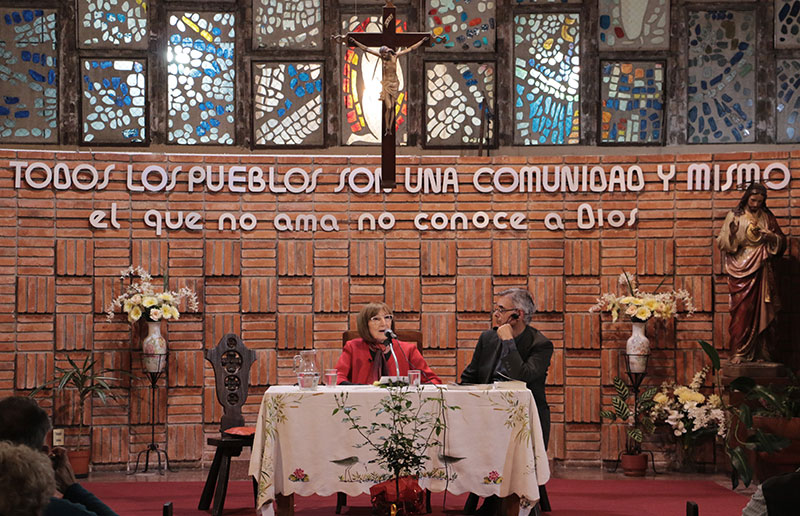
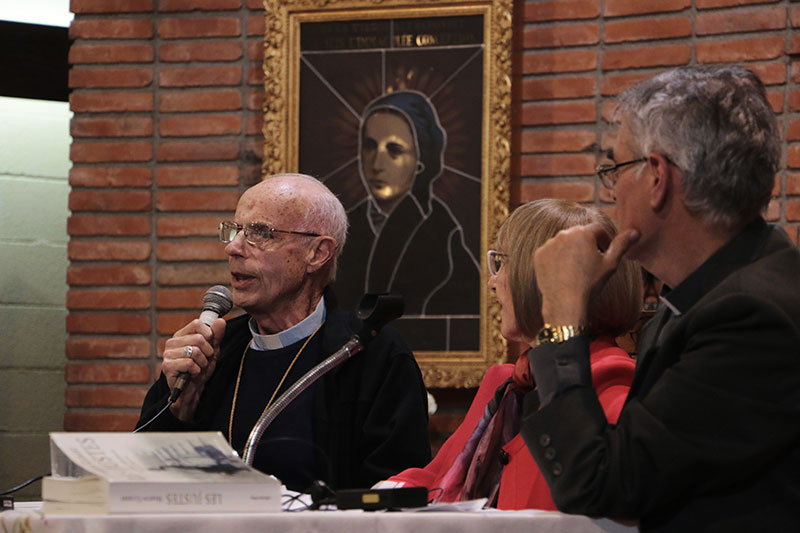
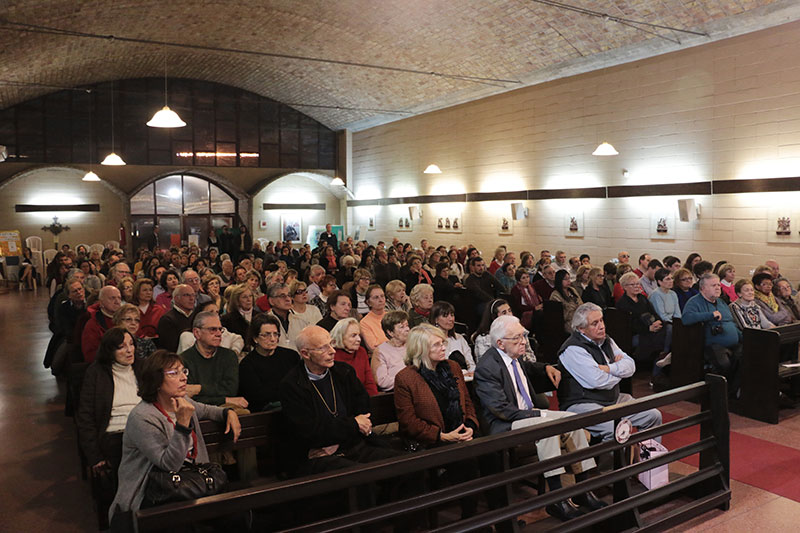
Several decades later, on Saturday, October 6, 2018, it was the memory of that priest that led the girl—now a grandmother with an internationally recognized professional career—to the Santa Bernardita parish, at the corner of Avenida Italia and Caldas, to speak before more than 300 people about that time of uncertainty and disappointment, but also of hope.
The full story is told in *The Girl Who Watched the Trains Leave*, a book by Ruperto Long that recounts the experience of Charlotte de Grünberg, president of Universidad ORT Uruguay, and explains how the French priest’s assistance was crucial.
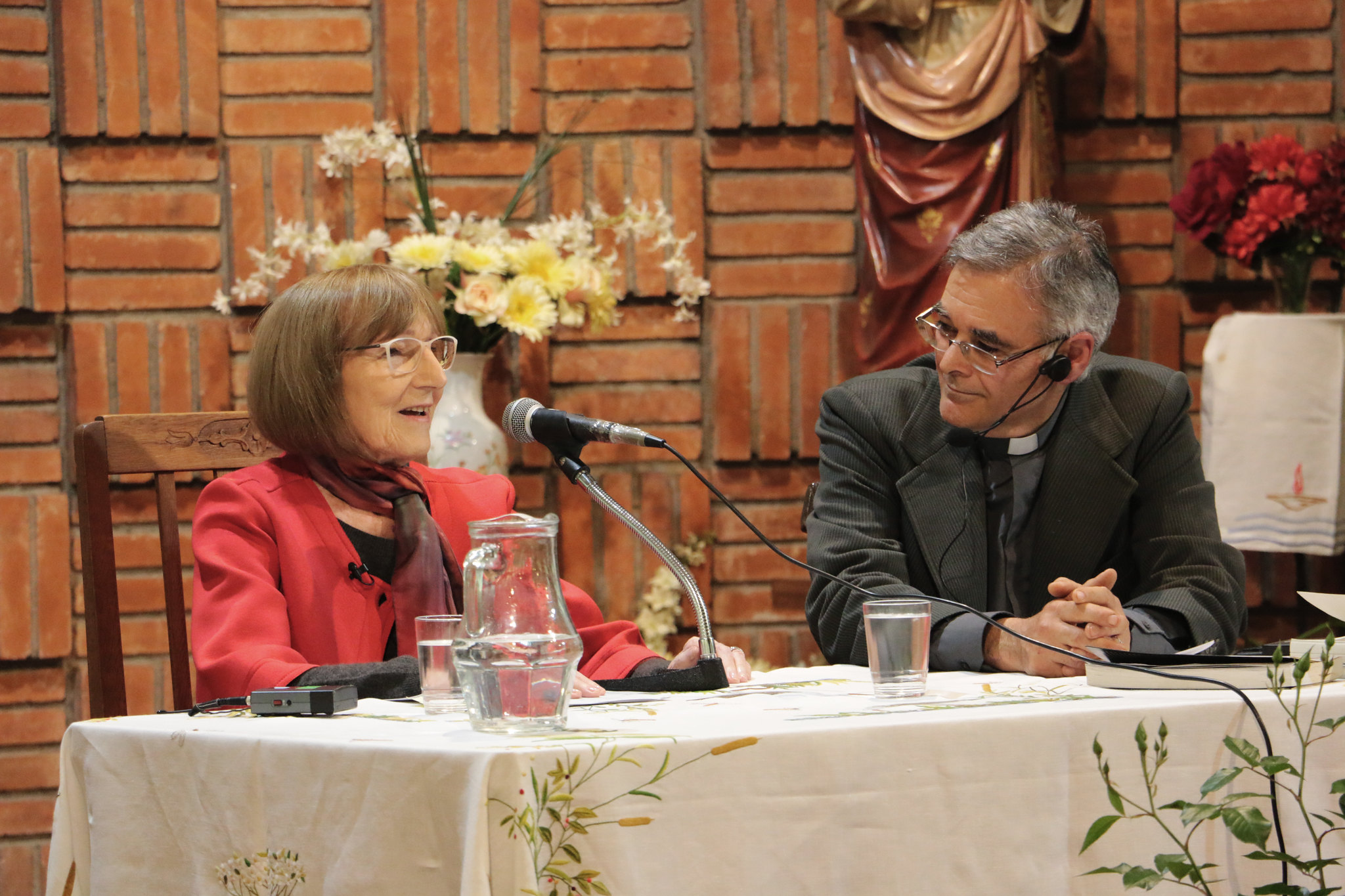
On this occasion, the talk was organized at the initiative of Rev. Dr. Omar França-Tarragó, who invited Charlotte de Grünberg to share her story in her own words. Thus, on Saturday evening, following the parish priest’s introduction, the professor began a narrative that captivated and moved the audience that filled the venue.
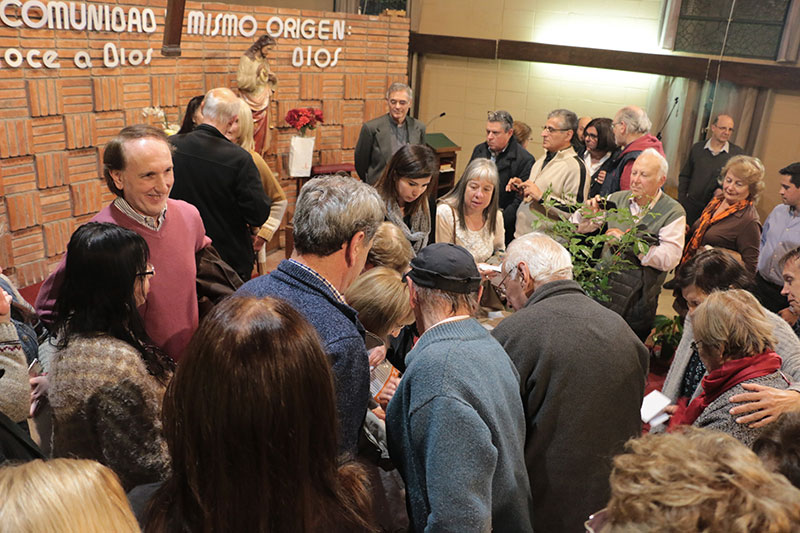
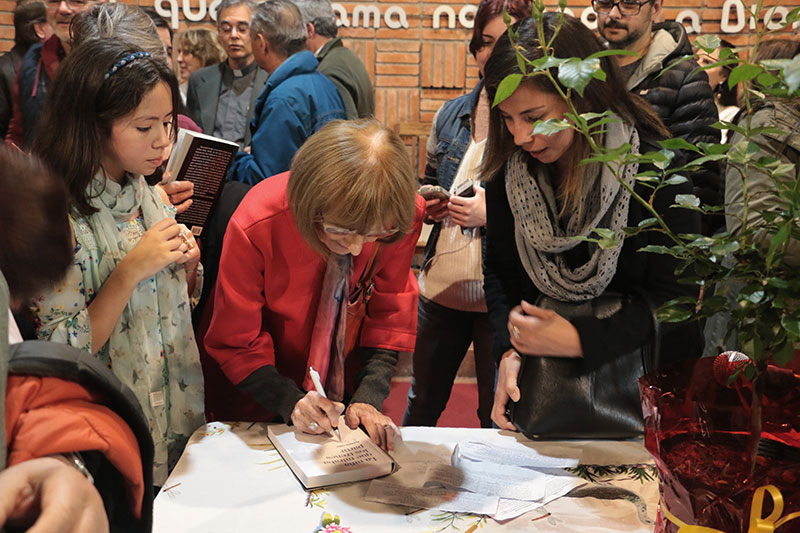
After the presentation, the audience had the opportunity to ask questions and chat with the guest speaker, who also signed books brought by several attendees.
Below, we share the speech by ORT’s Executive Director and a video of the event:
“Kristallnacht, which took place in Nazi Germany and Austria in November 1938 against Jewish citizens with the complicity of the civilian population, served as a kind of warning to them—a sort of canary in a coal mine for neighboring countries as well—despite the Munich Agreement, signed around the same time between England, France, and Germany.”
The event that brings me here before you today took place during World War II.
In today’s globalized world, it can be difficult to imagine situations like those that occurred during that period, since information was not available in real time. For most European Jews, Nazi rule inevitably meant the loss of their homeland and the urgent search for refuge in an attempt to escape the so-called “Final Solution”—that is, their extermination.
I was born and lived in Belgium with my parents and my brother. By the time we left Belgium, the mandatory wearing of a yellow Star of David on clothing had already been enforced. This was followed by humiliations, persecutions, and raids which, with few exceptions, took place amid the indifference of passersby who looked away. There were also heroic acts carried out by people who, defying the authorities of the day, saved human lives—the subject of today’s event.
The enactment of the so-called “Aryanization” laws, along with increasing mistreatment and the violation of even the most basic human rights, would affect every aspect of Jewish life. Jewish children were particularly affected, as they were barred from continuing their education and from using public recreational facilities.
There is an interesting comment by Patrick Modiano, the French writer and Nobel Prize winner, that illustrates the story of Jewish children rounded up by French militias from parks and schools: “Children who were so Parisian that they blended into the facades of buildings and sidewalks, all speaking with a Parisian accent.”
The barbarity of ordinary men (Hannah Arendt) and their “voluntary servitude” led them to commit heinous acts without hesitation, in an escalating spiral of violence that culminated in the construction of extermination camps—the final stage of the Nazi project to wipe out an entire culture.
Jews as a “group” were reduced to mere statistics—broken down by gender and age—in a macabre tally that varied in accuracy from country to country.
Looking for a place
In that dark period of Nazi-occupied France, under the control of the Vichy regime, the persecution of French Jews and European Jews who had taken refuge in France—carried out with the collaboration of local militias and the Gestapo—was relentless.
Fleeing from one place to another was a constant throughout that period, which lasted nearly four years. That is how we crossed much of France, searching for refuge. Our attempt to flee to Switzerland, an unoccupied and neutral country, was one of our most cherished plans. The journey involved crossing the Jura Mountains to reach the Swiss border. A group of 18 people, all on the run, who did not know one another, of different nationalities, ages, and languages, united by the same need to save their lives.
The trip to Switzerland turned out to be a huge scam, ending with the border guards abandoning the entire group in some remote spot in the mountains. It’s impossible to describe in just a few words what those days were like—they were certainly unforgettable.
My brother and I, the only French speakers in the group, began our descent down the mountain, hoping to find a small village where we could figure out exactly where we were. We found a small village and approached a church, where a young priest, dressed in a cassock, greeted us kindly and confirmed that we were not in Switzerland. Despite our fears, we told him about our ordeal and the scam the whole group had fallen victim to.
We were in a “red zone”—a restricted area under strict German control. If we had kept walking, we would have run into soldiers in Nazi uniforms. The priest decided to help us and managed to hide us in a barn near the church, where we stayed for several days, with him providing us with food.
At a time when so many turned their backs on us, someone cared about us. We understood the risks the priest was taking in this situation, because we knew of the Nazis’ brutal reprisals against those who helped Jews. This priest undoubtedly possessed great courage and a strong sense of moral responsibility—a rare quality, especially in such turbulent times.
Throughout my life, I have never stopped thinking about that unexpected act of human solidarity, which, faced with a dilemma, chose to take the risk.
I never found out how many members of our group survived the Holocaust, because after our time in the barn, we all went our separate ways in search of other options. Nor did I ever hear anything more about the priest.
George Bataille, the French writer, said at the end of the war: “Auschwitz is the work and the symbol of man. From now on, the image of man is inseparable from a gas chamber.”
The time has not yet come when, every time I come across words like Heidelberg—a university town, a place of beauty and learning; Vichy, an innocent spa town, the capital of an infamous regime; or other symbols of cruelty—I cannot help but think of Auschwitz. But I also think of that unknown priest from that little French village.
"History is fundamentally a matter of symbols."
Image gallery
https://youtu.be/a9XcIEif4XE?si=9LPI5Jp67R98t-mD