 “Democracy dies in the dark.” This new slogan is one of the many changes that Jeff Bezos, the billionaire owner of Amazon, introduced at The Washington Post after purchasing it for $250 million in late 2013.
Since then, one of the most influential newspapers in the United States has undergone a technological transformation, revamping its website and mobile apps and expanding its engineering team—which, according to Bezos, can compete with any other team in Silicon Valley. At the same time, new editors and reporters were hired, so that today, The Washington Post publishes an average of 1,200 stories per day.
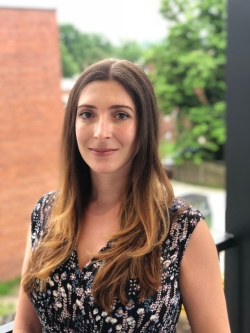
As part of that restructuring, a Uruguayan woman joined the newspaper’s editorial team. Her name is Maite Fernández; she holds a bachelor’s degree in Communication with a concentration in Journalism from Universidad ORT Uruguay, and since May she has been the newspaper’s new managing editor. Here, she explains what the role entails and how this new chapter in her life came about—a chapter that also includes motherhood, since shortly after joining the team she had to take leave for the birth of her first child.
How did you end up at The Washington Post?
After completing my master’s degree in Multimedia Journalism at the University of Maryland (United States), I was hired to work at the International Center for Journalists (ICFJ), an NGO that supports journalists around the world through training courses and fellowships, among other initiatives. I spent five years there in various roles: I started as an editor and community manager for IJNet Spanish, a website that publishes tips, best practices, and training courses for journalists in seven languages; then I became the site’s general editor, and later the director of communications at ICFJ.
After that, I spent a few months working at another NGO, and eventually I was hired by CQ Roll Call, a print newspaper and website that covers the U.S. Congress. There, I worked as an audience editor, managed the outlet’s social media and newsletter strategy, and conducted traffic analysis to grow the outlet’s audience.
I was there for a year until someone from The Washington Post contacted me to say that the position of operations editor was open. I applied, went through a series of interviews, and here I am.
What are your main responsibilities as an operations editor? Are you still able to conduct research and write, or is your role primarily one of editorial coordination?
My role focuses primarily on editorial coordination and digital production. My responsibilities include monitoring traffic for the section, proposing a daily digital strategy, and optimizing our articles to ensure they perform well in search engines and/or on social media. I also conduct traffic analysis to identify trends, suggest multimedia elements for specific articles and features, and assist editors with larger-scale multimedia projects, among other tasks.
Operations editors work in different sections. I work in the International and Homeland Security sections.
Is it common for women to hold these kinds of positions in the mainstream media?
I think so. There are six of us on the operations editorial team, and five of us are women.
It’s quite common for pregnant women to have a hard time finding work, since they’ll be going on maternity leave soon after. That wasn’t the case for you—they hired you even though your due date was just a few months after you started. Why do you think The Washington Post was something of an exception to that “unwritten rule” of the job market?
They hired me when I was six months pregnant, and now Liliana is with me. I think my situation is a bit unique because I wasn’t looking for another job. They had been looking for someone to join the team for a while when they contacted me. It was always clear from the start that I was pregnant, and it was never an issue. In fact, they offered me very generous maternity leave when they hired me, so everything worked out really well for me.
What do you think the future of the media will look like on an international level, given that companies are allocating an increasingly smaller portion of their budgets to media advertising, especially in print media?
There is a clear trend in the media toward diversifying revenue streams, whether through organizing events, implementingpaywalls, or offering subscriptions, among other strategies. With the shift toward online news consumption, it seems clear that digital advertising alone is no longer sufficient to sustain media outlets, as was the case with print media a few years ago. One media outlet in the United States that has been successful in this strategy of diversifying revenue streams is the Texas Tribune, for example. The Washington Post established a paywall a few years ago and has been highly successful in attracting subscribers.
On the other hand, I believe that given the highly politicized climate here and the rise of fake news, while content is abundant because anyone can publish an article online, exclusive, high-quality information—that is balanced and based on verified data—is a scarce commodity, and media outlets that focus on producing this kind of content are seeing a surge in readership.
While in Uruguay, you worked for a time at El Observador. Do you see any differences between Uruguayan journalism and journalism in other parts of the world?
Not really. El Observador, just like ORT, was a great school of journalism. When I was covering local elections, my editors encouraged me to look for unique angles and scoops that no one else had, while also insisting that I be rigorous with my reporting and verify my facts. That has been a valuable lesson that has helped me a great deal throughout my career. I took away a similar lesson from my classes with Leonardo Haberkorn at ORT—a great journalism professor—and from the projects we worked on together.
Journalism has always been considered more of a trade than a profession, especially because journalists didn’t receive formal training at an educational institution, but rather through day-to-day experience. In your case, you chose to pursue an undergraduate degree in journalism at ORT and a master’s degree in the United States. Why do you think it’s important to study journalism at a university?
While journalism is a craft, I believe it is increasingly necessary for journalists to educate themselves—and thoroughly. Not only in the basics of the journalistic trade, but also in general knowledge. A good journalist must know history and politics, must have above-average command of language, and much more. I believe it is more necessary than ever for journalists to know and understand technology. As daily life becomes increasingly dependent on technology—from shopping online to how we listen to music or conduct banking transactions—our work as journalists is shifting more and more in that direction, from the tools we use to produce content to the topics we cover. A journalist who doesn’t understand technology—or, worse yet, shies away from it—is at a clear disadvantage.