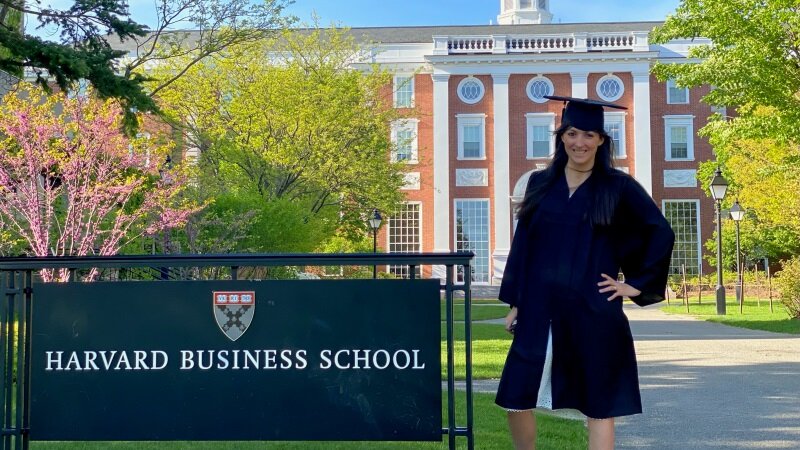
Magdalena Olazabal, who earned her degree in Public Accounting from Universidad ORT Uruguay, completed an MBA at Harvard Business School (HBS), one of the world’s leading business schools. She currently works as an Associate at McKinsey & Company, an international strategic consulting firm that provides services to large corporations, governments, and institutions.
Olazabal spoke about his academic and professional background. He shared his experiences at Harvard, the challenges he faces at McKinsey, and his time as a student at ORT. He discussed his future plans and offered advice to current students.
-You earned your MBA from Harvard Business School, one of the top business schools in the world. What was that experience like?
-The experience was transformative, not only professionally and academically, but also personally.
Most classes are based on the case method. We students prepare a case and discuss it to try to reach a solution, which is not necessarily unique.
Discussing ideas with peers from dozens of countries and professions is incredibly enriching. It broadens your perspective. It forces you to learn how to argue your point quickly and effectively.
Furthermore, discussing cases in which a key figure is facing a decision forces you to put yourself in the shoes of people in very different situations and positions, with limited information. We were often fortunate enough to have that person in the class, who would share their perspective at the end, describe how the case unfolded, and respond to our comments.
Making friends from such diverse backgrounds and all over the world, hearing speakers in person whom I never imagined I’d meet (such as Michael Porter), and participating in activities like chairing the annual Latin American conference made the MBA a truly unique experience.
-What is the most important thing you learned in the MBA program?
-A lot of things. Among them, seeing time and again how collaboration and teamwork lead to the best solutions.
Returning to the case study method, discussions are built on the arguments of other classmates, who come from different educational backgrounds and have varied experiences. And that is exactly what happens in real life; collaboration, teamwork, and diversity lead to progress, innovation, and better results.
-What are your responsibilities at McKinsey?
-I work on strategy and finance projects , primarily in M&A (mergers and acquisitions) and financial services, from the New York office.
In these projects, we help clients solve problems in key areas directly related to the company’s strategy, growth, or profitability, among other factors.
After gathering the relevant information, we analyze, formulate, and test hypotheses, and develop recommendations by working closely with senior clients. This gives us the opportunity to participate in very interesting discussions that will have a significant impact on companies, often in high-profile roles.
-What is it like to work at such a prominent strategy consulting firm?
-McKinsey has offices in dozens of countries. I think it’s a great place to work for three main reasons: its apprenticeship and mentorship model, the opportunity to build a career in the areas that interest you most, and the high impact of its projects.
The apprenticeship and mentorship model requires the company to maintain a constant focus on the training and development of its employees, not only through formal training programs and courses, but also within the teams themselves.
The senior partners and consultants are always coaching the team. At the same time, they’re always encouraging you to speak up, share your perspective, and speak out when you disagree, which makes the discussion sessions very valuable.
It's amazing how much time is dedicated to helping the entire team grow and achieve the best results—not only through these sessions, but also through regular one-on-one meetings to give and receive feedback.
This allows you to constantly improve. It also helps foster positive team dynamics. In addition, each person is assigned a development group leader (DGL), who serves as a partner to guide and advise you throughout your career. The result of this model is that you are always growing, receiving coaching, learning, and ultimately, having mentors who are key to your career development.
In terms of impact, McKinsey is a great place to work. The projects are always highly strategic, with tangible results, and cover a wide range of topics—from helping a financial services firm go digital to advising a government on the fight against COVID-19.
This ties into McKinsey’s third major appeal, which is that it allows everyone to carve out their own path within the firm. It is structured by industry verticals (financial services, consumer goods, etc.) and by function (strategy and finance, marketing, operations, etc.). Therefore, you have the opportunity to build your career within the industry and/or function that interests you most, making it a place where you can be very entrepreneurial when choosing what to work on, with whom, where to specialize, and how to grow.
This was something new to me, as it deviates from the traditional model of professional services where a manager assigns work to employees. At McKinsey, you work with a Professional Development Manager who guides you toward projects, but ultimately, you’re the one who ends up “interviewing” internally to land them. On the one hand, this makes you somewhat responsible for seeking out your own projects, and on the other hand, it allows you to develop expertise in the areas, topics, and clients that interest you most.
-Technological innovations are bringing about a series of changes in the profession, including in consulting services. Given your professional and academic experience, how do you see these changes affecting the role of accountants?
-Understanding that you don’t have to be an expert on every subject, but that you do need to grasp its essence in order to manage and explain it is, in my view, a key aspect of the accountant’s role.
What is happening today with technological innovations is just one aspect of a broader view of the accountant’s role, which is evolving into that of a skilled intermediary between specialists and the rest of the organization or other stakeholders.
I see accountants as professionals who, from the very beginning, learn to understand the fundamentals of how a business operates, and to explain how the decisions made or transactions carried out eventually translate into results that have an immediate and/or long-term impact.
This fundamental understanding, which enables accountants to describe all of a company’s financial transactions, is a key skill that allows them to distill often complex issues so that users of the information can understand them.
I believe that skill is a key differentiator that allows accountants to be flexible and thrive in a wide variety of fields—from traditional accounting and taxation to areas such as finance, business, and applied data analytics. It also equips them with the tools to work in all kinds of companies, from startups to S&P 500 multinationals, across various industries.
A degree in accounting prepares you to have the flexibility to grow and add value in an increasingly dynamic and interconnected world, with new industries and technologies.
-What skills did ORT's Certified Public Accountant program equip you with to tackle these professional and academic challenges?
-One of the reasons I chose ORT to study accounting is that, even back then, it was a pioneer in viewing the profession in a broader context, allowing students to shape their own careers by taking elective courses in fields beyond accounting and taxation, such as finance, economics, or business.
At ORT, I was able to build a comprehensive skill set. I gained a thorough understanding of accounting, which allows me to analyze a company through its financial statements and management information; I also learned the fundamentals of tax systems, which are applicable to other countries around the world, and how to calculate the value of various companies, assets, or services.
I think learning this early on in my career has been one of the most valuable lessons. I came to understand the meaning of risk and the time value of money. Internalizing this from the start has helped me a lot in my career in finance. It’s also been helpful in my personal life, where I apply it even to basic decisions like whether to pay for a purchase in cash or in six installments with no extra charge.
-As a graduate of the program with extensive professional experience, what advice would you give to current students?
-My main piece of advice is something I probably didn't do myself, which is to be more intentional about what you want to do in the future. Think two or three steps ahead and take the steps you need to get there.
For example, to apply for an MBA, you need to meet a number of requirements, such as taking the GMAT, having relevant work experience, or demonstrating personal achievements that set you apart from the thousands of other applicants each year.
In the United States, it is very common to take the GMAT while still pursuing an undergraduate degree, which then allows students to focus on their essays when applying to an MBA program a few years later.
In my case, I decided I wanted to pursue an MBA six years after graduating from ORT. So I had to prepare everything all at once: exams, essays, and interviews.
Thinking early on about what you want to be doing in five or ten years allows you to gain experience and make the right decisions to get where you want to be.
If you later decide to go in a different direction, you'll be able to draw on those experiences in your future projects in one way or another.
-You’ve worked in Uruguay, Argentina, and the United States, earned a Master’s in Finance from Torcuato Di Tela University, and are now pursuing an MBA at Harvard. What are your next projects?
-One of my goals is to encourage other Latin Americans, especially women, to apply to MBA programs and McKinsey.
During my time at HBS, I served as a tutor for the Career and Professional Development office, coaching classmates on how to prepare for interviews when applying for consulting positions. Since graduating, I have remained involved in the MBA admissions process, where I share my experience with candidates whom Harvard believes have a profile similar to mine.
At McKinsey, I’m part of the team that recruits HBS MBA candidates. I help candidates prepare for their interviews. I also enjoy helping people who reach out to me on LinkedIn with their MBA applications—from having conversations where I share my experiences to offering feedback on their essays.
As I said, the experience has been life-changing. My hope is that more Uruguayans and Latin Americans will learn about it, so they can share my perspective on how these processes work.