He also discussed how they are a product of the structures that people have internalized since birth and that have been passed down through generations.
The purpose of the presentation was to analyze how the media covers these issues.
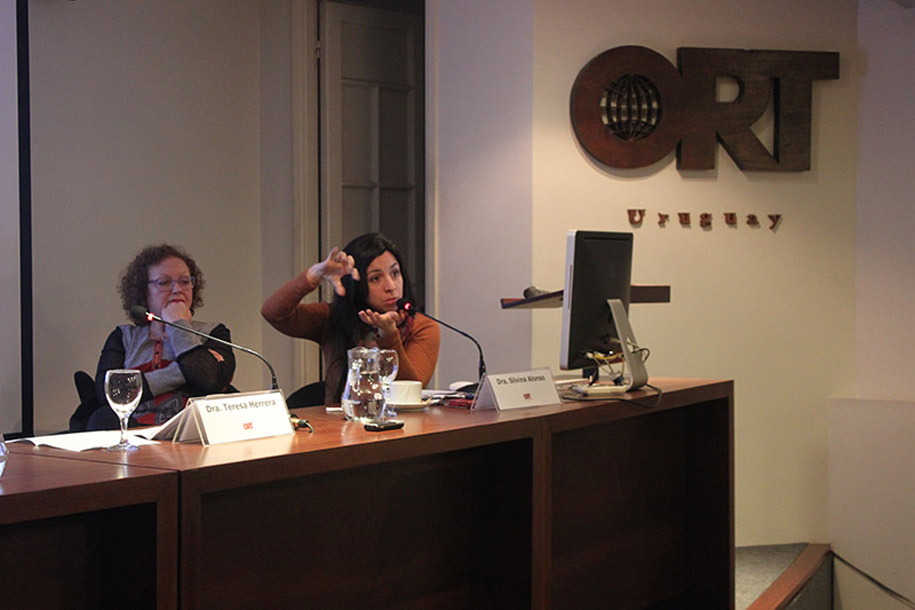
Two Argentine professors from the University of Buenos Aires delivered presentations: Dr. Daniel Obligado—a judge on the Fifth Federal Oral Court of the Federal Capital, Argentina—and Dr. Silvina Alonso—a lawyer, professor, and researcher at the University of Buenos Aires—; as well as Teresa Herrera, Ph.D. in Social Sciences—a researcher at the School of Communication and Design at Universidad ORT Uruguay.
Privacy
“The media are patriarchal because they frame society as a male-dominated sphere. They obscure the construction of patriarchy, normalizing it in various ways,” said Daniel Obligado. As he explained, this stems from a situation that is presented as commonplace, taking equality between men and women for granted.
To illustrate the right to privacy in the media, she cited the example of a photograph that circulated in Argentina showing Congressmen Sergio Massa and Victoria Donda in the halls of Parliament, striking a relaxed pose. As she explained, the image was interpreted through a binary lens: the man was advancing, and the woman was being provocative. “The congresswoman was asked what she intended to achieve with that pose, rather than being asked about the topic they were discussing. Privacy was invaded through a rigid conception of formal roles.”
“Privacy is eroded by a culture of mass consumption that encroaches on human development as individuals; not by intruding on an intimate sphere, but by distorting the evolving role of the sense of self,” Obligado argued. He concluded by explaining that we must change reality, while being respected in that endeavor and also respecting the dignity and privacy of others.
Visibility
Silvina Alonso began by addressing the media’s role as a “fourth estate” in both highlighting and obscuring a problem. “Not everything that is highlighted accurately reflects the reality of a situation. For a long time, violence against women has been denied in society,” she said. “A more conservative media outlet will be more closely aligned with patriarchal structures and will tend to ignore the issue of violence against women in its discourse.”
The lawyer cited numerous examples of these patriarchal structures, including the TV show *ShowMatch*, commercials for cleaning products, and a highly controversial episode that took place on Mirtha Legrand’s show. “During a lunch with Laura Miller, a victim of gender-based violence, Legrand asked, ‘What were you doing to make him hit you?’ She said it innocently, but it represents the collective mindset when addressing issues of domestic violence against women,” she explained. “This patriarchal model that we are trying to subvert can only be achieved through ideological subversion—that is, by challenging this patriarchal paradigm that we have been taking for granted for years.”
He cited more everyday examples, such as toys: girls are supposed to play with dolls or toy kitchens, and boys with superheroes or sports; thus, women are housewives and men are the source of brute strength. “One of the key tools for breaking down this ideology that we have been inheriting for years is education,” Alonso explained.
In any case, she also cited instances where the media played a positive role in addressing gender-based violence, citing the example of Wanda Taddei, the wife of the drummer for the band Callejeros, who was set on fire and killed by him. The press generated massive public attention. “This doesn’t mean that the issue didn’t exist before, but rather that no one knew about it because it wasn’t being brought to light,” she said.
Thanks to the media’s efforts, she said, femicide was also included in the Penal Code. “Still, I don’t think this reduces the death toll. Because if someone is sentenced to life in prison for femicide, it means the woman is already dead—that we’ve arrived too late. We need early and interdisciplinary intervention, which is what is still not happening,” she acknowledged. “The media is also beginning to shed light on this type of cultural and structural violence, which is the breeding ground for other manifestations such as assault or death.”
Alonso cited cases of very young women dying as a result of gender-based violence and how women’s accounts are often dismissed. “There was a case of a girl who was abused by people she knew, and because she had photos of herself in a crop top or shorts on social media, the media used that to claim that she was promiscuous and dressed that way to provoke men. ‘I consent to being beaten and raped by four men while I’m unconscious on the floor’: that’s what they’re saying,” she said.
He concluded his presentation by saying that it is possible to overturn cultural paradigms, and that the media, when used effectively, can help raise awareness. “It shouldn’t be left solely to the justice system; each of us must take up the cause of justice and social equality.”
Naturalization
In her lecture, Teresa Herrera addressed the false notion that the relationship between men and women is natural. “Gender differences were not invented in modern times,” Herrera explained: “The Quran states that men are superior to women; according to St. Paul, women must remain silent in churches; and according to Aristotle, women are inferior men. This patriarchal and ‘male-centered’ world has been around for a long time.”
The Ph.D. in Social Sciences explained that the media reinforces stereotypes and that, while they are beginning to contribute to a paradigm shift, there is still a long way to go.
“I’m going to talk about three stereotypes: first, the ‘mom, dad, and the little ones’ nuclear family. I have some bad news for you: only a quarter of the families in this country are ‘mom, dad, a boy, and a girl’.”
As a second stereotype, she cited equal access to resources and a level playing field. “Women earn 75% of what men earn in the same position. Nor do they have a say in key decisions. We are in the minority in government and in the media,” she explained.
“Third, the male breadwinner and the homemaker: more than 70% of women work outside the home. Even those women who earn more are more likely to experience violence because they challenge this traditional role of the male breadwinner.”
Feminist theory is a theory that seeks gender equality. “Gender equality will make us happier, and many women are being denied the right to happiness,” Herrera concluded. “There must be sisterhood—that bond of solidarity among women—but I like to think that there are also men who want to join in that embrace.”