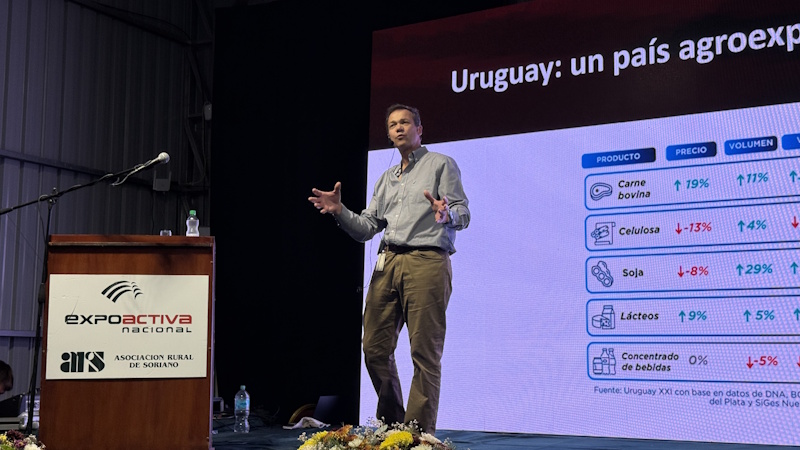
On Wednesday, March 18, in the department of Soriano, Juan Opertti, an engineer, participated in Expoactiva, the country’s largest agribusiness trade show, with a presentation focused on the strategic role of logistics. On that occasion, in addition to Opertti’s lecture, Universidad ORT Uruguay the streaming program La Sede, organized by the Rural Society of Río Negro—the first agricultural streaming program—which launched in 2025 with the support of the School of Communication.
The starting point was clear: the world is facing an increasingly complex landscape. Factors such as adverse weather conditions and geopolitical disruptions create uncertainty and put pressure on production systems. However, they can also become opportunities when managed effectively.
We are living in complex times, and that can be both a threat and an opportunity.
Bottlenecks affecting international trade
Opertti identified some of the key challenges currently shaping global trade and directly affecting agribusiness:
- Panama Canal
- Suez Canal
- Strait of Hormuz
These logistics hubs handle a significant portion of international freight traffic, so any disruption affects the entire supply chain.
From traditional logistics to complex supply chains
One of the key themes of the exhibition was the need to move toward more sophisticated management models.
“Now we have to focus on managing complex agribusiness supply chains,” he said.
This involves not only defining an appropriate logistics model, but also rethinking procurement systems, where the integration of artificial intelligence is already making a significant difference in decision-making.
View this post on Instagram
Technology, traceability, and sustainability
The transformation of the sector is also being driven by the adoption of new technologies. Concepts such as “Meat 4.0” reflect an ecosystem in which digitization, traceability, and automation are becoming increasingly important.
In this context, Opertti emphasized the importance of integrating technologies such as blockchain and strengthening cybersecurity, along with sustainable practices that meet current market demands.
A new competitive approach
The closing remarks highlighted a key point that sums up the paradigm shift:
Competition is no longer between companies, but between supply chains. Competitive advantage is built on end-to-end visibility, coordination, and resilience.
In this context, Opertti also highlighted the growth of logistics training in Uruguay. Universities are seeing a growing demand for these professionals, in line with a mature local industry that faces new challenges: operating in a coordinated manner, forming alliances to access markets, and competing with increasingly efficient supply chains.
In an increasingly demanding global environment, logistics is evolving from an operational support function into a key strategic factor in the development of agribusiness.
https://www.youtube.com/watch?v=svTD6yZ-UYU
In addition to being a professor of Operations and Logistics, Juan Opertti teaches in several programs within the School of Business and Social Sciences, includingthe Logistics and Supply Chain Management Analyst program, the Bachelor’s in International Studies, and the Master of Business Administration (MBA)program at the Business School.