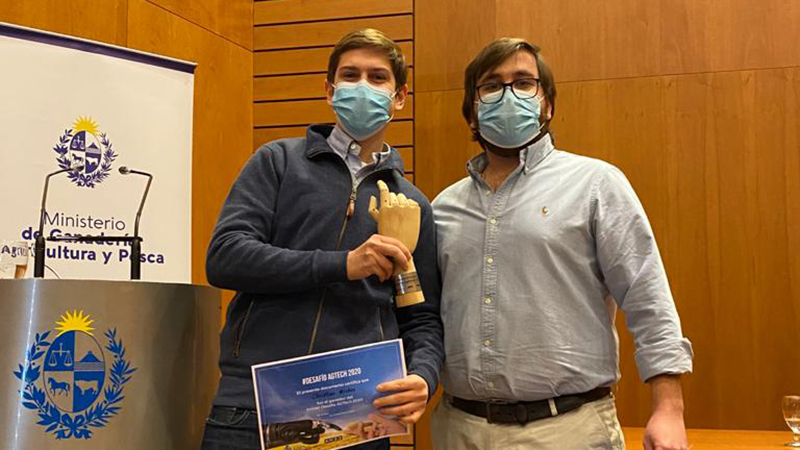
The competition was organized by the Ministry of Livestock, Agriculture, and Fisheries, the National Development Agency (ANDE), and the National Agency for Research and Innovation (ANII), which awarded the winning team a grant of $600,000 (pesos) to launch the project.
In this interview, Lorenzo explains how the idea came about, how it works, and what technologies they used to develop Firedet.
How did the Firedet project come about?
We’ve wanted to participate in some of the hackathons organized by the Ministry of Livestock, Agriculture, and Fisheries for a while now, since we’re both connected to the agricultural sector and we love technology. In addition, we’re already working on other agriculture-related ventures, such as AereoUY, which aims to increase crop yields by leveraging precision agriculture and using drones to map crop health, and Pluvi, a low-cost, autonomous, smart rain gauge based on the Internet of Things that allows users to track rainfall and receive near-real-time notifications when it starts to rain via an app. For this occasion, we wanted to try something different, which ultimately turned out to be Firedet.
What is the goal?
Firedet is a startup developing an early-warning system for detecting forest fires using cameras and artificial intelligence. The goal is to provide faster, automated, and more cost-effective detection than current methods.
" Universidad ORT Uruguay provided Universidad ORT Uruguay with the tools we need to become better entrepreneurs."
How does it work?
Basically, cameras are installed on towers that constantly take photos of the forest horizon. These images are sent to our servers and analyzed by artificial intelligence to detect smoke plumes. If a suspicious hotspot is detected, an alert is immediately triggered to facilitate its inspection, triangulation, and monitoring.
What’s next for the project after winning the award?
Over the past few months, we have successfully developed a working prototype of the solution, which we installed on actual observation towers in Tacuarembó, but there is still much work to be done. Thanks to the support of MGAP, ANII, ANDE, Ingenio, and the Ricaldoni Foundation, we have the resources and backing to move forward. As our next steps, we will focus on refining our product and turning this project into a company that adds value to the region’s forestry sector.
You've always had an entrepreneurial spirit. To what extent did college help you develop that mindset?
We’ve always enjoyed taking on projects, but Universidad ORT Uruguay has provided Universidad ORT Uruguay with the tools to become better entrepreneurs and further develop that skill set. From entrepreneurship classes and workshops to the Center for Innovation and Entrepreneurship and the networks we build within the university, these are some of the resources we value and strive to make the most of—and we encourage current and former students to do the same.