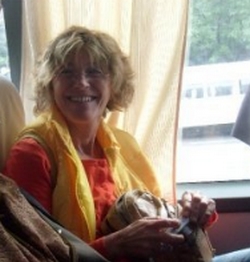
 A bureaucrat, mediocre, useless, indecisive, and dominated. These are just some of the characteristics of Mr. Fischer, a German man in his seventies who must face old age and widowhood, since his wife, Lola, passed away almost a year ago. "El señor Fischer," published in 2011 by Alfaguara, is about the life of a seemingly ordinary man who is, however, burdened with secrets, silences, lies, loves, and hates. The author of the novel is Ana Solari, a professor in the School of Communication and Design who has been teaching workshops on written expression since 1995. Below, she explains the meaning behind her latest novel:
What is the historical setting of the novel?
The novel is set in the present day—let’s say the late 20th century—but it travels back in time to the 1970s and places some of its key dramatic moments during World War II, under the Nazi regime. Both the World War II era and the 1970s are significant to me.
Why did you set the story in Germany?
Germany is my second "home," a place where I feel at ease and fully understand (and almost entirely share) the existential norms, a way of being, a way of life.
Who is Mr. Fischer?
Mr. Fischer is an ordinary, unremarkable man with an ordinary, unremarkable life; a man who acts without asking himself why—in truth, a man who doesn’t want to know. Seen from the outside, one might say he is an irreproachable citizen, a good family man, a good husband. But on the inside, he is not quite so. I suppose Mr. Fischer represents a huge number of citizens from all over the world, those who prefer not to know why things happen, a bit like “the ostrich.”
Why did you decide to publish the novel this year?
It wasn't my decision, but rather the result of the editorial process itself. I had already been working on the novel for about three years.
How do you write a novel that’s over 500 pages long and keep the reader engaged?
I have no idea; it wasn't intentional. I wrote it as if I were telling the story to myself, and Mr. Fischer's travels really piqued my curiosity. In fact, it was written in a "serialized" format—a bit each day that continued the next, like an oral narrative.
Why do people read less these days?
I’m not so sure if people are reading less; perhaps they’re reading differently, or perhaps there’s a greater literary offering—one more closely tied to the publishing industry and less to literature as we know it. In Uruguay, it seems that young people are the ones who read the least, because they receive an education—both formally and within the family—in which reading is neither encouraged nor fostered, nor valued; yet reading exercises the imagination, the capacity for abstraction, and vocabulary acquisition, and stimulates cognitive processes, among other things. Children and young people are more inclined (it’s not good to generalize, but I’ll do it anyway) to seek out other forms of entertainment rather than reading.
What can be done to encourage people to read more books?
Children mimic the behaviors they see. Children raised by parents who read benefit greatly; elementary and secondary schools should address this issue, but it is much more complex because it is linked to the characteristics of contemporary society.
What courses do you teach in the Bachelor's Degree in Communication?
Subjects directly related to written expression: Oral and Written Expression; Expressive Writing; Creative Writing; and those related to Corporate Communication: Writing for the Media, Institutional Writing Formats, and Institutional Publishing.
What do you enjoy most about teaching?
Beyond the fact that I am "literally" passionate about every single subject I teach, one of the most rewarding aspects is participating in and witnessing my students’ progress—it is a privilege for me to see how knowledge and understanding take root in them as they advance in the discipline. Sharing knowledge with them and learning from the insights they bring is immensely rewarding, as well as a challenge and a constant opportunity for self-reflection.
What does a Bachelor's degree in Communication offer a student who wants to pursue a career in writing? And what about other fields within communication?
That’s a complex question. It provides you with practical tools and may even challenge your own assumptions and expertise. Beyond that, anyone who wants to pursue a career in writing must do two things: read a lot and never stop writing. For the various fields of communication, the degree program not only equips you with the necessary knowledge but also fosters critical thinking and changes the way you view and analyze reality.
Who is the Bachelor's Degree in Communication for?
For all those who feel drawn to any of the different ways of communicating reality (and imagination as well—I’m referring specifically to those who, for example, want to tell stories in an audiovisual format). Communication makes us human, and it is the “space” in which we exist. I believe that students who enter the Communication program, consciously or unconsciously, are seeking the human element in its various expressions. Since the program includes a wide range of courses, each one contains what I’m talking about. A student who enters the program—this is my experience as a teacher—never graduates the same person.
Students pursuing a bachelor's degree are often associated with people who are more laid-back, unstructured, and easygoing; however, this isn't always the case. What does a bachelor's degree offer those who are laid-back, and what does it offer those who are more traditional?
Since I believe communication is one of the defining characteristics of human beings, everything mentioned in the question is covered by the discipline. Whether one is formal or informal will determine how each person understands and practices it in their own way. Someone working in audiovisual media, for example (the world of film shoots is more “informal,” according to the definition in the question), is very different from someone who is a specialist in organizational communication, a public relations professional, or a journalist. And it will also depend on the field in which they work; the field of communication is very broad.
What is your relationship with the students like?
It's natural and warm. Since I haven't forgotten what it was like to be a student, I always try to put myself in their shoes. I think I have a good relationship with them—one that's respectful and very lively.
What are some of the most enjoyable moments you remember from your classes?
One particular moment was when a group threw me a surprise birthday party. At the time, I had dyed my hair orange, and everyone came wearing something orange, including a talented student, Shay Levert (a graduate of the Bachelor’s program in Audiovisual Communication), who managed to find a “horrible” orange wig. Other memories involve beautiful group productions; discussions on current topics related to writing and, from there, who we are, and how writing and language shape us.
Would you like to add anything else?
Yes, I am grateful to Universidad ORT Uruguay all the support it has always given me, both academically and in my capacity as a writer. It is a university where I feel I am able to develop my teaching career in a well-rounded way. In particular, at the School of Communication, I have always found role models such as the Academic Coordinator of Communication, Virginia Silva, or the Dean of the School of Communication and Design, Eduardo Hipogrosso, who encourage us to continue our education and are open to new ideas. No two days are ever the same!